ISRA FACTSHEETS
ISRA FACTSHEETS
MEDITERRANEAN AND BLACK SEAS REGION
Güllük Bay
Summary
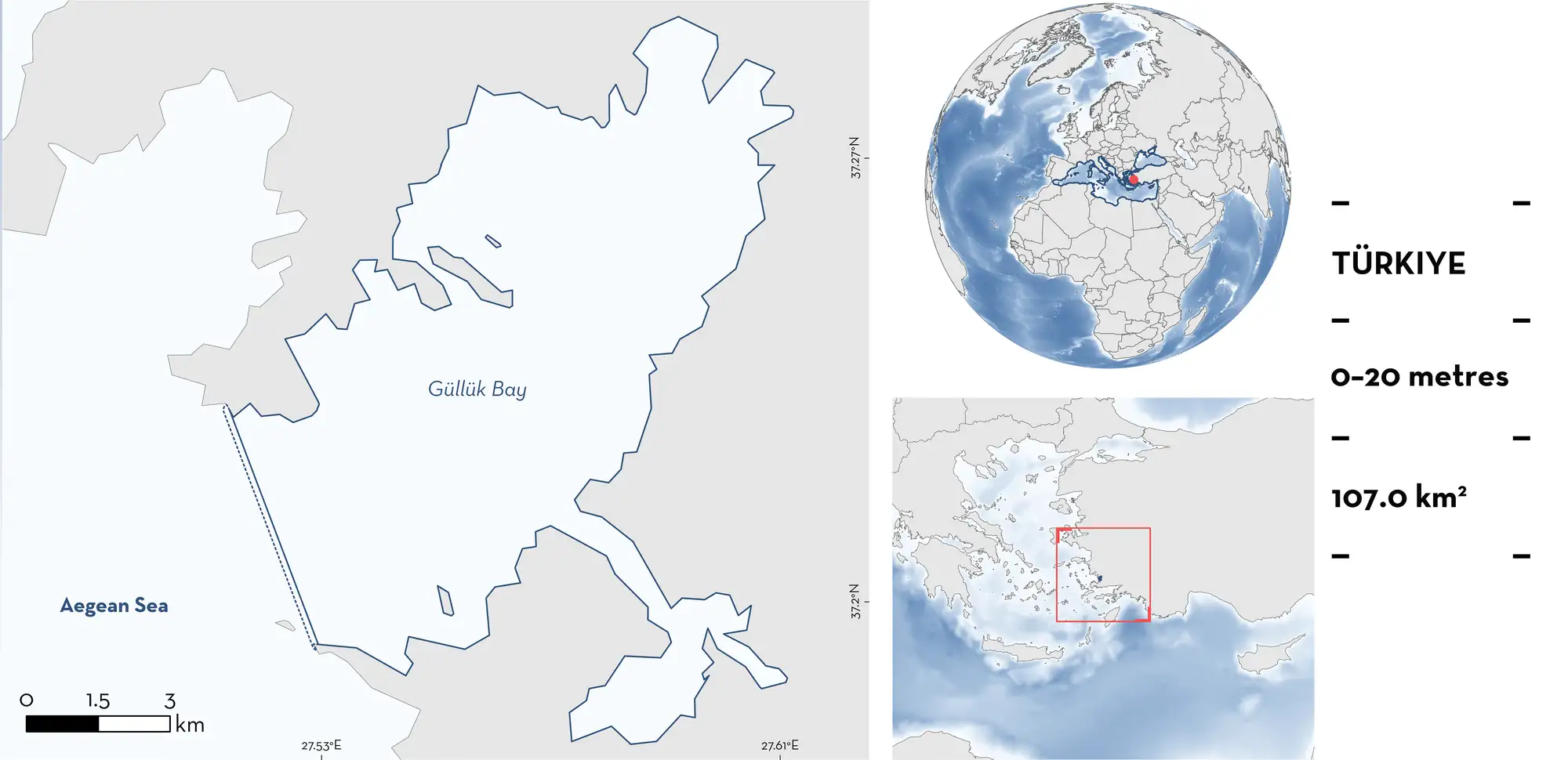
Güllük Bay is located in the southeast Aegean Sea along the coast of Türkiye. This area is characterised by hard substrates covered by algae and sponges with sand flats and seagrass meadows. The area overlaps with the Central Aegean Sea Ecologically or Biologically Significant Marine Area and two Key Biodiversity Areas. Within the area there are: threatened species (e.g., Spiny Butterfly Ray Gymnura altavela); and undefined aggregations (e.g., Duckbill Eagle Ray Aetomylaeus bovinus).
Download factsheet
Güllük Bay
DESCRIPTION OF HABITAT
Güllük Bay is located in the southeast Aegean Sea along the coast of Türkiye. The area sits in shallow waters on the continental shelf. The habitat is characterised by rocky substrates, with wide sand and muddy flats, and seagrass meadows (Mediterranean Tapeweed Posidonia oceanica) among the stony rocks. Hard ground is mostly covered with sponges (e.g., Yellow Tube Sponge Aplysina aerophoba) and algae (e.g., Peacock’s Tail Padina pavonia) (İlhan et al. 2017).
The area is influenced by the local Meltemi winds. These blow from the northwest during the late boreal spring to early autumn. During late autumn to early spring, winds are characterised by either strong northeasterlies (during cold weather) or southwesterlies (during rainy periods). The northeasterlies have a flushing effect on the bay. The adjacent estuary (Güllük Dalyanı) influences the area through freshwater inflow and thus sediment and nutrient transport into the bay.
The area overlaps with the Central Aegean Sea Ecologically or Biologically Significant Marine Area, (EBSA; CBD 2026) and Akbük Coast and Güllük Bay Key Biodiversity Areas (KBA 2026a, 2026b).
This Important Shark and Ray Area is benthic and is delineated from inshore and surface waters (0 m) to 20 m based on the depth range of Qualifying Species in the area.
CRITERION A
VULNERABILITY
Two Qualifying Species considered threatened with extinction according to the IUCN Red List of Threatened Species regularly occur in the area. These are the Critically Endangered Duckbill Eagle Ray (Dulvy et al. 2022) and the Endangered Spiny Butterfly Ray (Jabado et al. 2021).
CRITERION C
SUB-CRITERION C5 – UNDEFINED AGGREGATIONS
Güllük Bay is an important area for undefined aggregations of two ray species.
Between 2014–2022, opportunistic records of rays were collated from 33 dives by a spear fisher free diving in the area (Bilgili & Kabasakal 2023). The spear fisher recorded underwater observations using a video camera mounted to the spear gun. If rays were observed, these were approached and filmed, avoiding double filming any rays (rays were not a target of the spear fishing and were not fished) (A Bilgili unpubl. data 2014–2022). Identifications were then made from reviewing the video footage. Data were collected from dives undertaken in May and July 2014; June and July 2015; May, July, September, and October 2016; July and August 2017; June and July 2018; March, July, and September 2019; June, July, August, September, and October 2020; July 2021; and May and July 2022. Dive times ranged from 33–130 min underwater (average, 67.5 mins; dive time equals time spent underwater only with the diver surfacing for breathes between descents; time was measured by the diver’s video camera and a freediving computer on each dive). Dives focused on swimming a short distance in a single direction or remaining around a specific point searching for fish (A Bilgili unpubl. data 2014–2022). Aggregations were classified as three or more individuals of a species recorded on a single dive. This threshold was considered appropriate since both Qualifying Species are highly threatened and have undergone severe population reductions in the Mediterranean Sea where occurrence is now sparse (Jabado et al. 2021; Dulvy et al. 2022; Gajić & Karalić 2024; Matthews et al. 2025). Further, the benthic area covered on each dive was limited due to the nature of free-diving.
Duckbill Eagle Rays were recorded on 18 dives (54.5% of all dives) with aggregations recorded on four dives (12.1%). Duckbill Eagle Rays were observed from May to September, with a peak in July. Aggregations ranged 3–6 individuals and were recorded in July 2015, July 2017, July 2018, and September 2019, demonstrating repeated occurrence across multiple years. Most of the 31 individuals sighted (across all years) were females (96%). Some were observed to have a distended abdomen suggesting they might be pregnant. Juveniles (estimated ~40–50 cm disc width; DW) were recorded in August and September (Bilgili & Kabasakal 2023).
Spiny Butterfly Rays were recorded on 17 dives (51.5% of all dives) with aggregations recorded on 10 dives (30.3%). Spiny Butterfly Rays were observed from June to September, with a peak in July. Aggregations ranged 3–10 individuals and were recorded in July 2015, July 2017 (n = 2), August 2017, July 2018, July 2019, June 2020 (n = 2), and July 2022 (n = 2), demonstrating repeated occurrence across multiple years. These aggregations were observed in shallow waters, either in locations with sandy substrates or rocky areas, with some of them occurring around areas characterised by seagrass meadows. Most of the 65 individuals sighted (across all years) were females (70%) and some were observed with distended abdomens suggesting they might be pregnant. Juveniles (estimated ~40–50 cm DW) were recorded in August and September (Bilgili & Kabasakal 2023). Additional occurrences of up to 10 Spiny Butterfly Rays together in an area of no greater than 10 x 10 m have been observed on free dives since 2022 (A Bilgili pers. obs. 2023–2026).
Additional information is required to understand the nature and function of these aggregations.
Download factsheet
SUBMIT A REQUEST
ISRA SPATIAL LAYER REQUEST
To make a request to download the ISRA Layer in either a GIS compatible Shapefile (.shp) or Google Earth compatible Keyhole Markup Language Zipped file (.kmz) please complete the following form. We will review your request and send the download details to you. We will endeavor to send you the requested files as soon as we can. However, please note that this is not an automated process, and before requests are responded to, they undergo internal review and authorization. As such, requests normally take 5–10 working days to process.
Should you have questions about the data or process, please do not hesitate to contact us.