
ISRA FACTSHEETS
ISRA FACTSHEETS
NORTH AMERICAN PACIFIC
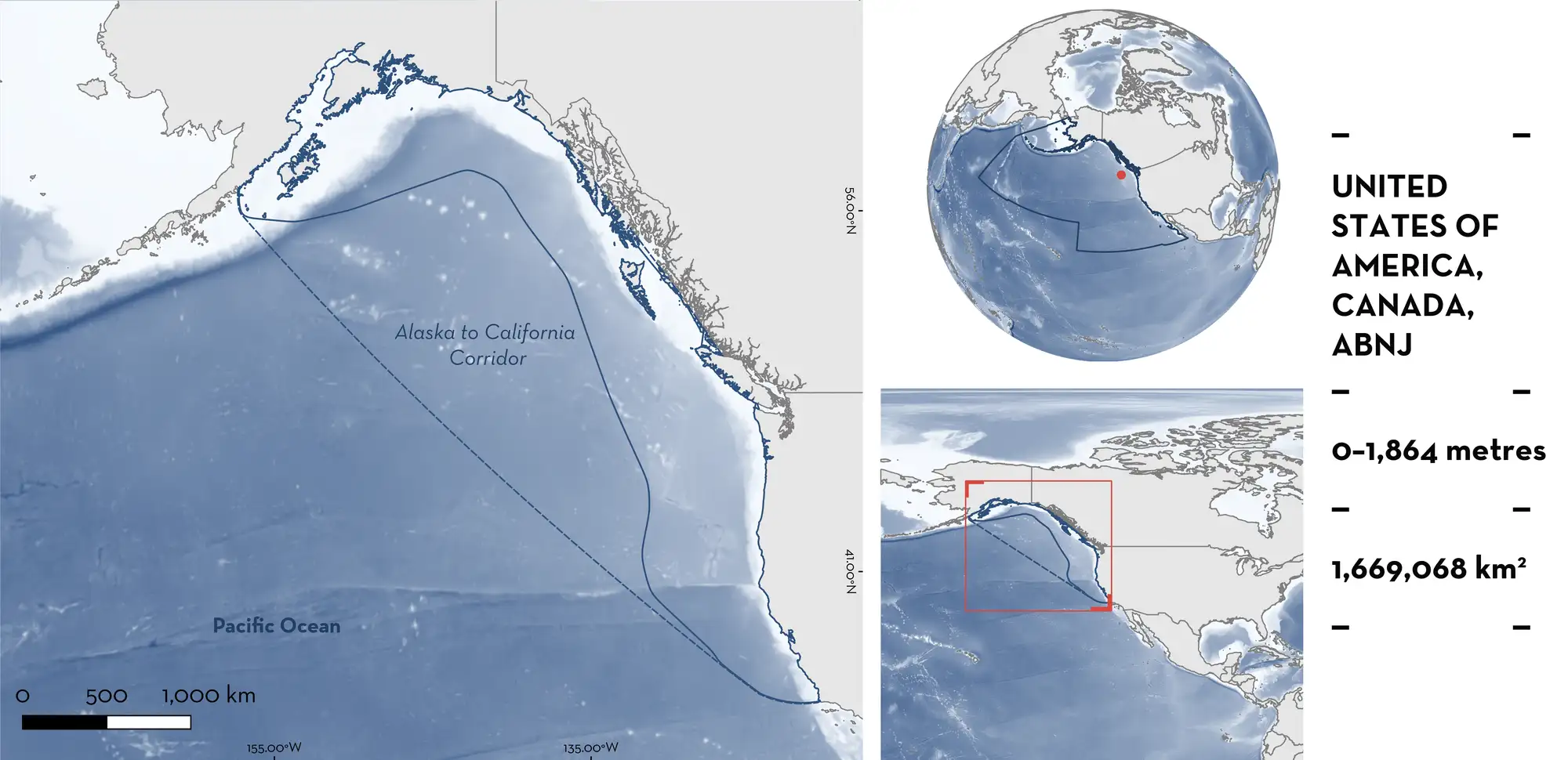
Alaska to California Corridor
Summary
Alaska to California Corridor is located on the west coast of North America encompassing waters of the United States of America, Canada, and areas beyond national jurisdiction (ABNJ). This area stretches from the Gulf of Alaska to southern California, including coastal, continental shelf, slope, and offshore waters. The habitat is characterised by kelp, canyons, seamounts, escarpments, and shelf and pelagic waters. It is mainly influenced by the California Current System in the south and the Alaska Current in the north and has a large temperature gradient from subpolar to subtropical waters. Within this area there are: areas important for movement (Salmon Shark Lamna ditropis).
Download factsheet
Alaska to California Corridor
DESCRIPTION OF HABITAT
Alaska to California Corridor is located in the northeast Pacific Ocean encompassing waters of the United States of America (USA), Canada, and areas beyond national jurisdiction (ABNJ). It stretches from Kodiak Island in the northwest via Prince William Sound in the north to southern California in the south. The area includes the broad continental shelf waters of the Gulf of Alaska and western Canada and the narrow coastal shelf of the western USA, as well as continental slope and offshore waters stretching into ABNJ. The habitat is characterised mainly by pelagic waters as well as by many canyons, seamounts, and escarpments. Coastal portions are characterised by kelp habitat.
This area is influenced by a large temperature gradient ranging from 2°C in the subpolar northern part to 24°C in the subtropical southern part of the area (Weng et al. 2005). The main oceanographic influences include the California Current System in the southern half that has an equatorward surface flow (California Current) and a poleward sub-surface flow along the slope (California Undercurrent), as well as by the poleward Alaska Current in the northern half of the area, and by wind-driven coastal upwelling (Royer 1981; Checkley & Barth 2009).
This Important Shark and Ray Area is pelagic and is delineated from inshore and surface waters (0 m) to 1,864 m based on the global depth range of Qualifying Species.
CRITERION C
SUB-CRITERION C4 – MOVEMENT
Alaska to California Corridor is an important movement area for Salmon Sharks.
Salmon Sharks seasonally migrate through this area, linking distant foraging locations and potentially also connecting northern mating sites with southern pupping grounds (Weng et al. 2005, 2008; Carlisle et al. 2011; Arnoldi et al. 2024). From 2002–2019, 102 adult female Salmon Sharks were tracked with SPOT satellite tags following capture at Prince William Sound, Alaska, as part of the Tagging of Pacific Predators (TOPP) program (Weng et al. 2005, 2008; Carlisle et al. 2011; Arnoldi et al. 2024). All sharks were captured and tagged in July and August in this important aggregation site located at the northern extent of this area. Although tracking locations were dispersed over a large region in the northeast Pacific Ocean, indicating individual variation in movements, the bulk of their seasonal movement was recorded within this area. Kernel density estimates derived from tracking data reveal a movement corridor extending from Kodiak Island and Prince William Sound southward along the coast to the tip of southern California, spanning ~300–500 km offshore across the width of the California Current Large Marine Ecosystem. Each boreal autumn, most of the tracked mature female Salmon Sharks (86%; 88 of 102 individuals) departed their summer foraging grounds in the Gulf of Alaska and undertook southward migrations through this corridor. Remaining individuals either overwintered in Alaskan and Gulf of Alaska waters or moved directly south into offshore waters of the northern Pacific Ocean (Weng et al. 2008). Among sharks that migrated south through this area (n = 88), the timing and duration varied among individuals, but sharks typically began departing Alaskan waters in late summer/early autumn, with northward return migrations initiated in spring (Weng et al. 2008).
Within the corridor, satellite tracking data reveal multi-year site fidelity to discrete, high-productivity features (Arnoldi et al. 2024). Seasonal hotspots, likely associated with foraging, have been identified at prominent bathymetric and oceanographic features including Heceta Bank (Oregon), Cordell Bank (northern California), the waters surrounding Haida Gwaii (British Columbia), and river plume-influenced coastal zones such as the Klamath River outflow, where sharks occur during both upwelling relaxation (August–November) and coastal upwelling periods (Arnoldi et al. 2024). Stable isotope analysis indicates that adult females foraging within this corridor consume a mix of continental shelf prey and deep-water squid, with liver tissue reflecting recent nearshore foraging and muscle tissue indicating longer-term reliance on mesopelagic prey (McInturf et al. 2025). These patterns are consistent with data from pop-up archival satellite tags showing diel vertical migrations to mesopelagic depths throughout the corridor, likely to access vertically migrating prey (Carlisle et al. 2011; Coffey et al. 2017).
Additionally, the southern extent of this corridor is likely important for reproduction. Mating is thought to occur during the autumn southward migration, evidenced by fresh bite marks observed on females departing Alaskan waters (Goldman & Human 2005; Weng et al. 2008). Following an 8–9 month gestation period, parturition is thought to occur in the late spring to early summer at the southern end of the corridor, with southern California and waters off Baja California identified as potential pupping grounds based on observational records of neonates and the occurrence of juvenile Salmon Sharks in the California Current System (Weng et al. 2008; Carlisle et al. 2015). Supporting the importance of the California Current as nursery habitat, juvenile Salmon Sharks strand consistently along the west coast of North America from British Columbia to northern Baja California, with southern California Current strandings occurring year-round and northern strandings concentrated in summer and autumn when sea surface temperatures are warmest (Carlisle et al. 2015). Stable isotope analysis of stranded juveniles indicates they forage on offshore meso- and epipelagic prey along the outer shelf and slope — habitats that fall within this movement corridor (Carlisle et al. 2015). Given the species’ biennial reproductive cycle, in any given year a proportion of mature females within the corridor are likely to be pregnant or recently parturient, further highlighting the reproductive significance of this region.
Collectively, satellite tracking, foraging ecology, and stranding data indicate that the Alaska to California Corridor provides critical, interconnected habitat supporting the foraging and reproductive life history of mature female Salmon Sharks across the breadth of their annual migrations. Stranding also highlight the importance of the southern half of this area for immature size classes of both sexes, with strandings of juveniles occurring from the tip of southern California to Vancouver Island (Carlisle et al. 2015). Strandings of juveniles also display a seasonal pattern, with strandings in northern areas (i.e., from Oregon northwards) occurring in warmer periods (August-October; Carlisle et al. 2015).
Download factsheet
SUBMIT A REQUEST
ISRA SPATIAL LAYER REQUEST
To make a request to download the ISRA Layer in either a GIS compatible Shapefile (.shp) or Google Earth compatible Keyhole Markup Language Zipped file (.kmz) please complete the following form. We will review your request and send the download details to you. We will endeavor to send you the requested files as soon as we can. However, please note that this is not an automated process, and before requests are responded to, they undergo internal review and authorization. As such, requests normally take 5–10 working days to process.
Should you have questions about the data or process, please do not hesitate to contact us.

