ISRA FACTSHEETS
ISRA FACTSHEETS
NORTH AMERICAN PACIFIC
Año Nuevo
Summary
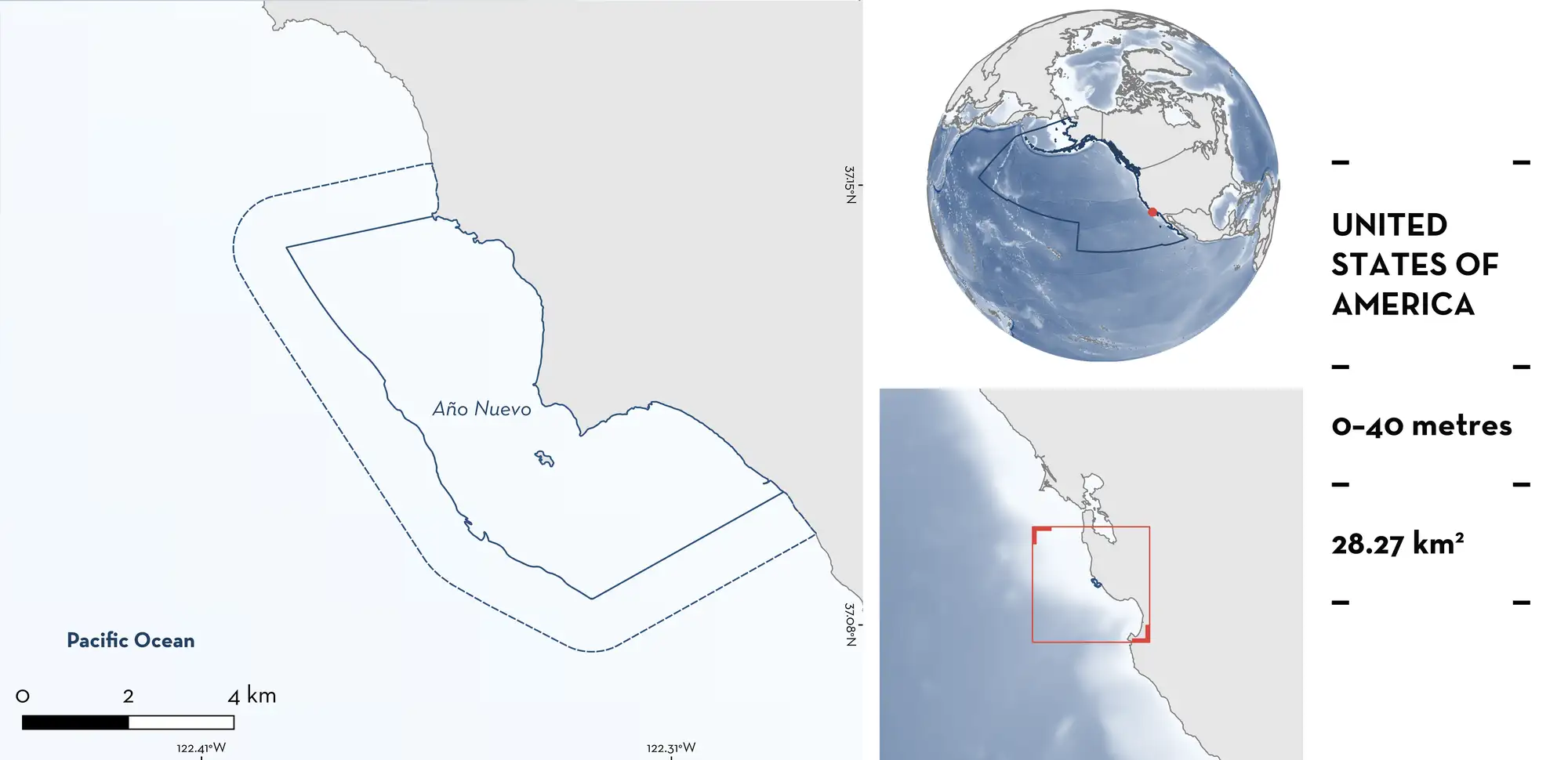
Año Nuevo is located in California, United States of America. It is situated ~30 km northwest of Santa Cruz. The area comprises coastal waters around the Año Nuevo headland and Año Nuevo Island. The habitat is characterised by rocky substrate, reefs, channels, and kelp forests. It is influenced by seasonal upwelling, the Año Nuevo Canyon, and the poleward flowing Davidson Current. It partially overlaps with the Año Nuevo State Marine Reserve. Within this area there are: threatened species and feeding areas (White Shark Carcharodon carcharias).
Download factsheet
Año Nuevo
DESCRIPTION OF HABITAT
Año Nuevo is located in California, United States of America. This area is situated 30 km northwest of Santa Cruz. The coastal side is bordered by shoreline composed of sand dunes and sandstone cliffs, and Año Nuevo Island is located in the centre of the area, ~800 m off the point of Año Nuevo. The marine habitats here are characterised by a rocky seafloor, reefs, and deeper channels, with seasonal kelp forests stretching from the benthos to surface waters (Cochrane et al. 2016).
Point Año Nuevo is a major coastal upwelling centre, characterised by the upwelling of cold, nutrient-rich water during northwesterly winds, particularly from March–August (Ramp et al. 2005; Rosenfeld et al. 1994). Upwelled water originates from depths of 100–200 m and is characterised by cold temperatures (often <11°C) and high salinity (>33.5 psu). This region experiences pronounced seasonal variability: persistent upwelling conditions dominate the boreal spring and summer, while wind relaxation events and the influence of the poleward-flowing Davidson Current are prevalent in autumn and winter. Sea surface temperatures range from ~10–11°C during peak upwelling to >16°C during relaxation events (Ramp et al. 2005). The area is also influenced by the Año Nuevo Canyon starting ~7 km offshore of the area that enhances local productivity through the channelling of nutrient-rich deep water and internal wave-driven mixing (Yoklavich & Greene 2012).
This area partially overlaps with the Año Nuevo State Marine Reserve (California State Parks 2026).
This Important Shark and Ray Area is pelagic and is delineated from inshore and surface waters (0 m) to 40 m based on the bathymetry of the area.
CRITERION A
VULNERABILITY
One Qualifying Species considered threatened with extinction according to the IUCN Red List of Threatened Species regularly occurs in the area. This is the Vulnerable White Shark (Rigby et al. 2022).
CRITERION C
SUB-CRITERION C2 – FEEDING AREAS
Año Nuevo is an important feeding area for one shark species.
Since the early 2000s to 2026, dedicated boat-based surveys have been conducted annually at Año Nuevo from October–February to photo-identify individual White Sharks and deploy acoustic and satellite tags. Surveys are weather-dependent and typically occur at least weekly during this period. At least one acoustic receiver has been consistently deployed throughout the entire effort period in this area, with a maximum of four receivers at any one time. The broader receiver array included many locations from the southern border of California to Washington State (Andrzejaczek et al. 2025). Residency measures were calculated for each year of an individual shark’s tag deployment period, with ‘number of days detected at a site’/365.
Año Nuevo is recognised as a feeding area for sub-adult and adult White Sharks, situated adjacent to important California Sea Lion Zalophus californianus and Northern Elephant Seal Mirounga angustirostris haul-out grounds (McHuron et al. 2018; Chinn et al. 2025; Hale et al. 2026). These prey species are present year-round with counts in the thousands, although life-stage composition varies seasonally by species, and seasonal patterns of moulting, breeding, and offshore feeding influence abundance (Lowry et al. 2017; Condit et al. 2022; Chinn et al. 2025; DP Costa unpubl. data 2026). California Sea Lions typically haul out on Año Nuevo Island, while Northern Elephant Seal colonies are present on the island and along the mainland coast. Predation events on both species are regularly observed by research teams at this site, with an estimated average of 1–2 events seen per month (BA Block et al. unpubl. data 2026), although they are challenging to document on film due to their rapid occurrence and sub-surface nature. Additionally, bite wounds consistent with White Shark predation are routinely recorded on hauled-out California Sea Lions and Northern Elephant Seals by long-term monitoring teams from the University of California Santa Cruz and the NOAA Marine Mammal Laboratory (PWR & DPC unpubl. data 2026).
The importance of Año Nuevo as a feeding area is further supported by mixing models incorporating movement and stable isotope data, which demonstrate high rates of White Sharks feeding on marine mammal prey at this coastal aggregation site, along with two other important sites at Tomales Bay and the Farallon Islands (Carlisle et al. 2012). Additionally, tagged sub-adult and adult White Sharks regularly and predictably use this area more than any other regional receiver site between mid-August to mid-February during their annual migration between the coast and offshore international waters (Jorgensen et al. 2010; Andrzejaczek et al. 2025). From 2006–2022, 355 sub-adult and adult White Sharks were tracked with acoustic tags amounting to over 760,000 detections on an extensive coastal array of receivers stretching from California to Washington (Andrzejaczek et al. 2025). Of these, 55% of detections were at Año Nuevo, with an average annual residency rate of 0.10 ± 0.10 per tagged individual in this area. The high detection rate, observed predation events, stable isotope evidence, and bite wounds on seals and sea lions show that this is a seasonally important feeding area for White Sharks.
Download factsheet
SUBMIT A REQUEST
ISRA SPATIAL LAYER REQUEST
To make a request to download the ISRA Layer in either a GIS compatible Shapefile (.shp) or Google Earth compatible Keyhole Markup Language Zipped file (.kmz) please complete the following form. We will review your request and send the download details to you. We will endeavor to send you the requested files as soon as we can. However, please note that this is not an automated process, and before requests are responded to, they undergo internal review and authorization. As such, requests normally take 5–10 working days to process.
Should you have questions about the data or process, please do not hesitate to contact us.