ISRA FACTSHEETS
ISRA FACTSHEETS
NORTH AMERICAN PACIFIC
Greater Farallones
Summary
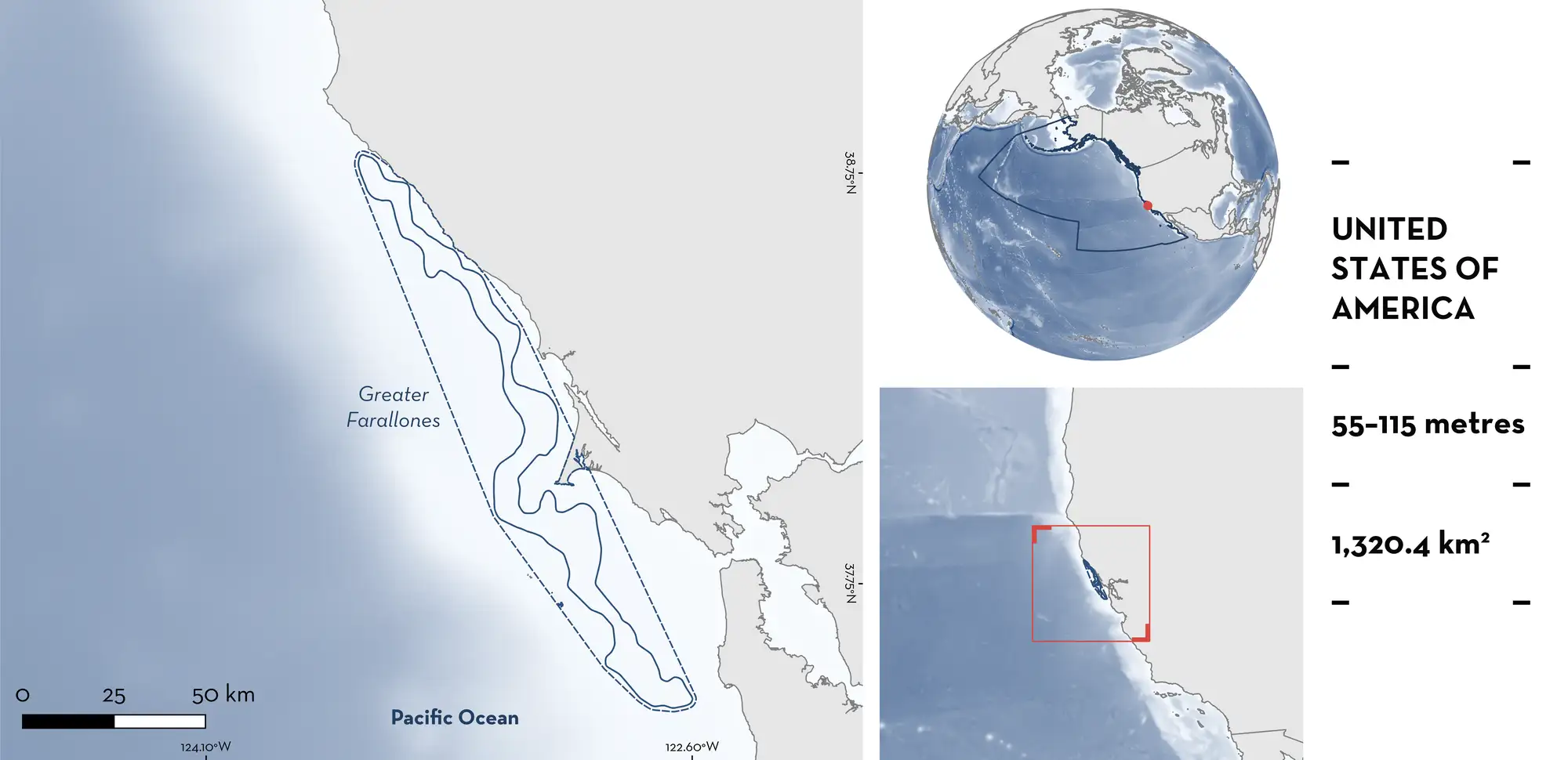
Greater Farallones is located in California, United States of America (USA). It is situated along the widest continental shelf on the west coast of the contiguous USA. The area is characterised by predominantly sandy substrates, with large underwater sand dunes, but also includes rocky and mixed substrates that support deep-sea corals and sponges. It is influenced by the California Current Upwelling System, one of the world’s major coastal upwelling systems. Within this area there are: range-restricted species and undefined aggregations (California Skate Caliraja inornata).
Download factsheet
Greater Farallones
DESCRIPTION OF HABITAT
Greater Farallones is located in California, United States of America (USA). It is situated along the widest continental shelf on the west coast of the contiguous USA. The area is characterised by predominantly sandy substrates, with large underwater sand dunes, but also includes rocky and mixed substrates that support deep-sea corals and sponges (ONMS 2024).
The area is influenced by the California Current Upwelling System, one of the world’s major coastal upwelling systems and exhibits three oceanographic seasons: upwelling (April–June), relaxation (July–September), and storm season (December–February) (García-Reyes & Largier 2012). During upwelling, strong northwest winds drive nutrient-rich deep waters to the surface, enhancing primary productivity and supporting higher trophic levels, despite lower oxygen levels and increased acidity (ONMS 2024). This process underpins the region’s high productivity and attracts migratory species. The area lies within a biogeographic transition zone, creating strong environmental gradients and high species diversity (ONMS 2024).
This Important Shark and Ray Area is benthic and subsurface and is delineated from 55–115 m based on the depth range of Qualifying Species in the area.
CRITERION B
RANGE RESTRICTED
This area holds the regular presence of California Skate as a resident range-restricted species. The West Coast Groundfish Bottom Trawl Survey (WCGBTS) is conducted annually between May–July and August–October along the USA west coast between the USA-Canada border and the USA-Mexico border, at depths ranging from 55 to 1,280 m (Keller et al. 2017). The survey area is subdivided into ~12,000 equal-area grid cells, from which 188 cells are randomly selected each year within depth and latitudinal strata to ensure representative spatial sampling. All sharks and rays captured are sorted to species level (or the lowest possible taxonomic resolution) and weighed, and subsamples of selected species are measured. The trawl net used in the survey has a headrope measuring 25.9 m and a footrope measuring 31.7 m. Trawling is conducted during daylight hours at a target speed of 2.2 ± 0.5 knots, with a standard tow duration of 15 minutes (approximately 0.55 km) (Keller et al. 2017). Between 2011–2025, 8,386 tows were conducted in the entire survey area, of which 166 were within this area (2%) (NOAA NWFSC FRAM 2026).
California Skates were captured in 1,073 tows in the entire survey area (13.1% of total tows) at depths between 54–536 m. Within this area, the species was captured in 159 tows (95.8% of tows in this area) at depths between 56–112 m. The average catch-per-unit-effort (CPUE; number of individuals per square kilometre; ind/km2) for tows with California Skate outside this area was 285.9 ind/km2, while in this area it was 942 ind/km2. The total number of individuals captured in all tows within this area was 2,417 (~14.6 per tow), while outside this area, 4,214 were captured (~0.5 per tow).
California Skates are restricted to the California Current Large Marine Ecosystem (LME) and the Gulf of California LME.
CRITERION C
SUB-CRITERION C5 – UNDEFINED AGGREGATIONS
Greater Farallones is an important area for undefined aggregations of one ray species.
The West Coast Groundfish Bottom Trawl Survey (WCGBTS) is conducted annually between May–July and August–October along the USA west coast between the USA-Canada border and the USA-Mexico border, at depths ranging from 55 to 1,280 m (Keller et al. 2017). The survey area is subdivided into ~12,000 equal-area grid cells, from which 188 cells are randomly selected each year within depth and latitudinal strata to ensure representative spatial sampling. All sharks and rays captured are sorted to species level (or the lowest possible taxonomic resolution) and weighed, and subsamples of selected species are measured. The trawl net used in the survey has a headrope measuring 25.9 m and a footrope measuring 31.7 m. Trawling is conducted during daylight hours at a target speed of 2.2 ± 0.5 knots, with a standard tow duration of 15 minutes (approximately 0.55 km) (Keller et al. 2017). Between 2011–2025, 8,386 tows were conducted in the entire survey area, of which 166 were within this area (2%) (NOAA NWFSC FRAM 2026).
California Skates were captured in 1,073 tows in the entire survey area (13.1% of total tows) at depths between 534–536 m. Within this area, the species was captured in 159 tows (95.8% of tows in this area) at depths between 56–112 m. The average catch-per-unit-effort (CPUE; number of individuals per square kilometre; ind/km2) for tows with California Skate outside this area was 285.9 ind/km2, while in this area it was 942 ind/km2. The average number of individuals in a single tow with California Skate in this area was 15.2 (maximum = 128) and outside this area it was 4.6 (maximum = 50) for the same average area (0.02 km2) (NOAA NWFSC FRAM 2026). The total number of individuals captured in all tows within this area was 2,417 (~14.6 per tow), while outside this area, 4,214 were captured (~0.5 per tow). Skates are often spatially aggregated and may be segregated by size and sex, with their distribution influenced by benthic habitat and depth, and occurring either in association with or independently of other skate species (Swain & Benoît 2006; Frisk 2010; Hoff 2010). They usually aggregate in high density areas where large catch quantities for these species occur (Bizzarro et al. 2014). Further information is required to understand the nature and function of these aggregations.
Download factsheet
SUBMIT A REQUEST
ISRA SPATIAL LAYER REQUEST
To make a request to download the ISRA Layer in either a GIS compatible Shapefile (.shp) or Google Earth compatible Keyhole Markup Language Zipped file (.kmz) please complete the following form. We will review your request and send the download details to you. We will endeavor to send you the requested files as soon as we can. However, please note that this is not an automated process, and before requests are responded to, they undergo internal review and authorization. As such, requests normally take 5–10 working days to process.
Should you have questions about the data or process, please do not hesitate to contact us.