ISRA FACTSHEETS
ISRA FACTSHEETS
NORTH AMERICAN PACIFIC
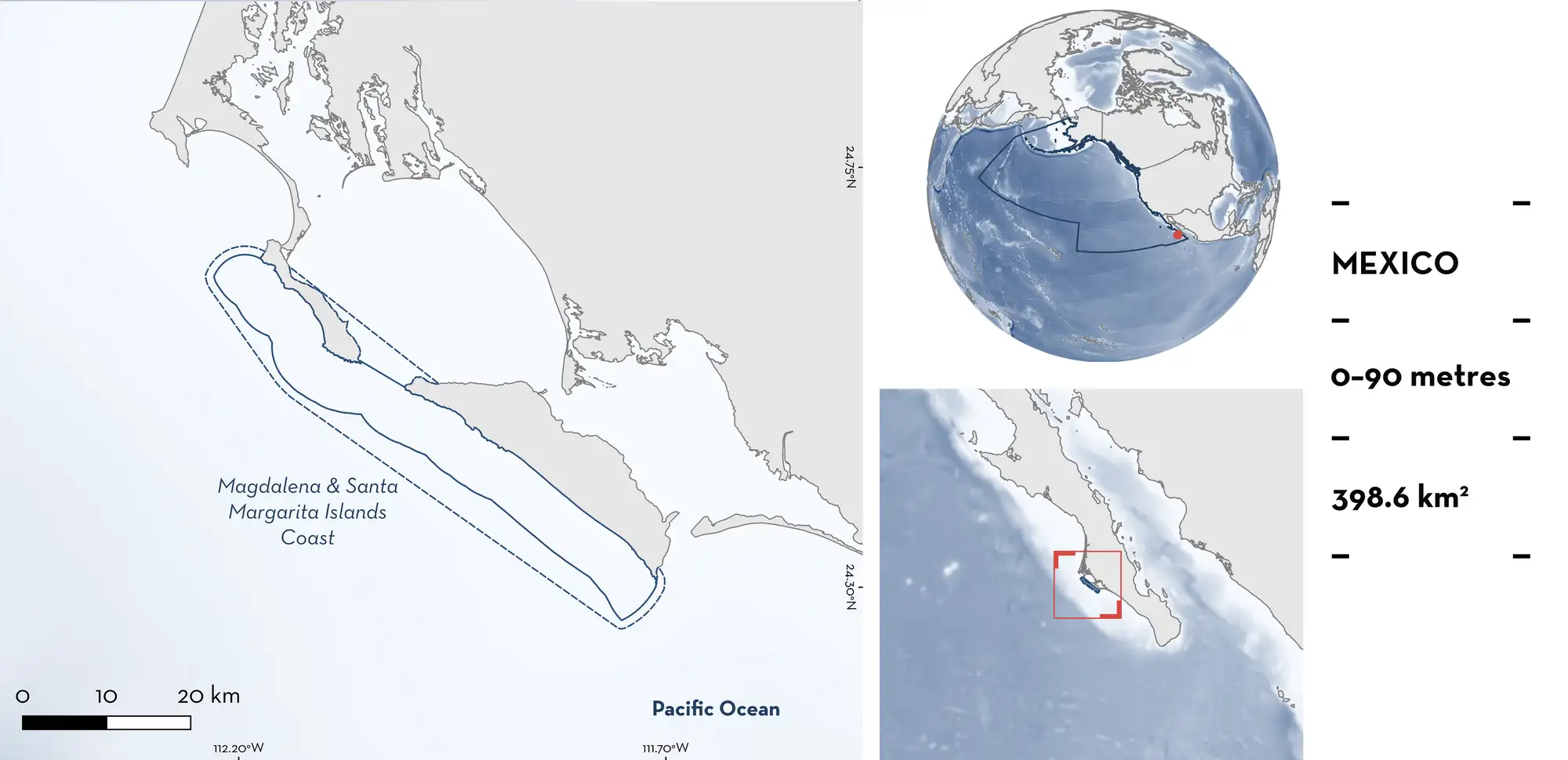
Magdalena & Santa Margarita Islands Coast
Summary
Magdalena & Santa Margarita Islands Coast is located on the Pacific Ocean coast of Baja California Sur, Mexico. The area is bounded by a series of barrier islands and includes the adjacent open coastal zone. It is characterised by a narrow continental shelf and volcanic and rocky substrates. The area is influenced by the California Current and the California Countercurrent, and wind-driven coastal upwelling. Within this area there are: threatened species and undefined aggregations (Munk’s Pygmy Devil Ray Mobula munkiana).
Download factsheet
Magdalena & Santa Margarita Islands Coast
DESCRIPTION OF HABITAT
Magdalena & Santa Margarita Islands Coast is located on the Pacific Ocean coast of Baja California Sur, Mexico. The area is bordered by Isla Magdalena and Isla Santa Margarita to the east and is connected to Magdalena Bay through a central channel, Boca de Entrada (~5.5 km wide), which reaches depths of 38 m. The habitat is characterised by a narrow continental shelf and predominantly volcanic and rocky substrates (Bizarro 2005).
The area is influenced by the California Current and the California Countercurrent, with wind-driven coastal upwelling. The California Current is a surface current (0–300 m deep) transporting cool, low salinity, oxygen-rich water towards the south while the California Countercurrent is a northward flowing nearshore current of warm, high salinity, and low oxygen characteristics. Upwelling systems occur more intensely during the boreal spring and early summer (March–June), although it persists episodically throughout the year (Bakun & Nelson 1977).
This Important Shark and Ray Area is pelagic and is delineated from surface waters (0 m) to 90 m based on the bathymetry of the area.
CRITERION A
VULNERABILITY
One Qualifying Species considered threatened with extinction according to the IUCN Red List of Threatened Species regularly occur in the area. These is the Vulnerable Munk’s Pygmy Devil Ray (Marshall et al. 2022).
CRITERION C
SUB-CRITERION C5 – UNDEFINED AGGREGATIONS
Magdalena & Santa Margarita Islands Coast is an important area for undefined aggregations of one ray species.
Munk’s Pygmy Devil Rays aggregate in groups of several hundred individuals in this area, with multiple recorded events between 2020–2025. Between December 2020–2025, safari tours searching for marine megafauna in the area were conducted on approximately 20 days per month during the months of November–December (F Nieto pers. obs. 2026). The seasonality of these tours reflects traditional ecological knowledge about the presence and movement of marine megafauna species in the area, including Munk’s Pygmy Devil Rays.
Every year, Munk’s Pygmy Devil Rays aggregations ranging between 300–1,000 individuals were observed in the area during November and early December during at least 40% of trips (8 days per month). All aggregations were observed close to the coastline, no further than 6 km away from the coast. Additionally, 108 individuals were tagged in the Gulf of California between 2015–2022 and monitored with a passive acoustic receiver array within the Gulf of California and the Pacific Coast, with just one receiver within this area during 2021–2023. Among the tagged individuals, five (5%) were detected in the area during September and October 2022; however, tourism activities do not occur during these months due to the hurricane season. Munk’s Pygmy Devil Ray presence in the area coincided with their absence in the Gulf of California, and based on seasonality of sightings and acoustic telemetry data, it is likely that these aggregations are linked to the annual migration of Munk’s Pygmy Devil Rays along the Baja Peninsula coast, coinciding with their entry into the Gulf of California in late winter (December–January) and their departure (June–August) (MD Palacios unpubl. data 2026). While Munk’s Pygmy Devil Ray exhibit a schooling behaviour across their life cycle (Palacios et al. 2024), they are normally observed in pulses along the Pacific coast of Baja California Sur, however, in this area the species is present for several months (F Nieto pers. obs. 2026; MD Palacios unpubl. data 2026). The seasonal occurrence of the species in the area may be related to feeding purposes as the productivity in the area is higher compared to the Gulf of California (Lezama-Ochoa et al. 2025).
Further information is needed to understand the nature and function of these aggregations.
Download factsheet
SUBMIT A REQUEST
ISRA SPATIAL LAYER REQUEST
To make a request to download the ISRA Layer in either a GIS compatible Shapefile (.shp) or Google Earth compatible Keyhole Markup Language Zipped file (.kmz) please complete the following form. We will review your request and send the download details to you. We will endeavor to send you the requested files as soon as we can. However, please note that this is not an automated process, and before requests are responded to, they undergo internal review and authorization. As such, requests normally take 5–10 working days to process.
Should you have questions about the data or process, please do not hesitate to contact us.