ISRA FACTSHEETS
ISRA FACTSHEETS
NORTH AMERICAN PACIFIC
Palos Verdes-Redondo Beach
Summary
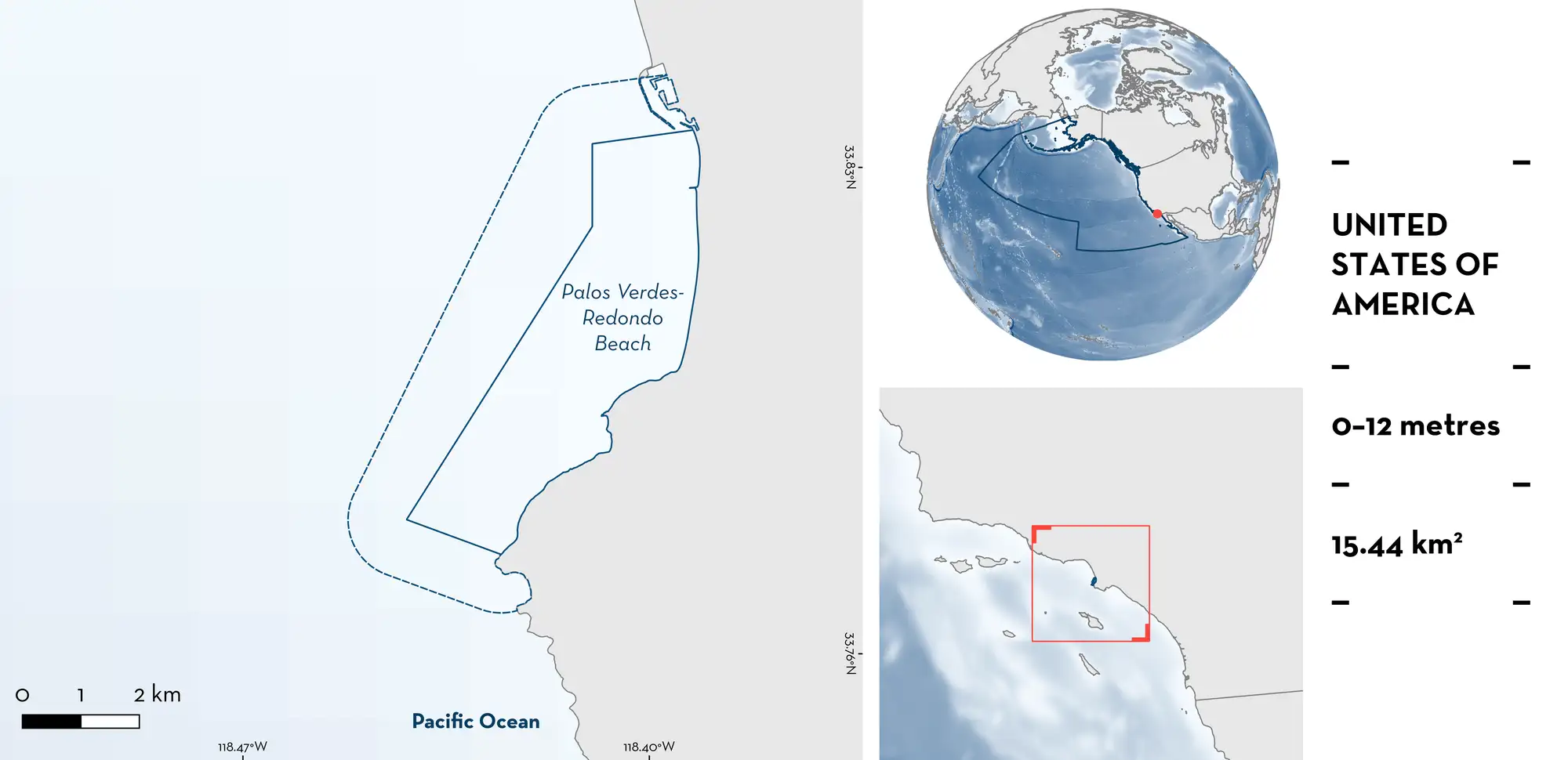
Palos Verdes-Redondo Beach is located in southern California, United States of America. The area is situated within the Southern California Bight and is characterised by rocky reefs, sand and cobble substrates, sandy beaches, breakwaters, and kelp forests. It is influenced by the California Current. Within this area there are: range-restricted species and reproductive areas (Horn Shark Heterodontus francisci).
Download factsheet
Palos Verdes-Redondo Beach
DESCRIPTION OF HABITAT
Palos Verdes-Redondo Beach is located in southern California, United States of America. The area is situated in the Southern California Bight and extends from Palos Verdes Peninsula in the south to Redondo Beach in the north. It is characterised by rocky reefs perpendicular to the coast and extending from the intertidal to sand and cobble substrates (Stephens et al. 1984). The area also includes sandy beaches, breakwaters that serve as artificial reefs, and Giant Kelp Macrocystis pyrifera forests (Stephens et al. 1984; Pondella et al. 2002).
The area is influenced by the California Current, a surface current carrying water equatorward along the Pacific North America coast and is characterised by low temperatures, low salinities, and high dissolved oxygen (Lynn & Simpson 1987). Local surface winds, coastal upwelling during the boreal spring, surface heating, and topography produce high variability in stratification, thermocline depth, and micro-scale cells of water (Di Lorenzo 2003).
This Important Shark and Ray Area is benthic and is delineated from inshore and surface waters (0 m) to 12 m based on the bathymetry of the area.
CRITERION B
RANGE RESTRICTED
This area holds the regular presence of Horn Shark as a resident range-restricted species. This species has been regularly recorded by citizen scientists between 2013–2026 (iNaturalist 2026). During this period, 1,042 observations of Horn Sharks were reported on iNaturalist from Point Conception in the north to the border with Mexico. After La Jolla (n = 363 observations), Palos Verdes-Redondo Beach held the second largest number of observations of Horn Sharks (n = 227). This species occurs in the California Current Large Marine Ecosystem (LME) and the Gulf of California LME.
CRITERION C
SUB-CRITERION C1 – REPRODUCTIVE AREAS
Palos Verdes-Redondo Beach is an important reproductive area for one shark species.
Citizen science reports suggest that this area is the largest hotspot of Horn Shark egg cases recorded in southern California (Alvarez 2025; iNaturalist 2026). Between 2013–2026, 1,042 observations of Horn Sharks were reported on iNaturalist from Point Conception in the north to the border with Mexico. After La Jolla (n = 363 observations), Palos Verdes held the second largest number of observations of Horn Sharks (n = 227). Of these, 180 (79.3%) observations were of egg cases, with 202 egg cases recorded across these observations and identified based on their distinct shape. While the majority (95.5%) of these records were observations from egg cases on the beach, 10 egg cases were also observed in natural habitat inside this area across multiple years, the largest number reported from across southern California (iNaturalist 2026). In addition, between June–July 2021, a citizen science study assessing the potential impact of marine debris on Horn Shark habitats, recorded 21 egg cases stranded on the beach around Palos Verdes (Alvarez 2025). Furthermore, small individuals ~19 cm total length (TL; n = 6) were recorded in the area during 2024 and 2025 (iNaturalist 2026). These are presumably young-of-the-year as their size is close to the reported size-at-birth (15–16 cm TL; Ebert et al. 2021). Rocky reefs and kelp forest in the area provide suitable habitat for egg deposition as this area has one of the largest coverages of kelp in southern California (Kelpwatch 2026). Fecund female Horn Sharks may select shallow habitat for mating and laying egg cases, which are designed to wedge into rocky environmental structures (Meese & Lowe 2020; Alvarez 2025).
Download factsheet
SUBMIT A REQUEST
ISRA SPATIAL LAYER REQUEST
To make a request to download the ISRA Layer in either a GIS compatible Shapefile (.shp) or Google Earth compatible Keyhole Markup Language Zipped file (.kmz) please complete the following form. We will review your request and send the download details to you. We will endeavor to send you the requested files as soon as we can. However, please note that this is not an automated process, and before requests are responded to, they undergo internal review and authorization. As such, requests normally take 5–10 working days to process.
Should you have questions about the data or process, please do not hesitate to contact us.