ISRA FACTSHEETS
ISRA FACTSHEETS
NORTH AMERICAN PACIFIC
Pribilof Canyon
Summary
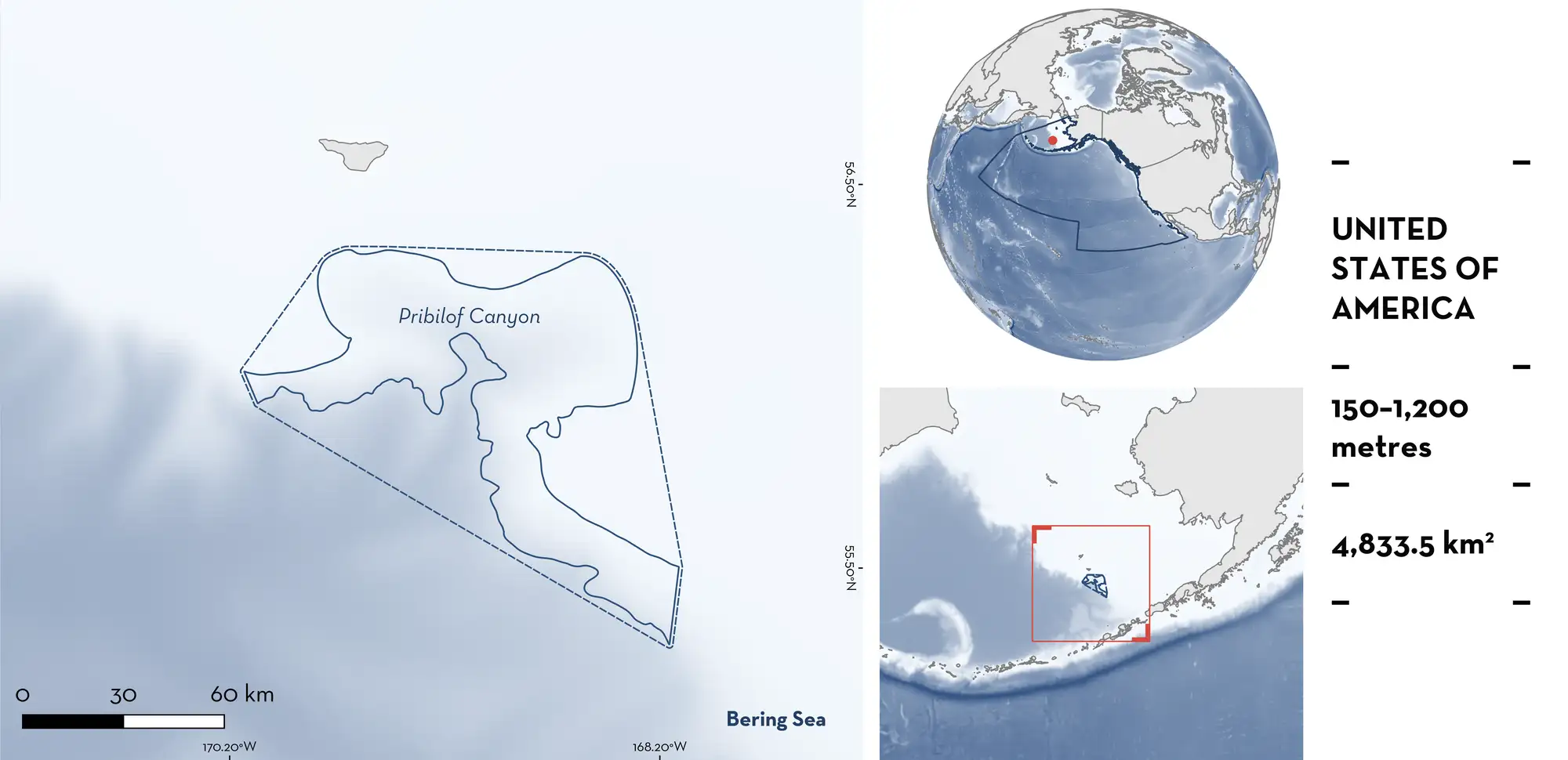
Pribilof Canyon is located in Alaskan waters of the United States of America. It sits on the continental shelf break of the Eastern Bering Sea and is characterised by a steep slope, coral and sponge communities, sandy and rock substrates, and strong eddy activity that enhances productivity. Within this area there are: reproductive areas (e.g., Alaska Skate Bathyraja parmifera); and undefined aggregations (e.g., Whitebrow Skate Bathyraja minispinosa).
Download factsheet
Pribilof Canyon
DESCRIPTION OF HABITAT
Pribilof Canyon is located in Alaskan waters of the United States of America. It sits on the continental shelf break of the Eastern Bering Sea between a wide shelf and the deep Aleutian Basin. The area is characterised by a steep slope and an elongated shape parallel to the shelf edge with sandy and rocky substrates and large communities of cold-water corals and sponges (Karl et al. 1996; Miller et al. 2012; Sigler et al. 2015).
The area is influenced by the Bering Slope Current, a boundary current flowing north following the continental slope along the southeastern Bering Sea, linking the subarctic North Pacific (via the Alaskan Stream) to the Bering Sea shelf (Stabeno et al. 1999). It is a relatively warm, saline, and nutrient-rich current that brings nutrients to shelf waters. The complex structure of canyons along the slope produces the formation of eddies with stronger activity during the boreal spring influencing spring blooms and enhancing productivity in the region (Ladd et al. 2012; Sigler et al. 2015).
This Important Shark and Ray Area is benthic and subsurface and is delineated from 150–1,200 m based on the depth range of Qualifying Species in the area.
CRITERION C
SUB-CRITERION C1 – REPRODUCTIVE AREAS
Pribilof Canyon is an important reproductive area for four ray species.
This area has been reported as a potential nursery area for Aleutian Skate, Whitebrow Skate, Alaska Skate, and Roughtail Skate based on the high density of egg cases and young-of-the year (YOY) individuals (Aleutian Skate) recorded in fisheries-independent surveys and commercial fisheries catches in the region (Matta 2015; Hoff 2016a, 2016b; Stevenson et al. 2018; Rooper et al. 2019; NOAA-AFSC 2026). Pribilof Canyon has been highlighted as an area with high habitat suitability for nursery areas of skates across the whole region (Rooper et al. 2019).
Between 1982–2025, the Alaska Fisheries Science Center (AFSC) – National Oceanic and Atmospheric Administration (NOAA) conducted trawl surveys during late spring and summer in the Bering Sea, the Aleutian Islands, and the Gulf of Alaska (NOAA-AFSC 2026). Temporal coverage of the surveys varies per region with most conducted annually (e.g., continental shelf surveys in the Bering Sea), or biennially (e.g., Gulf of Alaska) since 1999 (Hoff 2016b; Siple et al. 2024; Markowitz et al. 2025; Dowlin et al. 2026). The continental slope survey in the Bering Sea stopped in 2016 (Markowitz et al. 2025). Surveys were conducted at fixed stations or following a stratified random survey design and covering depths from 0–1,000 m divided in multiple depth strata across 300–500 stations per region. In general, otter trawls of ~25 m headrope and ~34 m footrope were used and tows lasted between 15–30 minutes at a speed of ~3 knots. Catch-per-unit-effort (CPUE) was estimated as the number of individuals or number of egg cases per square kilometre (no./km2) and the area swept (km2) as the linear distance towed, multiplied by the mean net width (Hoff 2016b; Siple et al. 2024; Markowitz et al. 2025; Dowlin et al. 2026). In addition, between 2004–2008, specific surveys looking for potential nursery habitats for skates were conducted in the Eastern Bering Sea. These surveys were done in locations that have previously recorded high abundance of egg cases in commercial fisheries (Hoff 2010).
Between 2000–2013, the highest abundance for YOY Aleutian Skates reported during fishing surveys was recorded in this area (CPUE = 796–2,315 individuals/km2; Hoff 2016a). Size-at-birth for Aleutian Skate is 22–25 cm total length (TL; Teshima & Tomonaga 1986; Hoff 2009) and YOY size for the region is ~35 cm TL (Matta & Gunderson 2007; Hass 2011). This high abundance of YOY suggests that recently hatched individuals stay in the area before moving to deeper waters (Hoff 2010, 2016a). In addition, between 2004–2025, 160 tows recorded the presence of Aleutian Skate egg cases during trawl surveys across the whole region, 15 (9.3%) of which were recorded inside this area in 2004, 2008, 2012, and 2016 at depths between 209–1,100 m (NOAA-AFSC 2026). CPUE values ranged between 25.1–741.4 egg cases/km2 (mean = 183.2) confirming the regular and contemporary presence of egg cases in the area (NOAA-AFSC 2026). Female Aleutian Skate are regularly recorded in trawl surveys with sizes ranging between 22–150 cm TL (average = 99 cm TL; Hoff 2016b). Size-at-maturity for female Aleutian Skate is >109 cm TL (Hass 2011), indicating mature females are regularly caught in the area although pregnancy has not been assessed.
Between 2004–2025, the presence of Whitebrow Skate egg cases was recorded in 73 tows during trawl surveys, 27 (37.0%) of which were recorded inside this area in June–July 2008, 2010, 2012, 2016, and 2019 at depths of 150–1,100 m (NOAA-AFSC 2026). The second highest CPUE of Whitebrow Skate egg cases was recorded in this area (mean CPUE = 167.1 egg cases/km2; 19.9–1,444.9) compared to the whole region surveyed (mean CPUE outside the area = 76.1 egg cases/km2; 21.1–537.6; NOAA-AFSC 2026).
The fourth largest CPUE (n = 16,473 egg cases/km2) of Alaska Skate egg cases in the whole Eastern Bering Sea was reported from this area during targeted surveys for egg cases. Egg cases were recorded in higher abundances between May–June at maximum depths of 205 m (Hoff 2010). Between 2004–2025, the presence of Alaska Skate egg cases was recorded in 710 tows during trawl surveys across the whole region, 63 (8.9%) of which were recorded inside this area in June–July of all surveyed years since 2004 at depths of 158–1,100 m (NOAA-AFSC 2026). CPUE values ranged between 19.1–3,180.9 egg cases/km2 (mean = 330.1) confirming the regular and contemporary presence of egg cases in the area (NOAA-AFSC 2026). In addition, between 2014–2017, the highest CPUE (>51 egg cases/km2) of egg cases in the Eastern Bering Sea was also recorded in this area during monitoring of commercial fisheries by onboard fisheries observers (Stevenson et al. 2018). YOY individuals (22–35 cm TL; Matta & Gunderson 2007; Hass 2011) were recorded exclusively outside this area during fishing surveys conducted between 2000–2013 suggesting that recently hatched individuals leave the area to shallow waters (Hoff 2010, 2016b). Pregnant females were also recorded in the area during surveys conducted in 2003–2005 (Matta 2015). Female Alaska Skate are regularly recorded in trawl surveys with sizes ranging between 18–114 cm TL (average = 90 cm TL; Hoff 2016b). Size-at-maturity for female Alaska Skate is >95 cm TL (Matta & Gunderson 2007), indicating mature females are regularly caught in the area.
Between 2004–2025, the presence of Roughtail Skate egg cases was recorded in 110 tows during trawl surveys across the whole region, 12 (10.9%) of which were recorded inside this area in June–July 2008, 2010, 2012, and 2016 at depths of 535–1,100 m (NOAA-AFSC 2026). The highest CPUE of Roughtail Skate egg cases was recorded in this area (mean CPUE = 348.1 egg cases/km2; 22.8–2,871.2) in the whole region surveyed (mean CPUE outside the area = 135.4 egg cases/km2; 18.4–786.8; NOAA-AFSC 2026).
CRITERION C
SUB-CRITERION C5 – UNDEFINED AGGREGATIONS
Pribilof Canyon is an important area for undefined aggregations of two ray species.
Skates are known to aggregate, with temporal changes in aggregations related to sex and life-stage segregations (Swain & Benoît 2006; Frisk 2010; Hoff 2010). Skate aggregations are usually related to high density areas where large catch quantities occur (Bizzarro et al. 2014). Between 1982–2025, AFSC conducted trawl surveys during late spring and summer in the Bering Sea, the Aleutian Islands, and the Gulf of Alaska (NOAA-AFSC 2026). Temporal coverage of the surveys varies per region with most conducted annually (e.g., continental shelf surveys in the Bering Sea), or biennially (e.g., Gulf of Alaska) since 1999 (Hoff 2016b; Siple et al. 2024; Markowitz et al. 2025; Dowlin et al. 2026). The continental slope survey in the Bering Sea stopped in 2016 (Markowitz et al. 2025). Surveys are conducted at fixed stations or following a stratified random survey design and covering depths from 0–1,000 m divided in multiple depth strata across 300–500 stations per region. In general, otter trawls of ~25 m headrope and ~34 m footrope were used and tows lasted between 15–30 minutes at a speed of ~3 knots. CPUE was estimated as the number of individuals/number of egg cases per square kilometre (no/km2) and the area swept (km2) as the linear distance towed, multiplied by the mean net width (Hoff 2016b; Siple et al. 2024; Markowitz et al. 2025; Dowlin et al. 2026).
Between 1999–2025, aggregations of Aleutian Skate were regularly recorded in this area. During this period, Aleutian Skate was recorded in 2,694 tows during trawl surveys across the whole region, 237 (8.8%) of which were recorded inside this area in June–August of all surveyed years at depths of 150–1,200 m (NOAA-AFSC 2026). The highest mean CPUE of Aleutian Skate in the region was reported from this area (mean = 380.1 individuals/km2; 18.2–3,981.1) compared to other areas in the surveyed region (mean CPUE outside the area = 115.5 individuals/km2; 16.9–2,580.3). Multiple individuals (>5) were recorded in 110 tows (46.4% of the tows inside this area) with 137 being the maximum number of individuals recorded in a single tow.
Between 1991–2018, aggregations of Roughtail Skate were regularly recorded in this area. During this period, Roughtail Skate was recorded in 327 tows during trawl surveys across the whole region, 26 (7.8%) of which were recorded inside this area in June–July of 2002, 2004, 2006, 2008, 2010, 2012, and 2016 at depths of 221–1,200 m (NOAA-AFSC 2026). The highest mean CPUE of Roughtail Skate in the region was reported from this area (mean = 198.4 individuals/km2; 22.7–847.0) compared to the whole region surveyed (mean CPUE outside the area = 108.6 egg cases/km2; 19.5–779.8; NOAA-AFSC 2026). Multiple individuals (>5) were recorded in 10 tows (38.5% of the tows inside this area) with 34 being the maximum number of individuals recorded in a single tow.
Additional information is required to understand the nature and function of these aggregations.
Download factsheet
SUBMIT A REQUEST
ISRA SPATIAL LAYER REQUEST
To make a request to download the ISRA Layer in either a GIS compatible Shapefile (.shp) or Google Earth compatible Keyhole Markup Language Zipped file (.kmz) please complete the following form. We will review your request and send the download details to you. We will endeavor to send you the requested files as soon as we can. However, please note that this is not an automated process, and before requests are responded to, they undergo internal review and authorization. As such, requests normally take 5–10 working days to process.
Should you have questions about the data or process, please do not hesitate to contact us.