
ISRA FACTSHEETS
ISRA FACTSHEETS
NORTH AMERICAN PACIFIC
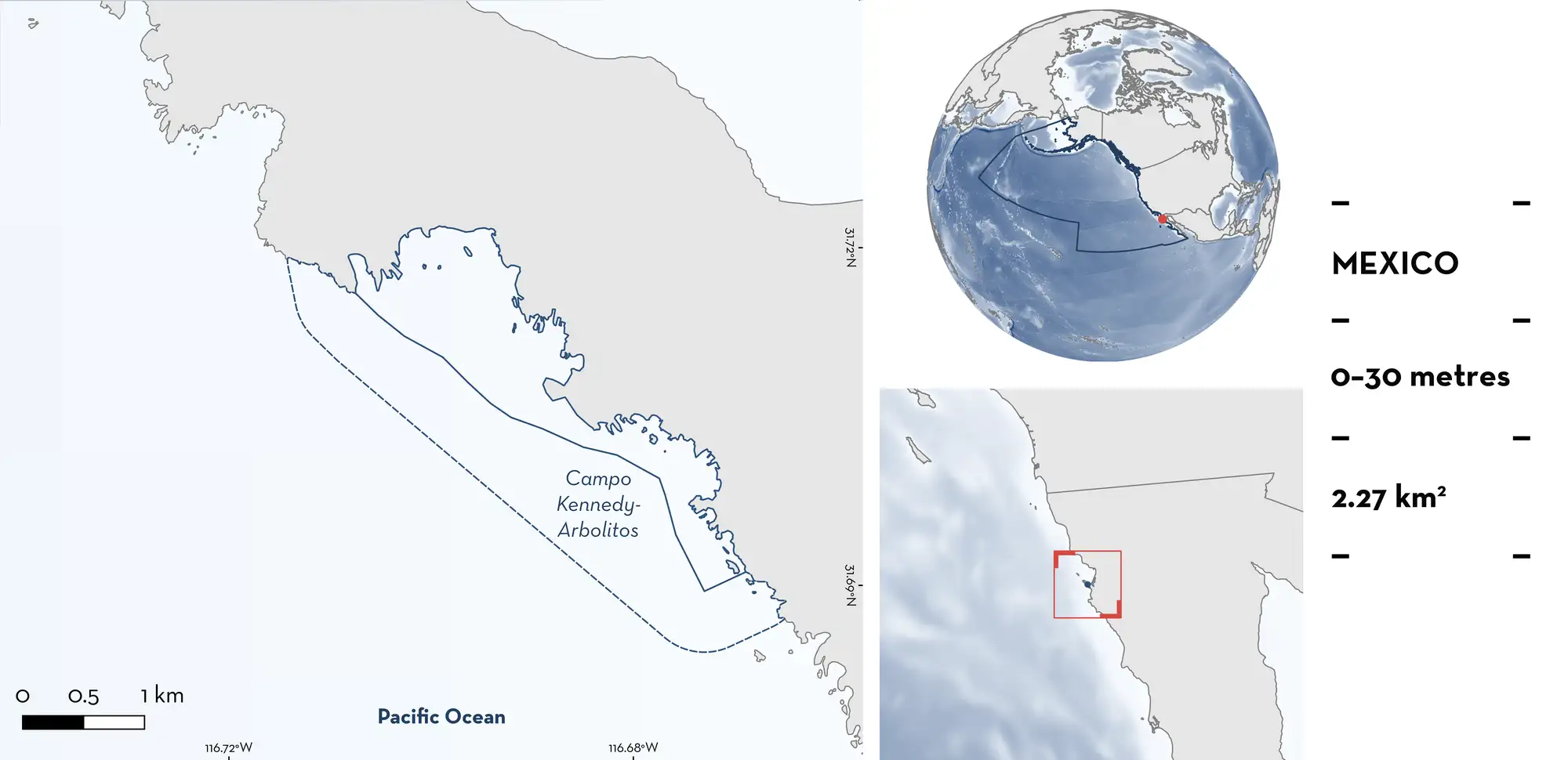
Campo Kennedy-Arbolitos
Summary
Campo Kennedy-Arbolitos is located in northwest Baja California, Mexico. This area is a shallow embayment in the Punta Banda Cape with multiple islets. The habitat is characterised by rocky reefs and kelp forest. This is a high productivity area influenced by an oceanographic transitional zone between two water masses that results in permanent upwelling. Within this area there are: threatened species (Banded Guitarfish Zapteryx exasperata); range-restricted species (e.g., Horn Shark Heterodontus francisci); reproductive areas (Swellshark Cephaloscyllium ventriosum); and undefined aggregations (Banded Guitarfish).
Download factsheet
Campo Kennedy-Arbolitos
DESCRIPTION OF HABITAT
Campo Kennedy-Arbolitos is located in northwest Baja California, Mexico. It is found in the exposed side of the Punta Banda Cape. It is a shallow embayment with multiple islets and is characterised by rocky reefs and Giant Kelp Macrocystis pyrifera forests (Beas-Luna & Ladah 2014; Sgarlatta et al. 2023).
The oceanographic conditions of the area are characterised by a high energy flow and an important oceanographic transitional zone between two water masses: the California Current, a surface current that transports subarctic water that has low salinity and high levels of dissolved oxygen; and the California Undercurrent, a subsurface poleward-flowing counter-current transporting equatorial water of high salinity, elevated nutrient concentrations, and low dissolved oxygen levels (Durazo et al. 2010). The California Undercurrent flows along the North American Pacific coast, bringing nutrient-rich waters to the surface (upwelling) near the coast throughout the year, driven by northwesterly winds, resulting in high biological productivity (Muñoz-Anderson et al. 2015).
This Important Shark and Ray Area is benthic and pelagic and is delineated from inshore and surface waters (0 m) to 30 m based on the bathymetry of the area.
CRITERION A
VULNERABILITY
One Qualifying Species considered threatened with extinction according to the IUCN Red List of Threatened Species regularly occurs in the area. This is the Vulnerable Banded Guitarfish (Rigby et al. 2025).
CRITERION B
RANGE RESTRICTED
This area holds the regular presence of Horn Shark and Banded Guitarfish as resident range-restricted species. Both species have been regularly recorded by local divers between 2015–2026 (A Bermúdez-Romero & EG Farfán-Arámbula pers. obs. 2026). On average, diving activities are conducted twice per week across four locations inside (Campo Kennedy-Arbolitos) and outside of the area (Campo 7, La Bufadora, Punta Brava, and Todos Santos Island). Individuals of both species are observed at least once per month. Horn Sharks are regularly observed as single individuals and mostly at night, while Banded Guitarfish are observed as single individuals or in aggregations. Both species are associated with rocky areas near kelp forests. Campo Kennedy-Arbolitos is the only area where both species are regularly recorded while observations are occasional at the other locations (A Bermúdez-Romero & EG Farfán-Arámbula pers. obs. 2026). Campo Kennedy-Arbolitos holds one of the last spots with kelp coverage in the region providing suitable habitats for these species (Kelpwatch 2026). These species occur in the California Current Large Marine Ecosystem (LME) and the Gulf of California LME.
CRITERION C
SUB-CRITERION C1 – REPRODUCTIVE AREAS
Campo Kennedy-Arbolitos is an important reproductive area for one shark species.
Swellshark egg cases have been regularly recorded by local divers and citizen scientists between 2015–2026 (JB Rangel-Navarro, A Bermúdez-Romero, & EG Farfán-Arámbula pers. obs. 2026; iNaturalist 2026). On average, diving activities are conducted twice per week across four locations (Campo Kennedy-Arbolitos, Campo 7, La Bufadora, Punta Brava) around Punta Banda Cape and Todos Santos Island. This is the only area where egg cases have been regularly recorded by local divers and one of the few locations in Baja California where egg cases for the species have been recorded. Egg cases with live embryos are observed mostly during the boreal spring and summer associated with soft corals and rocky substrates at depths of ~20–25 m (JB Rangel-Navarro, A Bermúdez-Romero, & EG Farfán-Arámbula pers. obs. 2026).
CRITERION C
SUB-CRITERION C5 – UNDEFINED AGGREGATIONS
Campo Kennedy-Arbolitos is an important area for undefined aggregations of one ray species.
Aggregations of Banded Guitarfish have been regularly recorded by local divers between 2015–2026 (A Bermúdez-Romero & EG Farfán-Arámbula pers. obs. 2026). On average, diving activities are conducted twice per week across four locations (Campo Kennedy-Arbolitos, Campo 7, La Bufadora, Punta Brava) around Punta Banda Cape and Todos Santos Island. Groups of 4–5 Banded Guitarfish are regularly recorded at depths of ~18 m in this area. Single individuals are observed year-round but aggregations are mostly recorded in October–November. This is the only location in the whole Punta Banda Cape and Todos Santos Island region where these aggregations have been recorded (A Bermúdez-Romero & EG Farfán-Arámbula pers. obs. 2026). Additional information is needed to confirm the nature and function of these aggregations.
Download factsheet
SUBMIT A REQUEST
ISRA SPATIAL LAYER REQUEST
To make a request to download the ISRA Layer in either a GIS compatible Shapefile (.shp) or Google Earth compatible Keyhole Markup Language Zipped file (.kmz) please complete the following form. We will review your request and send the download details to you. We will endeavor to send you the requested files as soon as we can. However, please note that this is not an automated process, and before requests are responded to, they undergo internal review and authorization. As such, requests normally take 5–10 working days to process.
Should you have questions about the data or process, please do not hesitate to contact us.

