
ISRA FACTSHEETS
ISRA FACTSHEETS
AUSTRALIA AND SOUTHEAST INDIAN OCEAN
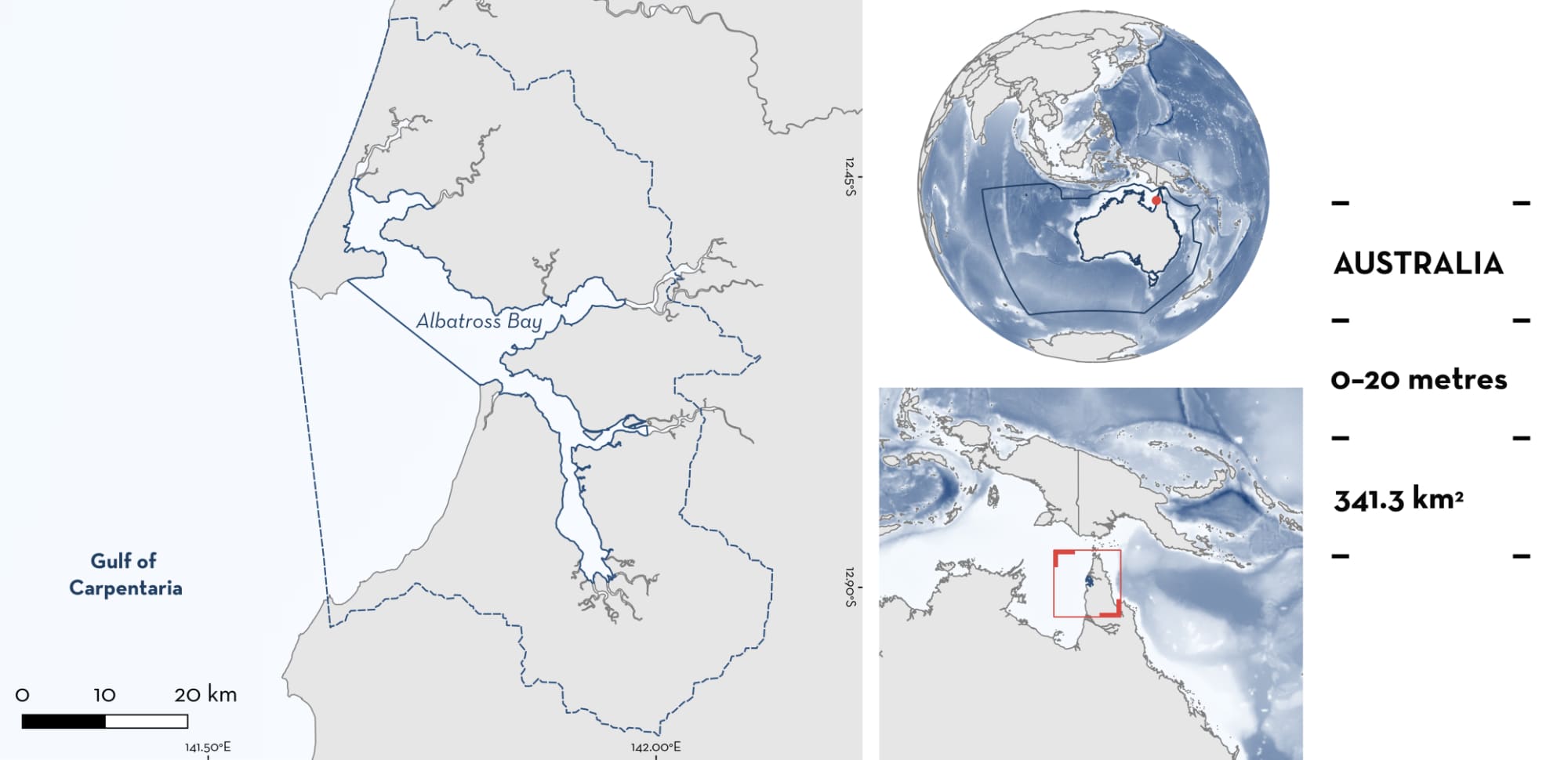
Albatross Bay
Summary
Albatross Bay is located on the western coast of Cape York, Queensland, Australia. It encompasses the tidal and intertidal areas of the estuaries of the bay’s major rivers (Pine, Mission, Embley, and Hey rivers). The area is characterised by extensive seagrass meadows, mangrove-lined estuarine waterways, saltpan and saltmarsh, fringing reefs, rocky foreshores, sandy and pebble beaches, and open marine waters. The area is influenced by the seasonal variations in tidal patterns and rainfall with a tropical monsoonal climate. Within the area there are: threatened species (e.g., Green Sawfish Pristis zijsron); and reproductive areas (e.g., Dwarf Sawfish Pristis clavata).
Download factsheet
Albatross Bay
DESCRIPTION OF HABITAT
Albatross Bay is located on the western coast of Cape York, Queensland, Australia. It encompasses the tidal and intertidal areas of all the estuaries draining into the bay, the main ones being the Pine, Mission, Embley and Hey rivers. Albatross Bay catchment is 4,622 km2 (National Land & Water Resources Audit 2002). The area is characterised by extensive seagrass meadows, mangrove-lined estuarine waterways, saltpan and saltmarsh, fringing reefs, rocky foreshores, sandy and pebble beaches, and open marine waters (Baker & Sheppard 2006). It is the largest estuarine inlet along western Cape York and contains the most extensive system of mangrove-lined waterways (Baker & Sheppard 2006). The dominate mangroves are Rhizophora spp., Avicennia spp., and Ceriops spp. (Danaher 1995). The area also has between 3,000–5,000 ha of seagrass meadows (Roelofs et al. 2003).
Albatross Bay is influenced by the seasonal variations in tidal patterns and rainfall with a tropical monsoonal climate (Baker & Sheppard 2006). Average annual rainfall in the area is over 1,700 mm and is highly seasonal with most of the annual rain falling between December and March (Baker & Sheppard 2006). During the wet season, pools within the marsh complex provide important nursery habitats for a range of species (Baker & Sheppard 2006).
This Important Shark and Ray Area is benthic and pelagic and is delineated from inshore and surface waters (0 m) to 20 m depth based on the bathymetry in the area.
CRITERION A
VULNERABILITY
Three Qualifying Species considered threatened with extinction according to the IUCN Red List of Threatened Species regularly occur in the area. These are the Critically Endangered Dwarf Sawfish (Grant et al. 2022) and Green Sawfish (Harry et al. 2022), and the Endangered Spotted Eagle Ray (Finucci et al. 2024).
CRITERION C
SUB-CRITERION C1 – REPRODUCTIVE AREAS
Albatross Bay is an important reproductive area for three ray species.
Sampling trips for sawfishes in Albatross Bay were conducted between 2023–2024 (SARA 2025; BE Wueringer & RG Dwyer unpubl. data 2025). Benthic-set monofilament gillnets (stretched mesh size 8″, net drop 2 m, net length 100–200 m) were deployed during March 2023 and April 2024. In addition, seven baited drumlines were employed in April 2024. In total, 24 nets were deployed for 102.9 hrs, with a mean soak time of 4.3 ± 1.8 hrs (BE Wueringer & RG Dwyer unpubl. data 2025). All specimens captured were measured (total length; TL) and sexed. Additionally, between 2016–2025, citizen science data (n = 79 sightings) were collected from collaborating recreational fishers and charter operators, who are more active during the dry season (May–November). These data included photographs, capture details, species identifications, and total length (TL) or disc width (DW; either reported directly or estimated using rostrum morphometrics) (Biskis et al. 2025; SARA 2025; BE Wueringer & VN Biskis unpubl. data 2025).
Between 2023–2024, a total of 27 neonate and YOY Spotted Eagle Rays were captured in the area, ranging in size between 38–55 cm DW (mean = 46.3 cm DW; BE Wueringer & RG Dwyer unpubl. data 2025). These represented 34% of the 79 Spotted Eagle Rays captured in the area. Size-at-birth for this species is 18–50 cm DW (Last et al. 2016), indicating that captured individuals were neonates or YOY. These individuals were captured during March 2023 (n = 13) and April 2024 (n = 14; BE Wueringer & RG Dwyer unpubl. data 2025). Juveniles (n = 47) ranging between 60–130 cm DW were captured in March 2023 (n = 33) and April 2024 (n = 14; BE Wueringer& RG Dwyer unpubl. data 2025). No pregnant females were captured. Albatross Bay, along with Port Musgrave to the north, hosts the largest number of neonates and YOY for the species on the east coast of the Gulf of Carpentaria.
Between 2011–2025, a total of 30 Dwarf Sawfish were observed in the area (SARA 2025; BE Wueringer & VN Biskis unpubl. data 2025). Of these, seven (23.3%) were neonate and YOY. The neonate had a visible membrane sheath around rostral teeth and YOY (n = 6) ranging in size between 59.3–100 cm TL (BE Wueringer & VN Biskis unpubl. data 2025). Observations were submitted through citizen science with size information in 2011, 2012, 2018, 2021, and 2023 during March (the neonate) and September–November (SARA 2025; BE Wueringer & VN Biskis unpubl. data 2025). Size-at-birth of the species is 65 cm TL and YOY sizes are estimated at <111 cm TL based on growth curves (Peverell 2009). The area is also important for juvenile Dwarf Sawfish with 19 individuals ranging in size between 119–220 cm TL submitted by citizen scientists between March–January (BE Wueringer & VN Biskis unpubl. data 2025). Of those, eight (44%) were between one and two years of age (based on Peverell 2009) ranging in size 110–140 cm TL (BE Wueringer & VN Biskis unpubl. data 2025). This area holds the largest contemporary records of neonate and YOY Dwarf Sawfish on the east coast of the Gulf of Carpentaria, based on monitoring efforts across four basins within the gulf (BE Wueringer & VN Biskis unpubl. data 2025).
Between 2011–2025, a total of four YOY Green Sawfish were observed in the area, ranging in size between 97–117 cm TL (SARA 2025; BE Wueringer & VN Biskis unpubl. data 2025). These represented 23% of the 13 Green Sawfish reported in the area. Size-at-birth of the species is 77–97 cm TL (Morgan et al. 2015) and YOY sizes are estimated at <117 cm TL, based on growth curves (Lear et al. 2023). Observations of YOY were submitted through citizen science with size information in 2014 (n = 1), 2017 (n = 1), 2019 (n = 1), and 2021 (n = 1; BE Wueringer & VN Biskis unpubl. data 2025). Juveniles (n = 7) ranging between 134–213 cm TL were also observed by citizen scientists in the area in 2015, 2016, 2017, 2018, 2019, and 2025 (SARA 2025; BE Wueringer & VN Biskis unpubl. data 2025). Four of these juveniles were estimated to be between 1–2 years old (134–154 cm TL; BE Wueringer & VN Biskis unpubl. data 2025). Albatross Bay hosts all early life-stages of Green Sawfish, from neonates to sub-adults. Although only low numbers have been recorded in the area, this may be explained by the species’ pattern of low abundance and highly variable frequency of occurrence within the Gulf of Carpentaria (Peverell 2009). Sexually mature Green Sawfish were also present in the area, with animals ranging between 300–458 cm TL observed in March–April in 2018 and 2024, however, no pregnant females have been recorded (SARA 2025; BE Wueringer & VN Biskis unpubl. data 2025).
Download factsheet
SUBMIT A REQUEST
ISRA SPATIAL LAYER REQUEST
To make a request to download the ISRA Layer in either a GIS compatible Shapefile (.shp) or Google Earth compatible Keyhole Markup Language Zipped file (.kmz) please complete the following form. We will review your request and send the download details to you. We will endeavor to send you the requested files as soon as we can. However, please note that this is not an automated process, and before requests are responded to, they undergo internal review and authorization. As such, requests normally take 5–10 working days to process.
Should you have questions about the data or process, please do not hesitate to contact us.

