ISRA FACTSHEETS
ISRA FACTSHEETS
AUSTRALIA AND SOUTHEAST INDIAN OCEAN
Ashburton
Summary
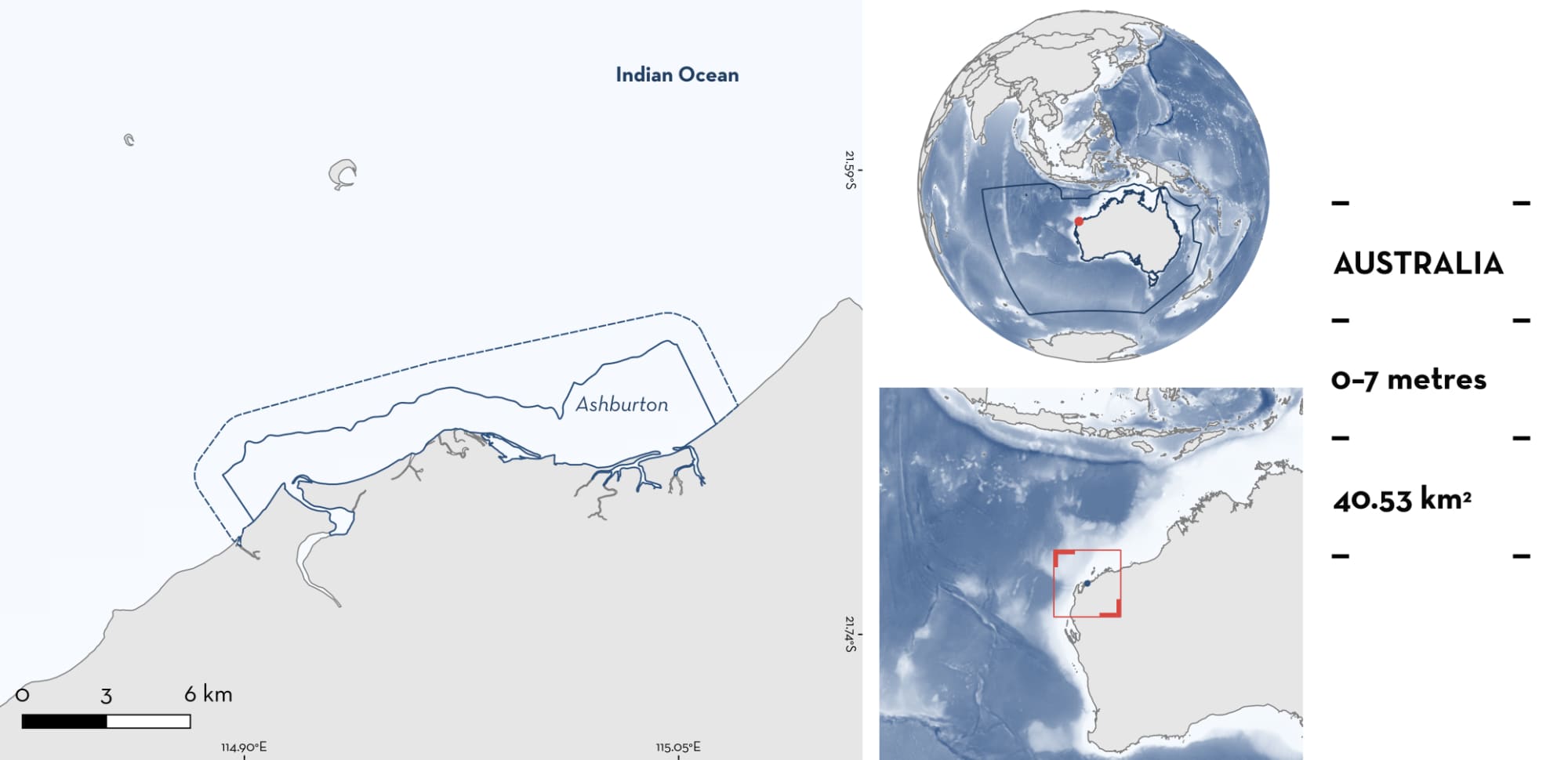
Ashburton is located in the Pilbara region of northwest Western Australia, Australia. This area includes the Ashburton Estuary, Hooley Lagoon, Hooley Creek, and Four Mile Creek. This area is characterised by shallow sand or mud flats and mangroves. It is influenced by sporadic freshwater flows that are the only major input of regular terrestrial run-off for several hundred kilometres of coastline. Within this area there are: threatened species and reproductive areas (Green Sawfish Pristis zijsron).
Download factsheet
Ashburton
DESCRIPTION OF HABITAT
Ashburton is located in the Pilbara region of northwest Western Australia, Australia. It is situated in the Thalanyji Country. This area encompasses the Ashburton Estuary and nearby northern mangrove creeks (Hooley Creek, Four Mile Creek, and Hooley Lagoon). This coastal area is characterised by mud or sand flats often lined with dense mangroves (Lear et al. 2024). Hooley Lagoon, Hooley Creek, and Four Mile Creek are mangrove-lined tidal creeks with no regular freshwater input, although they may receive some overland freshwater run-off during extreme rainfall events. In the absence of rainfall, salinity levels within all creeks and the Ashburton River mouth are generally high (>36 ppt), given proximity to large-scale intertidal salt flats.
The Pilbara region is hot and arid, with mean maximum austral summer and winter air temperatures being 35.2 and 25.6°C, respectively (Morgan et al. 2017). During summer months, rainfall mainly occurs from thunderstorms, with a highly variable contribution from tropical cyclones. The sporadic rainfall (mean annual rainfall = 275.8 mm) causes periodic freshwater flow events in the Ashburton River usually after summer or autumn cyclonic events (Morgan et al. 2017). These sporadic freshwater flows are the only major input of regular terrestrial run-off for several hundred kilometres of coastline (Lear et al. 2023).
This Important Shark and Ray Area is benthic and pelagic and is delineated from inshore and surface waters (0 m) to 7 m based on the depth range of Qualifying Species in the area.
CRITERION A
VULNERABILITY
One Qualifying Species considered threatened with extinction according to the IUCN Red List of Threatened Species regularly occurs in the area. This is the Critically Endangered Green Sawfish (Harry et al. 2022).
CRITERION C
SUB-CRITERION C1 – REPRODUCTIVE AREAS
Ashburton is an important reproductive area for one ray species.
In April and October 2011, 2014, and 2018–2025, fishery-independent gillnet surveys (100–150 mm mesh, 60 m length) were conducted in Ashburton and nearby creeks (Four Mile Creek, Hooley Creek, and Hooley Lagoon) (Morgan et al. 2015, 2017; Lear et al. 2023, 2024; Ingelbrecht et al. 2024; KO Lear unpubl. data 2025). Additionally, citizen science, fisheries, and scientific research records of sawfish were collated for the Pilbara and Gascoyne regions (Bateman et al. 2024).
All gillnet surveys captured neonate, young-of-the-year (YOY), and older juvenile Green Sawfish measuring between 65–323 cm total length (TL) (Morgan et al. 2015, 2017; Lear et al. 2023; KO Lear unpubl. data 2025). Size-at-birth of the species is 77–97 cm TL (Morgan et al. 2015) and YOY sizes are estimated at <117 cm TL, based on growth curves (Lear et al. 2023). Neonates and YOY were consistently captured in spring surveys in all years of sampling, including individuals with open or partially healed yolk-sac scars and, on one individual, the remains of a rostral sheath (Morgan et al. 2015). This suggests that births take place in this area or its vicinity. No adult Green Sawfish have been captured in this area, indicating that it acts as a birthing location and primary and secondary nurseries, rather than adult habitats (Morgan et al. 2015, 2017; Lear et al. 2023). However, adult Green Sawfish have been recorded in the Pilbara region in deeper offshore areas (Harry et al. 2024).
Recaptures of conventionally tagged individuals and acoustic telemetry of Green Sawfish in this area indicates that individuals tend to remain within the area for at least several years. At first, neonate Green Sawfish are limited to a single creek (likely their birthing location), gradually expanding their range across multiple creek systems as older juveniles (Morgan et al. 2017; Lear et al. 2023, 2024). Between 2019–2022, 60 Green Sawfish (77–320 cm TL) were acoustically tracked on an acoustic receiver array in this area (Morgan et al. 2017; Lear et al. 2024). Neonates predominantly used the estuary and the nearby tidal creeks. As YOY grow into larger juveniles, they regularly move between the estuary and mangrove creeks, providing connectivity among critical habitats for reproduction and supporting multiple life-stages.
Kinship was inferred from the genotypes of 104 Green Sawfish sampled between 2011–2014 (n = 31) and 2020–2022 (n = 73) in this area (Ingelbrecht et al. 2024). High relatedness (e.g., sibling pairs) among sampled Green Sawfish was found and revealed that at least 50 female Green Sawfish had given birth in this area over a period of ~15 years, with some individuals pupping in multiple years, and in some cases for over a decade (Ingelbrecht et al. 2024). These findings indicate that this area and adjacent areas are regularly and predictably used as a birthing location by adult female Green Sawfish, which display highly localised philopatry to this area.
Unpublished citizen science records of large-bodied rhino rays (order Rhinopristiformes) were collated from databases held within the following organizations: Fin Focus Research, Sharks and Rays Australia, Sawfish Conservation Society, and Murdoch University’s Centre for Sustainable Aquatic Ecosystems. These records included newspaper articles relating to occasional captures, sightings/ captures from snorkellers, divers, recreational fishers and other recreational ocean users. Records generally included the date, location (exact or approximate), a size estimation, and occasionally sex (Bateman et al. 2024). Most submissions were within the last 15 years (i.e., since 2010), with historical submissions (n = 9) also included from prior to 2008. Targeted research surveys used gillnets, cast nets, and capture by hand (e.g., Morgan et al. 2015; Morgan et al. 2017; Cooper 2022). These surveys were conducted across multiple years (2011–2022) and seasons (Bateman et al. 2024). Collated records indicate that this area holds the largest number of Green Sawfish records along the Pilbara and Gascoyne regions (Bateman et al. 2024).
This is one of the most studied and important areas for early life-stages of the Green Sawfish in Australia (Morgan et al. 2015, 2017; Lear et al. 2023, 2024; Ingelbrecht et al. 2024; KO Lear unpubl. data 2025). Across the Indian Ocean, only three other reproductive areas for this species have been identified, all located in the Red Sea (Jabado et al. 2023, 2024).
Download factsheet
SUBMIT A REQUEST
ISRA SPATIAL LAYER REQUEST
To make a request to download the ISRA Layer in either a GIS compatible Shapefile (.shp) or Google Earth compatible Keyhole Markup Language Zipped file (.kmz) please complete the following form. We will review your request and send the download details to you. We will endeavor to send you the requested files as soon as we can. However, please note that this is not an automated process, and before requests are responded to, they undergo internal review and authorization. As such, requests normally take 5–10 working days to process.
Should you have questions about the data or process, please do not hesitate to contact us.