
ISRA FACTSHEETS
ISRA FACTSHEETS
NEW ZEALAND & PACIFIC ISLANDS REGION
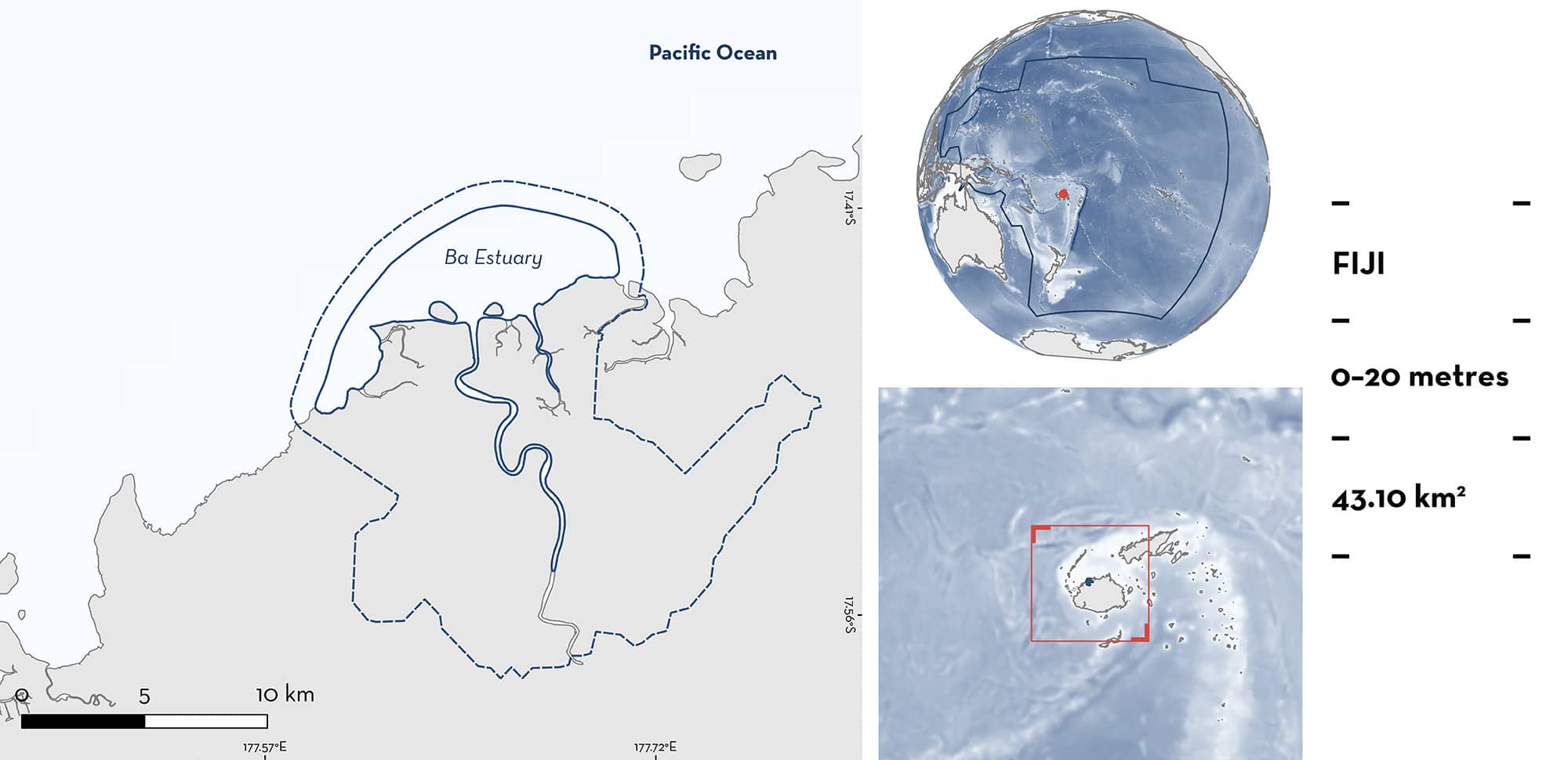
Ba Estuary
Summary
Ba Estuary is located in northwestern Viti Levu, the largest island in Fiji. The area encompasses the lower reaches of Ba River and the estuary. It is characterised by shallow coastal waters fringed by mangroves, rocky and sandy substrates, and seagrass beds. It is influenced by freshwater input from the river and tidal mixing in the lower river. Within this area there are: threatened species (e.g., Great Hammerhead Sphyrna mokarran); and reproductive areas (e.g., Scalloped Hammerhead Sphyrna lewini).
Download factsheet
Ba Estuary
DESCRIPTION OF HABITAT
Ba Estuary is located on the northwest coast of Viti Levu Island in Fiji. The Ba River mouth and estuary is part of a larger bay that is sheltered from the open sea by patches of fringing reefs and from the mainland by extensive mangrove forests. The substrate in the area predominantly consists of mud and seagrass beds (T Vierus pers. obs. 2024). The lower stretches of the river are under strong tidal influence and can be brackish, with a tidal range of ~2 m. The area experiences a wet season (November–April) when the South Pacific Convergence Zone lies over Fiji, and a dry season (May–October). The river catchment receives 2,400 mm of rainfall annually (Stephens et al. 2018).
This Important Shark and Ray Area is benthic and pelagic and is delineated from inshore and surface waters (0 m) to 20 m based on the bathymetry of the area.
CRITERION A
VULNERABILITY
Four Qualifying Species considered threatened with extinction according to the IUCN Red List of Threatened Species regularly occur in the area. These are the Critically Endangered Great Hammerhead (Rigby et al. 2019a) and Scalloped Hammerhead (Rigby et al. 2019b); and the Vulnerable Blacktip Shark (Rigby et al. 2021a) and Bull Shark (Rigby et al. 2021b).
CRITERION C
SUB-CRITERION C1 – REPRODUCTIVE AREAS
Ba Estuary is an important reproductive area for four shark species.
Fishery-independent studies were conducted in Ba Estuary over 113 days between December 2015 and July 2019, comprising 330 bottom-set gillnet and 31 longline deployments at multiple sites within the estuary (Vierus et al. 2018; Paris et al. 2019). Sampling in the area was generally conducted at night between 17:00–02:00. The sampling sites were selected based on advice from local fishers and a previous study that highlighted its importance for sharks based on Traditional Ecological Knowledge (TEK) (Rasalato et al. 2010). Up to two gillnets (100 m length and 3 m width, ~10 cm mesh size) were deployed simultaneously with a soak time of 1–6 hours, being checked every 5–25 minutes. The longline (75 m) had 27 hooks and a 2.4–2.8 m distance between 0.6–3 m long ganglions with a baited 13” circle hook. A total of 57 Blacktip Sharks, 35 Scalloped Hammerheads, and 11 Great Hammerheads were tagged with a Passive Integrated Transponder (PIT tag), however, no recaptures were recorded during sampling. The umbilical scar condition was categorised based on the degree of healing; open and semi-healed umbilical scars are characteristic of the neonate period with a duration of ~15 days. Healed scars are indicative of an age between 15 days and one year, and these specimens are classified as young-of-the-year (YOY) (Duncan & Holland 2006).
All Bull Sharks were neonates (n = 5) or YOY (n = 2) and were captured near the main Ba River mouth in January 2017, which corresponds with the peak in Bull Shark parturition in Fiji (Glaus et al. 2019). Fishing effort in the river was low compared to the estuary, and Bull Sharks at this life stage are mostly found in rivers (Glaus et al. 2019), explaining the low numbers in the fishing surveys. During the first survey in 2016, local fishers caught at least two neonate Bull Sharks from gillnets in Ba River, measuring 76 and 78 cm total length (TL), and one small individual of unknown length (Vierus et al. 2018). TEK also indicates that small Bull Sharks are caught seasonally in this river, with nine interviewed fishers reporting that they regularly catch small Bull Sharks (T Vierus pers. obs. 2018). Between 2016–2018, 31 pregnant Bull Sharks, with visibly distended abdomens, were tagged with acoustic transmitters at the Shark Reef Marine Reserve located ~180 km along the coast from Ba Estuary. Acoustic receivers were placed in the Rewa, Sigatoka, Navua, and Ba Rivers on the island of Viti Levu (K Glaus et al. unpubl. data 2024). Fourteen individuals were detected in the four rivers for a few, typically consecutive, days during parturition season (November–March). Two tagged pregnant females were detected in the area. Combined, these data show that this is an important area for parturition and the early life stages of Bull Sharks.
Blacktip Sharks were the second-most captured species (n = 89) in the surveys, representing 40% of all shark and ray captures in Ba Estuary (Vierus et al. 2018; Paris et al. 2019). Almost all individuals were neonates with an open (n = 60) or semi-healed (n = 17) umbilical scar. The others were YOY (n = 10) and two could not be assessed. Blacktip Sharks measured 54.5–76.4 cm TL (mean = 66.1 ± 3.5 cm TL). The size-at-birth of the species is 38–72 cm TL (Ebert et al. 2021). The sex ratio was even (45 males : 43 females : 1 unassessed). A clearly defined parturition period was observed between November and February. The small fraction of YOY individuals during January to March, coupled with the absence of the species from April to October, suggests that Blacktip Sharks leave the estuary soon after birth.
The Scalloped Hammerhead was the most abundant shark species captured during the survey (n = 97; 43% of total shark and ray catch) (Vierus et al. 2018; Paris et al. 2019). All Scalloped Hammerheads were either neonates, with an open (n = 26) or semi-healed (n = 31) umbilical scar, or YOY individuals (n = 40). Individuals measured 37–61.8 cm TL (mean = 51.6 cm TL). The size-at-birth of the species is 31–57 cm TL (Ebert et al. 2021). The sex ratio was even (50 males : 47 females). This species was caught year-round and across years with a high percentage of neonates observed between September and February, indicative of the birthing period during these months. A higher proportion of YOY individuals between March and June suggests the species tends to remain in, or return to, the estuary for at least several months after birth (Vierus et al 2018).
Fourteen Great Hammerheads were captured in Ba Estuary, including four neonates, nine YOY individuals, and one with an unrecorded umbilical scar condition (Vierus et al. 2018). Ba Estuary has regional importance as it is the only location in Fiji and the broader region where both neonates and YOY Great Hammerheads have been documented. The number of captured individuals in Ba Estuary surpasses that reported in a 10-month study around the Florida Keys (Macdonald et al. 2021). In Ba Estuary, neonate and YOY individuals were captured in January, February, August, September, and December, suggesting that they may spend a significant portion of their early life stages in the area. This is supported by a tagging study in Australia that showed limited dispersal and small home ranges for acoustically tracked Great Hammerheads in similar tropical nearshore coastal areas (Lubitz et al. 2023). The general absence of neonates in nearshore habitats has been used to argue that Great Hammerheads primarily use offshore habitats for pupping (Harry et al. 2011), though direct observations or evidence of pupping there are lacking. The observations from this area highlight the importance of Ba Estuary for Great Hammerheads in early life stages.
Download factsheet
SUBMIT A REQUEST
ISRA SPATIAL LAYER REQUEST
To make a request to download the ISRA Layer in either a GIS compatible Shapefile (.shp) or Google Earth compatible Keyhole Markup Language Zipped file (.kmz) please complete the following form. We will review your request and send the download details to you. We will endeavor to send you the requested files as soon as we can. However, please note that this is not an automated process, and before requests are responded to, they undergo internal review and authorization. As such, requests normally take 5–10 working days to process.
Should you have questions about the data or process, please do not hesitate to contact us.

