ISRA FACTSHEETS
ISRA FACTSHEETS
NEW ZEALAND & PACIFIC ISLANDS REGION
Drawaqa Island
Summary
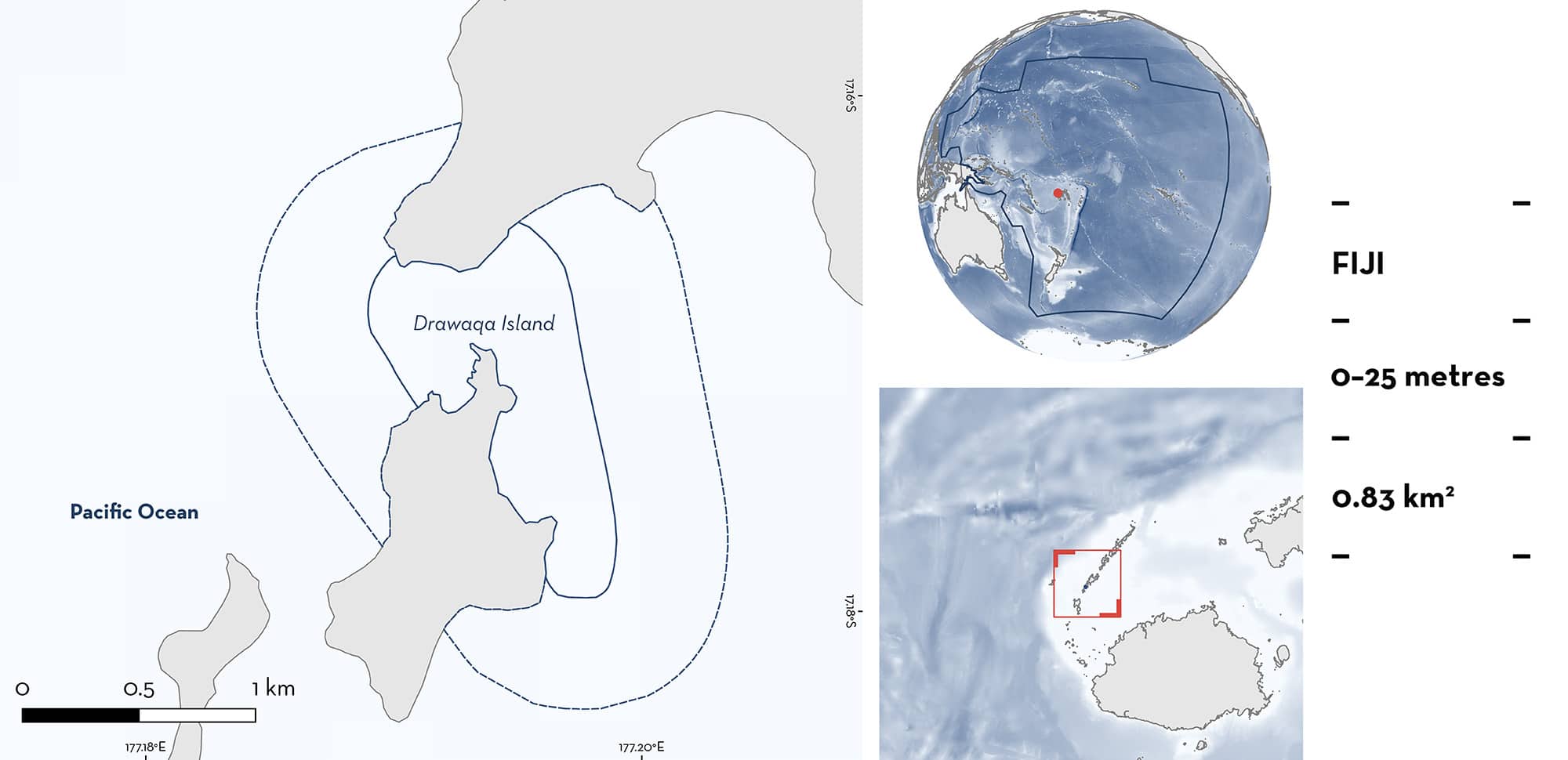
Drawaqa Island is located in the Yasawa Islands northwest of Viti Levu in Fiji. The area includes coastal waters off five beaches as well as a shallow channel between two islands. The area is characterised by sandy beaches, sand flats, seagrass beds, and coral reefs. In the austral winter from April–October, strong easterly and southeasterly winds and cooler surface waters likely cause zooplankton density to increase in the area. This zooplankton is then funnelled through the channel from east to west on the falling tide. Within this area there are: threatened species (Reef Manta Ray Mobula alfredi); range-restricted species (Oceania Fantail Ray Taeniura lessoni); reproductive areas (Oceania Fantail Ray); and feeding areas (Reef Manta Ray).
Download factsheet
Drawaqa Island
DESCRIPTION OF HABITAT
Drawaqa Island is located in the Yasawa Islands, northwest of Viti Levu in Fiji. The Yasawa Islands consist of 11 main volcanic islands extending 90 km to the northeast (Ward & Beggs 2007). This area includes shallow coastal waters around Drawaqa Island and a channel located in an east to west orientation between Naviti and Drawaqa Islands (Murphy et al. 2018). The habitat is characterised by sandy beaches, seagrass beds, shallow reef flats, a reef slope from 3–7 m, and a sloping sandy bottom with coral pinnacles. The north of Drawaqa Island includes five beaches, which fall within the area: Goat, Lagoon, Manta, Sunrise, and Sunset Beach. The channel has hard coral cover throughout and is subject to strong tidal currents. Strong easterly and southeasterly winds during the austral winter (Kumar & Prasad 2010) are likely to bring cool, nutrient-rich water into the eastern side of the channel and east of Drawaqa Island, causing primary productivity to increase and, in turn, dense zooplankton patches to form (L Gordon pers. obs. 2024). On the falling tide the current flows southwest through the channel, causing the dense zooplankton to be funnelled through the channel (Murphy et al. 2018). Winds also influence the shallow waters, with calm areas off Manta and Sunset Beach on the westward side of the island and stronger winds and waves off Sunrise Beach.
This Important Shark and Ray Area is benthopelagic and is delineated from surface waters (0 m) to a depth of 25 m based on the bathymetry of the area.
CRITERION A
VULNERABILITY
One Qualifying Species considered threatened with extinction according to the IUCN Red List of Threatened Species regularly occurs in the area. This is the Vulnerable Reef Manta Ray (Marshall et al. 2022).
CRITERION B
RANGE RESTRICTED
This area holds the regular presence of the Oceania Fantail Ray as a resident range-restricted species. This species occurs year-round and is regularly encountered at Drawaqa Island (Glaus et al. 2024). The species’ range is outside of Large Marine Ecosystems, but is small and restricted to Melanesia, including Papua New Guinea, Vanuatu, Solomon Islands, and Fiji (Last et al. 2016a; Hylton et al. 2017). The area includes pupping grounds and habitat niches for reproductive activities (Glaus et al. 2024). Since 2017, Oceania Fantail Rays have been observed in the area at least once a week (R Macfarlane pers. obs. 2024). According to reports from regional dive operators, Oceania Fantail Rays are seen occasionally throughout the Yasawa Islands. However, Drawaqa Island stands out as their hotspot, with high encounter rates and re-sightings of individuals identified from photos of their spot pattern (Glaus et al. 2024).
CRITERION C
SUB-CRITERION C1 – REPRODUCTIVE AREAS
Drawaqa Island is an important reproductive area for one ray species.
Over 40 days across January to March 2024, 105 surveys were conducted to observe Oceania Fantail Rays off five beaches in Drawaqa Island (Glaus et al. 2024). Surveys lasted 45 min and were conducted as roving explorations, including 53 snorkel surveys, 32 beach walks, and 20 dives. Snorkel and dive surveys were conducted at five sites along 100 m transect lines parallel to the shoreline, with a maximum depth of 12 m for snorkel and 21 m for dive surveys. Beach walks were performed at all five beaches.
Oceania Fantail Rays were observed in 71 surveys (68 % of total) and included neonates as well as mature, and pregnant individuals (Glaus et al. 2024). Disc width (DW) measurements of individuals in situ included four females ranging 21–25 cm DW, indicative of mature individuals. The mature female paratype Oceania Fantail Ray specimen was 22 cm DW (Last et al. 2016a). Mature females were sighted 38 times during the survey period. Before detailed surveys started, large and likely mature individuals had been encountered in the area since 2018 (R Macfarlane pers. obs. 2024). Moreover, four females in advanced gestation with conspicuously convex dorsa were encountered 24 times at the same site from the beginning of January until the end of March 2024. Since the end of the survey, pregnant individuals are still seen on an almost daily basis (R Macfarlane pers. obs. 2024). Parturition events in the area were inferred from sightings of three previously pregnant individuals with a concave dorsum, indicative of recent parturition (Henningsen 2000; Spieler et al. 2013), between the end of February to mid-March. Neonates were conservatively classified as <10 cm DW, considering that the congener Bluespotted Lagoon Ray Taeniura lymma is born at ~13 cm (Last et al. 2016b). Neonates were sighted from early March, coinciding with the observed parturition period. YOY individuals are still seen in August, highlighting the continued use of the area by early life stages of the species (R Macfarlane pers. obs. 2024). Small Oceania Fantail Rays, likely to be neonates and YOY individuals based on their sizes, have been encountered before the detailed surveys began since April 2021 (L Gordon pers. obs. 2024). Mating may also occur in this area, with one mature female observed with a visible dermal abrasion on the left pectoral fin (K Glaus pers. obs. 2024), possibly indicating a pre-copulatory bite wound (Kajiura et al. 2000).
CRITERION C
SUB-CRITERION C2 – FEEDING AREAS
Drawaqa Island is an important feeding area for one ray species.
Reef Manta Rays seasonally aggregate in this area to feed (Murphy et al. 2018; Gordon et al. 2022; Manta Project Fiji unpubl. data 2023). Between 2012–2024 (except 2017), a total of 1,882 snorkel surveys recorded 3,808 Reef Manta Ray sightings of 142 individuals confirmed with photo-identification. Surveys lasted 45–60 minutes and consisted of a team of in-water observers taking identification photos of Reef Manta Rays. Surveys separated by <60 min on the same day were classified as the same survey. The species was seen on 54–82% of surveys each year. Reef Manta Rays seasonally aggregate in the area between April and October, with a peak in June–September. Feeding was recorded for 3,057 sightings (80%) since 2012 (Gordon et al. 2022; Manta Project Fiji unpubl. data 2023). Feeding groups range from 2–15 individuals. Their behaviour is either surface feeding, by swimming in the channel against the current, or somersault feeding on the eastern edge of the channel (Murphy et al. 2018). During April–October strong southeasterly winds likely influence prey availability by bringing cool, nutrient-rich water into the area where zooplankton patches form (Gordon et al. 2022; Manta Project Fiji unpubl. data 2023). Strong currents funnel water through the channel in a southwest direction during the start of the falling tide, coinciding with aggregations of feeding Reef Manta Rays (Murphy et al. 2018).
Download factsheet
SUBMIT A REQUEST
ISRA SPATIAL LAYER REQUEST
To make a request to download the ISRA Layer in either a GIS compatible Shapefile (.shp) or Google Earth compatible Keyhole Markup Language Zipped file (.kmz) please complete the following form. We will review your request and send the download details to you. We will endeavor to send you the requested files as soon as we can. However, please note that this is not an automated process, and before requests are responded to, they undergo internal review and authorization. As such, requests normally take 5–10 working days to process.
Should you have questions about the data or process, please do not hesitate to contact us.