ISRA FACTSHEETS
ISRA FACTSHEETS
NORTH AMERICAN PACIFIC
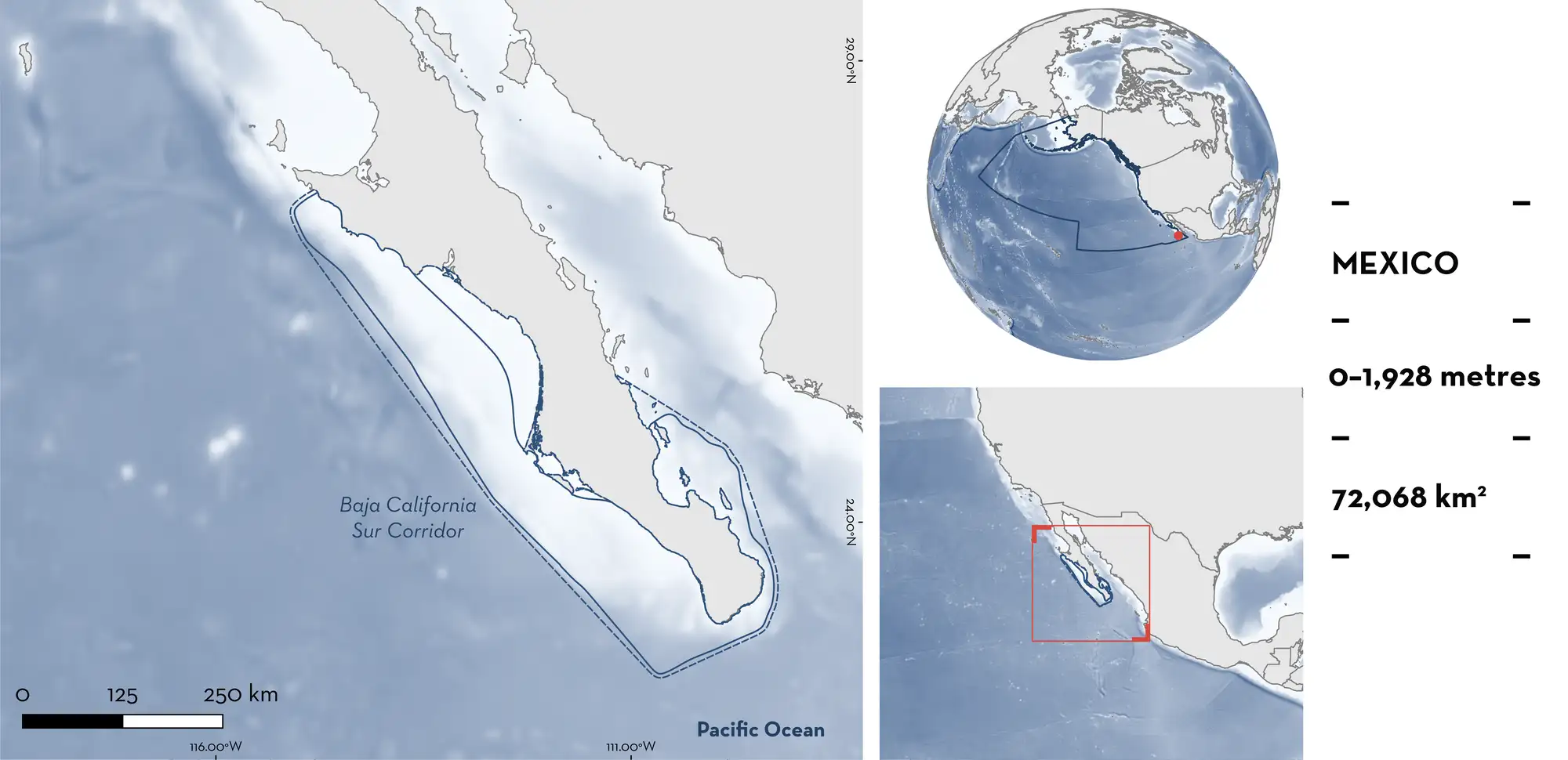
Baja California Sur Corridor
Summary
Baja California Sur Corridor is located in Baja California, Mexico. This area stretches from Bahía de la Paz on the southeast coast of Baja California Sur (Gulf of California) to the central-west coast of Baja California Sur (Pacific Ocean). The habitat is characterised by coastal, continental shelf, and slope pelagic waters and dynamic frontal zones. It is influenced by the cooler California Current System meeting the warmer North Equatorial and Tropical Pacific systems, as well as by wind-driven coastal upwelling. Within this area there are: threatened species and areas important for movement (Whale Shark Rhincodon typus).
Download factsheet
Baja California Sur Corridor
DESCRIPTION OF HABITAT
Baja California Sur Corridor is located in Baja California, Mexico. This movement area stretches from Bahía de la Paz on the southeast coast of Baja California Sur (Gulf of California) to the central-west coast of Baja California Sur (Pacific Ocean). The habitat is characterised by coastal, continental shelf, and slope pelagic waters and dynamic frontal zones. The interaction between static bathymetric features and predictable seasonal oceanographic processes results in a productive and spatially structured environment (Giddings et al. 2022; Sarmiento-Lezcano et al. 2024).
The area serves as a biogeographic transition zone where the cooler, nutrient-rich waters of the California Current meet the warmer waters of the North Equatorial and Tropical Pacific systems (Durazo 2009; Giddings et al. 2022). The California Current is characterised by low sea surface temperatures (<18°C), low salinity, and high concentrations of nutrients and dissolved oxygen. In contrast, tropical and subtropical surface waters have higher temperatures (>20°C), higher salinity, and lower nutrient availability. The convergence of these different water masses creates strong physical and chemical gradients over relatively short distances (Durazo 2009; Sutton et al. 2017). Oceanographic dynamics in the area are also shaped by seasonal wind forcing and large-scale circulation patterns. During the boreal winter, spring, and early summer, intensified southward flow of the California Current and persistent winds drive coastal upwelling, enhancing nutrient input to the euphotic zone and promoting elevated phytoplankton biomass and productivity (Gaxiola-Castro et al. 2010; Giddings et al. 2022). Mesoscale processes, including fronts and semi-permanent eddies, are recurrent features in the region, particularly off Punta Eugenia and Bahía Sebastián Vizcaíno at the northern extent of this area, influencing the distribution and retention of planktonic biomass (Aceves-Medina et al. 2019).
This Important Shark and Ray Area is pelagic and is delineated from inshore and surface waters (0 m) to 1,928 m based on the global depth range of Qualifying Species.
CRITERION A
VULNERABILITY
One Qualifying Species considered threatened with extinction according to the IUCN Red List of Threatened Species regularly occurs in the area. This is the Endangered Whale Shark (Pierce et al. 2025).
CRITERION C
SUB-CRITERION C4 – MOVEMENT
Baja California Sur Corridor is an important movement area for Whale Sharks.
Between 2008–2012, 17 Whale Sharks ranging from 300–1,200 cm total length (TL) were tagged in Bahía de la Paz in the Gulf of California with pop-up archival satellite transmitters (Ramírez-Macías et al. 2017). Tracked sharks included nine mature (defined >900 cm TL) individuals (eight females and one male) and eight juvenile individuals (<900 cm TL). Although five tracking devices deployed on mature Whale Sharks never transmitted, tracking data indicated that all three mature females tagged in May 2009 and June–July 2010 used this movement corridor from the Gulf of California to coastal Pacific Ocean waters off the southwest coast of Baja California. These mature females departed from the tagging area after 7–15 days and subsequently travelled along the southwestern coast of the Baja California peninsula, where they remained associated with productive coastal waters in July/August, before moving to an oligotrophic offshore area (outside this area) in September where tags popped off. By contrast, all juveniles remained in the Gulf of California (Ramírez-Macías et al. 2017).
A second study tracked nine mature female Whale Sharks (850–1,250 cm TL) tagged with various satellite transmitter models (SPOT-257s, SPOT-420, SPLASH10-346s, SPLASH10-F-312s, and MiniPAT-390) between May and July 2025. Three individuals were tagged off Todos Santos on the west coast of the Baja California peninsula, and the remaining six individuals were tagged in Bahía de La Paz and off Espiritu Santo Island, within the Gulf of California. All Whale Sharks departed the tagging areas shortly after deployment (García-Baciero et al. unpubl. data 2026). Consistent with patterns described by Ramírez-Macías et al. (2017), all mature females used this movement corridor, moving around the tip of the peninsula in May–June and then along productive coastal waters off the southwest coast of the Baja California peninsula from late June–September, before transitioning to oligotrophic offshore waters (outside this area) later in the year. The recurrence, timing, and spatial coherence of these movements indicate predictable and repeated seasonal use of the southwest Baja California Pacific Ocean coast by mature female Whale Sharks. Satellite telemetry further suggests coordinated movements and temporary aggregation in highly productive coastal areas, likely associated with foraging given direct observations of a female feeding on zooplankton in the upwelling area identified (García-Baciero et al. unpubl. data 2026). The region is characterised by elevated zooplankton biomass, including euphausiids, which strongly influences the distribution of planktivorous megafauna (Lezama-Ochoa et al. 2025).
A third study tracked seven adult female Whale Sharks (900–1,200 cm TL) tagged with satellite transmitters during May–June of 2022–2025 in two focal areas: Bahía de La Paz (southern Gulf of California) and Pacific Ocean waters of the Bahía Magdalena region (J Ketchum et al. unpubl. data 2026). The tracks indicate a consistent movement connection between these areas and the Pacific margin of the Baja California Peninsula. Three sharks tagged in Bahía de La Paz moved out of the Gulf of California and around Cabo San Lucas into the Pacific Ocean, then travelled along the outer shelf and slope of the Baja California Peninsula to the Bahía Magdalena region, demonstrating a repeatable trans-peninsular route that connects a known seasonal Whale Shark use-area in La Paz with oceanic habitat on the Pacific Ocean margin (Ketchum et al. 2013; Whitehead et al. 2019). Track durations ranged from 31 to 74 days and tracks connected the whole movement area (Ketchum et al. unpubl. data 2026). In addition, four females >900 cm TL tagged in late July 2025 in Bahía Magdalena moved north to Bahía Tortugas, at the northern end of the movement corridor, within approximately one month. Between September and November, they then moved southward while remaining within the movement corridor. Track durations ranged from 30–60 days (E Salazar-Cervantes et al. unpubl. data 2026). The concentrated use of the Pacific-margin seascape indicates that this region functions not only as a transit pathway but also as an extended-use movement area within the broader corridor (J Ketchum et al. unpubl. data 2026; E Salazar-Cervantes et al. unpubl. data 2026).
Combined, the tracking data indicate that the Baja California Sur Corridor likely functions as a key transition zone in the species’ movement ecology. Although the proximate drivers of these movements remain uncertain, they may reflect reproductive motivations in females (Ramírez-Macías et al. 2017), tracking productivity concentrations that can shape feeding opportunities (Hobbs et al. 2009; Ketchum et al. 2013; Ryan et al. 2017), and/or following geomorphological features (e.g., seamount, pinnacles, and canyons) that can structure pathways and space use (D’Antonio et al. 2025), among other factors.
Download factsheet
SUBMIT A REQUEST
ISRA SPATIAL LAYER REQUEST
To make a request to download the ISRA Layer in either a GIS compatible Shapefile (.shp) or Google Earth compatible Keyhole Markup Language Zipped file (.kmz) please complete the following form. We will review your request and send the download details to you. We will endeavor to send you the requested files as soon as we can. However, please note that this is not an automated process, and before requests are responded to, they undergo internal review and authorization. As such, requests normally take 5–10 working days to process.
Should you have questions about the data or process, please do not hesitate to contact us.