ISRA FACTSHEETS
ISRA FACTSHEETS
NORTH AMERICAN PACIFIC
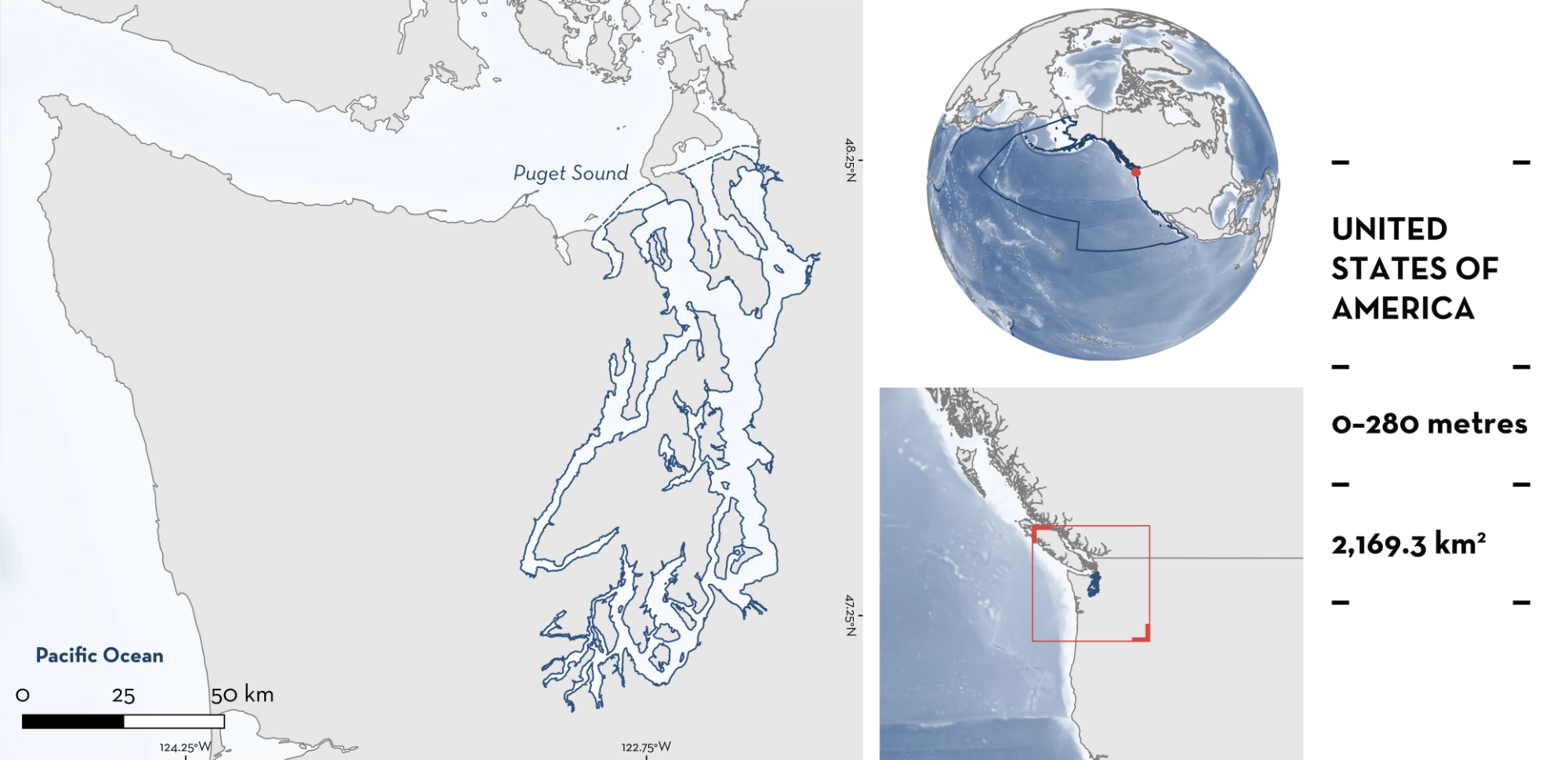
Puget Sound
Summary
Puget Sound is located in Washington State, United States of America. The area forms the southern portion of the Salish Sea. This fjord–estuarine system is characterised by deep basins separated by sills and extensive shallow nearshore environments. Habitats include rocky reefs, kelp beds, mixed sediment intertidal beaches, tidal flats, subtidal soft sediments, and eelgrass gardens. The area is influenced by tidal currents, freshwater input from rivers, and deep inflow of marine waters from the Pacific Ocean. The area overlaps with several Washington State Conservation Areas. Within the area there are: reproductive areas (Bluntnose Sixgill Shark Hexanchus griseus).
Download factsheet
Puget Sound
DESCRIPTION OF HABITAT
Puget Sound is located in Washington State, United States of America (USA). The area forms the southern portion of the Salish Sea, a large estuary spanning the border between northwestern Washington State, USA and southwestern British Columbia, Canada (outside of the area). The area encompasses the full Puget Sound basin, including all connected inlets, channels, and deep basins south of Admiralty Inlet. This fjord–estuarine system is characterised by deep basins separated by sills and extensive shallow nearshore environments. The basins average 62.5 m depth with deeper depths reached in channels (Andrews et al. 2010). Habitats comprise diverse temperate environments including rocky reefs, kelp beds, mixed sediment intertidal beaches, tidal flats, subtidal soft sediments, and Common Eelgrass Zostera marina gardens (Ruckelshaus & McClure 2007).
The area is influenced by tidal currents, freshwater input from rivers, and deep inflow of marine waters from the Pacific Ocean (Ruckelshaus & McClure 2007). The area is generally stratified in the boreal summer due to freshwater input from rivers and solar heating and is often well mixed in winter (Ruckelshaus & McClure 2007; Andrews et al. 2010).
This area overlaps with several small Washington State Conservation Areas (no-take Marine Protected Areas; WDFW 2026).
This Important Shark and Ray Area is benthic and pelagic and is delineated from inshore and surface waters (0 m) to 280 m based on the bathymetry of the area.
CRITERION C
SUB-CRITERION C1 – REPRODUCTIVE AREAS
Puget Sound is an important reproductive area for one shark species.
Bluntnose Sixgill Sharks recorded in the area range from neonates to adults but are dominated by a range of juvenile size classes, highlighting the use of the area as a primary and secondary reproductive site. Available evidence comes from catch records (Andrews et al. 2007, 2010; Williams et al. 2010; Griffing et al. 2016; International Pacific Halibut Commission [IPHC] unpubl. data 2014), a beach stranding (Larson et al. 2011; Griffing et al. 2016), kinship analyses (Larson et al. 2026), telemetry studies (Andrews et al. 2007, 2010; Levin et al. 2012), and SCUBA diving observations (Six Gill Sharks 2026).
Historical data (>15 years old, i.e., pre-2011) include catches of sharks ranging 153–270 cm TL (n = 12 sharks; 2004–2005; Andrews et al. 2007); 140–250 cm TL (n = 13; 2005–2007; Levin et al. 2012); 109–293 cm TL (n = 34; 2005–2008; Andrews et al. 2010); and 150–296 cm TL for males and 175–315 cm TL for females (2006–2008; Williams et al. 2010). Pregnant females are rarely encountered anywhere in the global range of the species, but a beach stranding at Hammersley Inlet in the area in 2007 showed a large female with near-term pups (some aborted; Larson et al. 2011; Griffing et al. 2016). Size-at-birth of the species is 61–74 cm TL (Ebert et al. 2021) and young-of-the-year (YOY) are <99 cm TL (based on preliminary unvalidated growth rates; McFarlane et al. 2002). Size-at-maturity is ~310–330 cm TL for males and >400 cm TL for females (Ebert et al. 2021).
Contemporary records include Bluntnose Sixgill Sharks recorded during fishery-independent longline surveys conducted in 2014 (fixed-hook longlines using skates [longline units] standardised to 1,800-foot groundlines with 100 size-16 circle hooks at 18-foot spacing; IPHC 2026; IPHC unpubl. data 2014). IPHC surveys are limited in Puget Sound, but over three days of surveys (29–31 May 2014), 31 Bluntnose Sixgill Sharks were caught of which 19 were measured and ranged 86–250 cm TL (mean ± standard deviation = 145.5 ± 42.7 cm TL; IPHC unpubl. data 2014). This included two YOY measuring 86 cm TL providing direct evidence of the occurrence of this early life-stage in the area. The remaining measured individuals were all juvenile ranging 109–250 cm TL (IPHC unpubl. data 2014).
Telemetry data have revealed localised residency and small-scale movements in juvenile life-stages. Firstly, a short-term passive acoustic telemetry study over 138 days (October 2004–February 2005) where 12 tagged sharks ranging in size 153–270 cm TL (all juveniles), demonstrated residency to small areas (Andrews et al. 2007). Sharks were detected at the same site as the previous day 76% of the time; mean daily movement = 0.2–3.1 km; mean displacement from tagging site = 3.8–10.8 km; and maximum displacement from tagging site = 8.4–29.2 km (Andrews et al. 2007). Secondly, a study undertaken between March 2005 and August 2007 actively tracked 13 sharks for periods of 11–45 hours at a time (some sharks were tracked on more than one occasion resulting in 21 tracks of which 14 were tracked for 24 hours; Levin et al. 2012). There sharks ranged 140–250 cm TL (all juveniles) and undertook linear distance movements of 4.3–22.5 km over the individual tracks (Levin et al. 2012). Finally, a longer-term passive acoustic telemetry study tagged 34 sharks ranging in size 109–293 cm TL (all juveniles) between June 2005 and April 2008 (Andrews et al. 2010). This study demonstrated residency of juvenile sharks to Puget Sound prior to ontogenetic shifts to coastal waters outside of the sound (Andrews et al. 2010). Sharks displayed consistent seasonal movement patterns, moving to the north of Puget Sound from the winter to spring, and moving to the south of Puget Sound from summer to autumn, demonstrating wide use of the area by Bluntnose Sixgill Sharks (Andrews et al. 2010). Over the study period, larger sharks (n = 19) departed the area for Pacific Ocean coastal waters outside of the area (Andrews et al. 2010).
Genetic analyses identified closely related relatives across disparate years demonstrating breeding ground philopatry to the area (Larson et al. 2026). A relatedness study used tissue samples collected from 286 Bluntnose Sixgill Sharks from this area from 2003–2007 and 2018, and from the southern Strait of Georgia, British Columbia, Canada in 2019 (outside the area) (Larson et al. 2026). Close-kin relationships included first order relationships (full-sibling or parent-offspring pairs) identified over five different years, and second order relationships (half-siblings, aunts/uncles, or grandparents) identified over a decade or more apart (Larson et al. 2026). The demonstrated relatedness provides evidence that mature females, or their close kin, return to the area to give birth multiple times throughout their lives (Larson et al. 2026).
Most research on Bluntnose Sixgill Sharks in Puget Sound has been undertaken historically (i.e., >15 years ago; Andrews et al. 2007, 2010; Williams et al. 2010; Larson et al. 2011; Levin et al. 2012; Griffing et al. 2014, 2016). Further, the species has undergone an apparent local population reduction (Griffing et al. 2016, 2019). Despite this, the species continues to be recorded by SCUBA divers given that it frequents observable depths and is a diving attraction within this area (Six Gill Sharks 2026). A total of 216 sightings were logged from dives between 2018–2026 in the area (Six Gill Shark 2026). While divers often provision sharks, this serves to bring the sharks closer, and they are known to be in the immediate area of the dive sites. Estimated size is provided for a number of logged sightings with accompanying photos, which were all juveniles (mostly ranging <152–274 cm TL) with a record of a ~61 cm TL neonate in 2023 (sizes converted from feet; Six Gill Shark 2026).
Despite its widespread global distribution (Ebert et al. 2021), Bluntnose Sixgill Shark ecology remains poorly understood. Puget Sound and the broader Salish Sea are one of the few locations where regular reproductive activities have been documented.
Download factsheet
SUBMIT A REQUEST
ISRA SPATIAL LAYER REQUEST
To make a request to download the ISRA Layer in either a GIS compatible Shapefile (.shp) or Google Earth compatible Keyhole Markup Language Zipped file (.kmz) please complete the following form. We will review your request and send the download details to you. We will endeavor to send you the requested files as soon as we can. However, please note that this is not an automated process, and before requests are responded to, they undergo internal review and authorization. As such, requests normally take 5–10 working days to process.
Should you have questions about the data or process, please do not hesitate to contact us.