ISRA FACTSHEETS
ISRA FACTSHEETS
ASIA REGION
Bengkalis-Rangsang
Summary
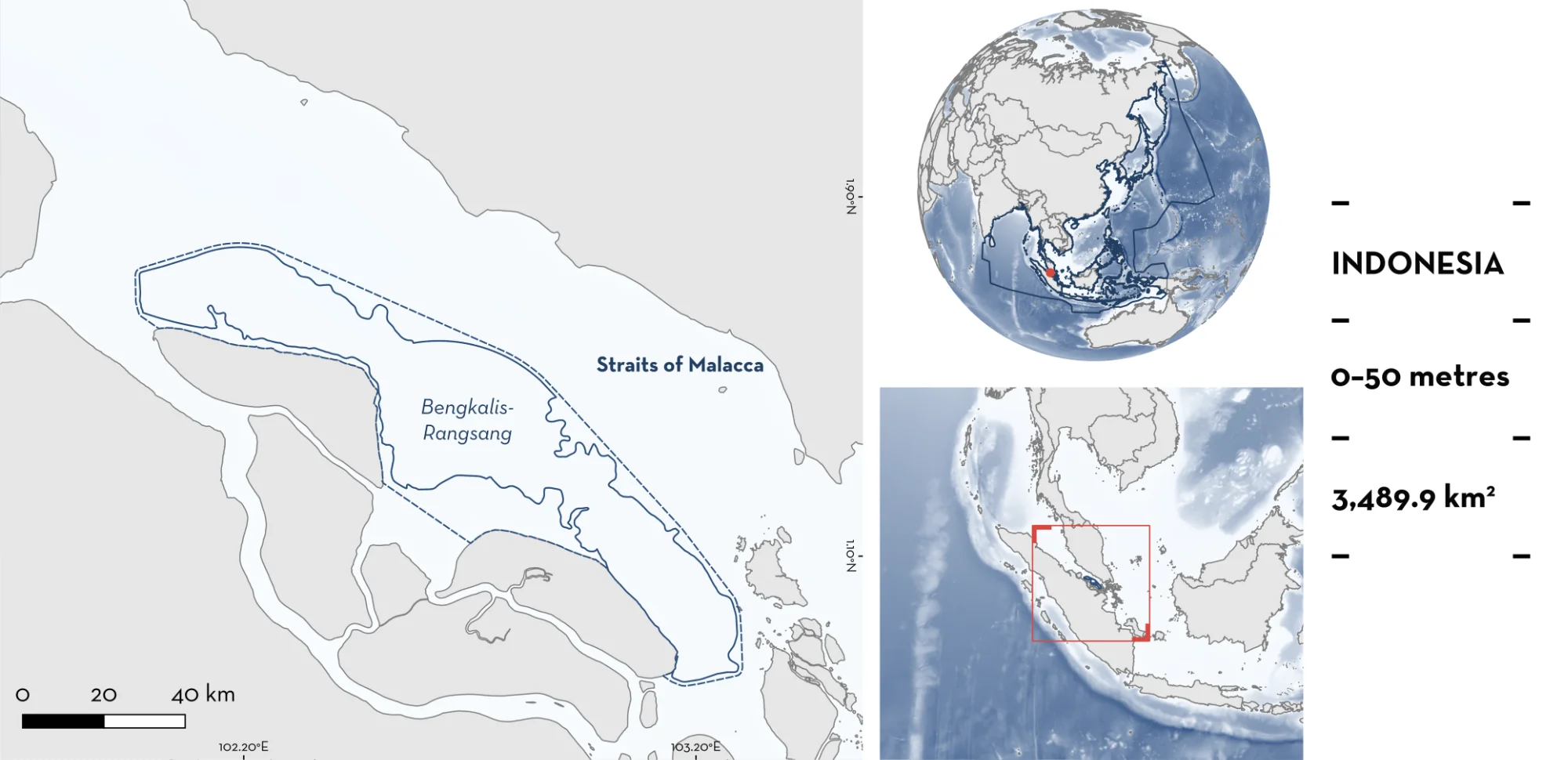
Bengkalis-Rangsang is located along the eastern coast of Sumatra, Indonesia. The area encompasses waters off Bengkalis and Rangsang islands. Substrates are muddy, while adjacent coastlines consist of mangroves, sandy beaches, and mudflats with strong tidal flow. The area is influenced by a monsoonal climate and by runoff from the Siak River. The area overlaps with the Southern Straits of Malacca Ecologically or Biologically Significant Marine Area. Within this area there are: threatened species and range-restricted species (Clown Wedgefish Rhynchobatus cooki).
Download factsheet
Bengkalis-Rangsang
DESCRIPTION OF HABITAT
Bengkalis-Rangsang is located along the eastern coast of Sumatra. Indonesia. It is situated on the Straits of Malacca (a funnel-shaped channel between the Malaysian Peninsula and eastern coast of Sumatra) within the Sundaland paleo-drainage system (an ancient river system in Southeast Asia when sea levels were lower), a major biodiversity hotspot with high endemism (Cheng & Faidi 2025). The area encompasses waters off the islands of Bengkalis and Rangsang. Substrates are muddy, while adjacent coastlines consist of mangroves, sandy beaches, and mudflats with strong tidal flow.
The area is influenced by a monsoonal climate and tropical oceanographic processes driven by the mixing of water masses from the Java Sea, South China Sea, and Andaman Sea (Tay et al. 2016; Ai et al. 2025). The area is also strongly affected by freshwater runoff from the Siak River. This system facilitates the transport of nutrients, sediments, and water masses within the strait, and drives variation in salinity (Ai et al. 2024). In addition, there is an influx of cooler, more saline deep water from the Andaman Sea, driven by sea level gradients at the northern part of the Straits of Malacca and bathymetric depressions along the east coast of Sumatra (Rizal et al. 2010; Tay et al. 2016).
The area overlaps with the Southern Straits of Malacca Ecologically or Biologically Significant Marine Area (CBD 2026).
This Important Shark and Ray Area is benthic and is delineated from inshore and surface waters (0 m) to 50 m based on the bathymetry of the area.
CRITERION A
VULNERABILITY
One Qualifying Species considered threatened with extinction according to the IUCN Red List of Threatened Species regularly occurs in the area. This is the Critically Endangered Clown Wedgefish (Kyne et al. 2019).
CRITERION B
RANGE RESTRICTED
This area holds the regular presence of Clown Wedgefish as a resident range-restricted species.
Social media posts, fisheries monitoring, and fisher knowledge has shown that Bengkalis-Rangsang is one of only two areas where Clown Wedgefish have been recorded in the wild (the other being Singkep and Lingga islands to the east of Sumatra). Between 2020–2023, seven records of Clown Wedgefish were posted on social media by local fishers from Merbau Island (n = 5) and Bengkalis Island (n = 2), both adjacent to the area (McDavitt & Simeon 2024). These posts revealed that these animals were caught locally in small-scale fisheries (McDavitt & Simeon 2024).
Between 2022–2024, a dedicated project focused on documenting local landings of the species in Bengkalis-Rangsang, as well as Singkep and Lingga islands (east of Sumatra; outside of this area) through fisheries monitoring (BM Simeon et al. unpubl. data 2022–2024). A total of 18 specimens were documented in Bengkalis-Rangsang across this period (2022, n = 5; 2023, n = 11; 2024, n = 2) (BM Simeon et al. unpubl. data 2023–2024). This included pregnant females (n = 3) and neonates (n = 7) suggesting that the area is likely important for reproduction. To understand exactly where the species was being caught, semi-structured interviews were conducted on Rangsang Island (n = 43 interviewed fishers) in 2023–2024 (BM Simeon et al. unpubl. data 2023–2024). Fishers consistently identified this area as the fishing grounds where they encounter Clown Wedgefish (BM Simeon et al. unpubl. data 2023–2024).
Clown Wedgefish are restricted to the South China Sea Large Marine Ecosystem.
Download factsheet
SUBMIT A REQUEST
ISRA SPATIAL LAYER REQUEST
To make a request to download the ISRA Layer in either a GIS compatible Shapefile (.shp) or Google Earth compatible Keyhole Markup Language Zipped file (.kmz) please complete the following form. We will review your request and send the download details to you. We will endeavor to send you the requested files as soon as we can. However, please note that this is not an automated process, and before requests are responded to, they undergo internal review and authorization. As such, requests normally take 5–10 working days to process.
Should you have questions about the data or process, please do not hesitate to contact us.