
ISRA FACTSHEETS
ISRA FACTSHEETS
NORTH AMERICAN PACIFIC
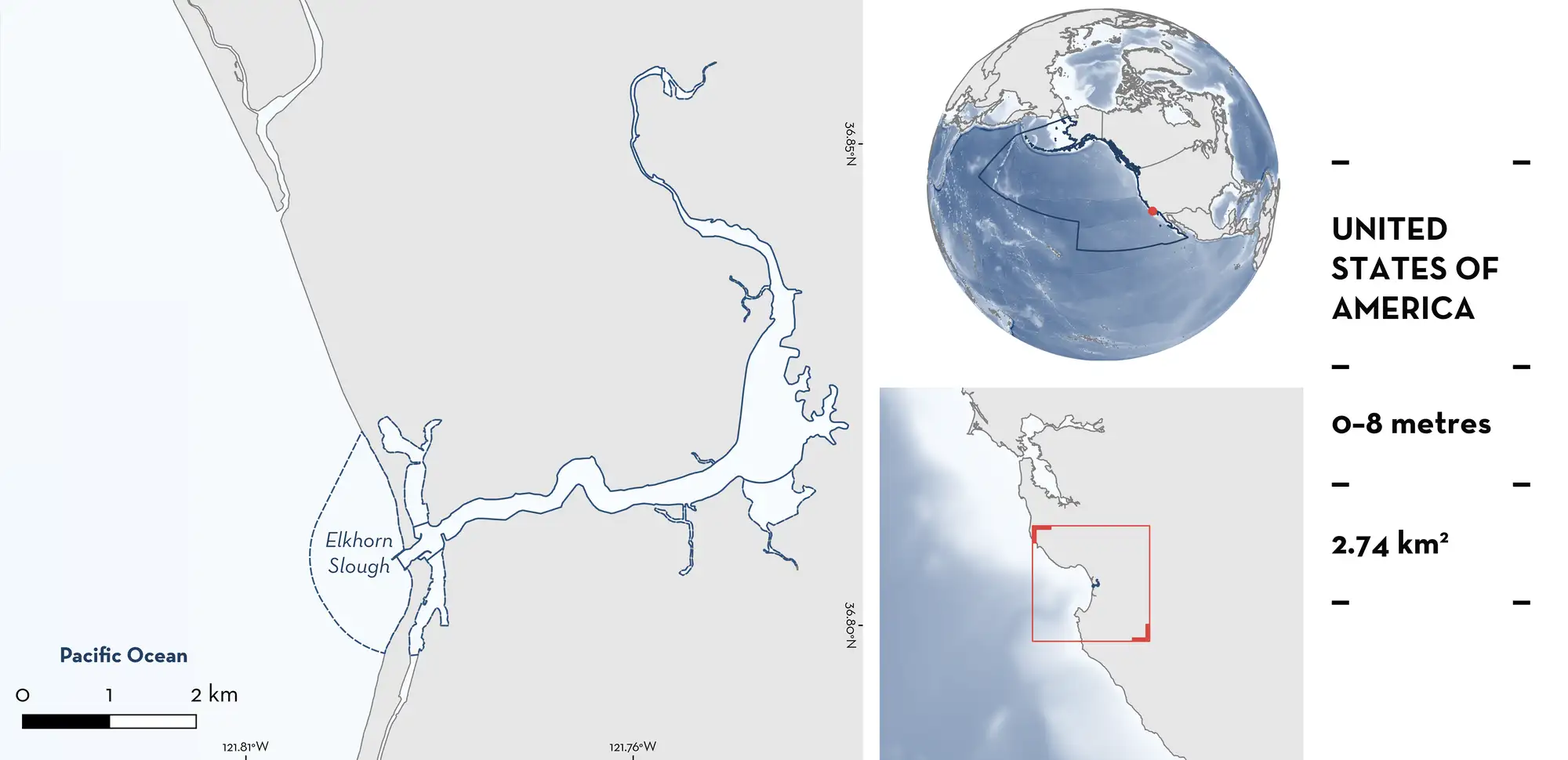
Elkhorn Slough
Summary
Elkhorn Slough is located in California, United States of America. It is a shallow estuary that drains into Monterey Bay near the head of the Monterey Submarine Canyon. The habitats in the area include flat and sloped sandy sediments, flat and sloped muddy sediments, and eelgrass on flat sandy substrates. Significant freshwater input occurs primarily during the boreal winter months, originating from rainfall and agricultural runoff within its small drainage basin. Within this area there are: reproductive areas (e.g., Thornback Ray Platyrhinoidis triseriata).
Download factsheet
Elkhorn Slough
DESCRIPTION OF HABITAT
Elkhorn Slough is located in California, United States of America. It is a shallow estuary that drains into Monterey Bay near the head of the Monterey Submarine Canyon. The habitats include flat and sloped sandy sediments, flat and sloped muddy sediments, and eelgrass on flat sandy substrates (Walton et al. 2016). Significant freshwater input occurs primarily during the boreal winter months, originating from rainfall and agricultural runoff within its small drainage basin. Several tributaries, including Bennett Slough and Azevedo Ponds, feed directly into the area (Broenkow & Breaker 2019).
Tides in Monterey Bay are predominantly semidiurnal. Temperature and salinity in the lower Elkhorn Slough reflect the influence of Monterey Bay waters, with temperatures ranging from 9–16°C and salinity between 33–34 ppt. In contrast, the upper slough is more strongly influenced by local processes. During summer, salinity increases due to evaporation, while in winter it decreases, often falling below 10 ppt as a result of precipitation and runoff. This low-salinity water mass forms in the upper slough, ~5–10 km from the mouth (Broenkow & Breaker 2019). Maximum tidal currents in Elkhorn Slough reach ~150 cm/s (Broenkow & Breaker 2019).
This Important Shark and Ray Area is benthic and pelagic and is delineated from inshore and surface waters (0 m) to 8 m based on the bathymetry of the area.
CRITERION C
SUB-CRITERION C1 – REPRODUCTIVE AREAS
Elkhorn Slough is an important reproductive area for one shark and two ray species.
Pregnant Leopard Sharks, neonate and young-of-the-year (YOY) Bat Rays, and pregnant Thornback Rays regularly use this area based on scientific surveys undertaken between 2013–2016 and historical shark fishing tournaments (only for Leopard Sharks).
Between March 2013–July 2014, Leopard Sharks, Thornback Rays, and Bat Rays were captured in a small portion of the area for maternal offloading of mercury studies (van Hees 2014). A 91.4 m gillnet with 12.7 cm and 17.8 cm mesh panels was set for 20-minute intervals and checked frequently to minimise stress on captured individuals. Gillnets for Leopard Sharks and Bat Rays were set at peak high tide and continued as the tide ebbed, when individuals were funnelled into the main channel (~2–3 hours). Gillnets for Thornback Rays were set during the rising tide, shortly before high tide (~1 hour) (van Hees 2014).
Between March 2015–August 2016, a study to characterise shark and ray species composition was conducted using longlines and gillnets (Pien 2018). Gillnets were selected based on their demonstrated catch efficiency in previous shark and ray studies conducted in the system (Pien 2018). Longlines were included to target individuals not effectively sampled by gillnet mesh sizes. Sampling was conducted every two weeks, with four sampling days per cycle, covering the lower, mid, and upper slough. All sampling occurred during high tide. Two longlines were deployed approximately one hour before high tide and soaked for 3.5 hours. During this period, one gillnet was set for 20 minutes per deployment, with 2–5 sets per day depending on handling time. A total of 971 shark and rays were captured in 486 gillnet sets (200 hours) and 256 longline sets (934 hours). Gillnets primarily captured Leopard Sharks and Bat Rays, while longlines predominantly captured Bat Rays and Thornback Rays (Pien 2018).
Between March 2013–July 2014, 10 male and 16 female Leopard Sharks were collected (van Hees 2014). Males ranged from 109–136 cm total length (TL) and were all mature, as indicated by calcified claspers. Females ranged from 115–145 cm TL, with 10 pregnant individuals (62.5%) carrying embryos at various developmental stages. Of the remaining six females, the two smallest (115 cm TL) were juveniles, while three were entering their first reproductive cycle (van Hees 2014). Between March 2015–August 2016, Leopard Sharks were primarily captured in gillnets (272 individuals) of which 144 were females, and 128 males, ranging 66–146 cm TL (average = 119 cm TL). On longlines, 16 Leopard Sharks were captured (10 females, 6 males), ranging 59–132 cm TL (average = 93 cm TL). Of the total, 54.0% of females and 81.8% of males were classified as mature. Leopard Sharks were present throughout the wet season but showed reduced abundance between November and February (Pien 2018). Historical information supports the regular use of the area by pregnant females. Based on three shark tournaments in 1969 and 1970, 378 female Leopard Sharks were captured in this area, of which 169 (44.7%) had embryos or eggs in at least one ovisac (131 carried embryos) (Ackerman 1971). The gestation period for Leopard Sharks is ~10–12 months with pupping occurring in spring, suggesting that the higher abundance is during later stages of gestation (Ebert et al. 2013).
Between March 2013–July 2014, a total of 10 male and 11 female Bat Rays were collected ranging from 29–96 cm disc width (DW), of which nine (42.9%) were <51 cm DW (van Hees 2014). The two largest females (95 and 96 cm DW) were not fully mature, as their ovaries lacked eggs greater than 10 mm in diameter (van Hees 2014). Males mature at 62–66 cm DW, females 88–100 cm DW, and they are born at 20–31 cm DW (Last et al. 2016). Between March 2015–August 2016, 117 Bat Rays were captured in gillnets (61 females, 51 males), ranging from 30–114 cm DW (mean = 53 cm DW). Of the Bat Rays captured in gillnets, 43 individuals (37.1%) were classified as neonates or YOY (<41 cm DW) (Pien 2018). On longlines, 402 Bat Rays were captured (246 females, 156 males), ranging from 31–124 cm DW (mean = 54 cm DW) and ~56 individuals (13.9%) were <41 cm DW. Of the individuals captured on longline, only 5.3% of females and 16.2% of males were mature. Combining gillnets and longlines, the total number of Bat Rays ranging 30–36 cm DW was 39 individuals. Bat Rays were present throughout most of the year, but mature individuals were absent during autumn and winter 2015, completely absent in December, and reappeared in early spring (February–March 2016). No pregnant females were captured in both survey periods. They were distributed throughout the system, with higher abundance in the mid-slough and during the dry season. This seasonal pattern is consistent with reproductive migrations observed in other shark and ray species, which occupy deeper waters outside the reproductive period and move inshore for parturition and mating (Pien 2018).
Between March 2013–July 2014, two male and 11 female Thornback Rays were collected (van Hees 2014). Both males were mature, measuring 51.0 and 53.3 cm TL. Females ranged from 59–71 cm TL, and all were mature and pregnant, carrying embryos at different developmental stages (van Hees 2014). Between March 2015–August 2016, 143 Thornback Rays were captured on longlines (129 females, 14 males), ranging 48–75 cm TL (mean = 64 cm TL) and 22–39 cm DW (average = 33 cm DW). Eight Thornback Rays were captured in gillnets (5 females, 3 males), ranging 47–70 cm TL (average = 58 cm TL) and 21–35 cm DW (average = 30 cm DW) (Pien 2018). All individuals were classified as mature based on external characteristics and internal examination of a subset. Abundance declined sharply after June 2015, with near absence by October and reappearance in April 2016. Clear sexual segregation was observed in the area: males were restricted to lower and lower-mid slough areas, while females were distributed across the mid and upper slough. Females comprised 92% of longline captures, and all individuals captured in upper areas were female. Of 16 dissected females, 13 were pregnant at multiple developmental stages. Early-season individuals (May–June) contained early-stage embryos, while late-season individuals (August–September) contained well-developed embryos. Use of warmer habitats early in gestation may function to accelerate embryonic development or increase offspring size, as documented in other ray species (Jirik & Lowe 2012; Lyons & Lowe 2013). Despite the presence of late-stage embryos, no neonates were recorded (Pien 2018). Gestation is estimated at 10–12 months, with parturition occurring in summer (Ebert 2003). Mating activity of Thornback Rays was also observed in the area (Pien 2018). Two events were recorded, one in September 2015 and another in August 2016. In both cases, one to three males were observed biting the pectoral fins of a female captured on longline, consistent with mating behaviour.
Download factsheet
SUBMIT A REQUEST
ISRA SPATIAL LAYER REQUEST
To make a request to download the ISRA Layer in either a GIS compatible Shapefile (.shp) or Google Earth compatible Keyhole Markup Language Zipped file (.kmz) please complete the following form. We will review your request and send the download details to you. We will endeavor to send you the requested files as soon as we can. However, please note that this is not an automated process, and before requests are responded to, they undergo internal review and authorization. As such, requests normally take 5–10 working days to process.
Should you have questions about the data or process, please do not hesitate to contact us.

