ISRA FACTSHEETS
ISRA FACTSHEETS
NORTH AMERICAN PACIFIC
Guadalupe Island
Summary
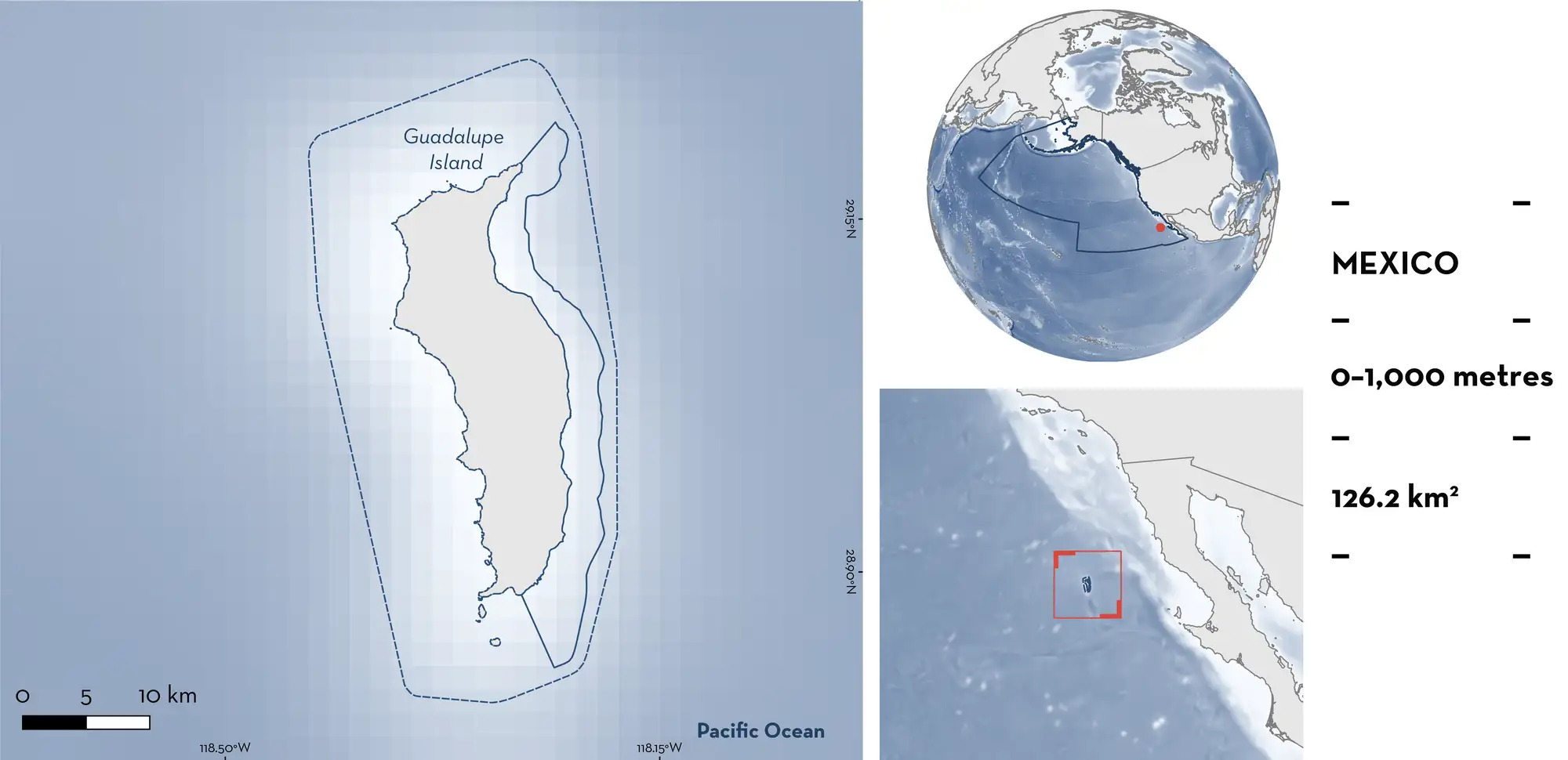
Guadalupe Island is an oceanic island located off northwest Mexico, ~260 km from the mainland. The area is characterised by a narrow insular shelf, steep slope, and rocky reefs with localised upwelling and retention zones that enhance productivity. The area overlaps with the Biosphere Reserve Isla Guadalupe. Within this area there are: threatened species and undefined aggregations (White Shark Carcharodon carcharias).
Download factsheet
Guadalupe Island
DESCRIPTION OF HABITAT
Guadalupe Island is an oceanic island located off northwest Mexico. This volcanic island sits ~260 km from the coast of Baja California. The area is characterised by a narrow insular shelf, steep slope, and rocky reefs (Trasviña et al. 2003).
Oceanographic conditions are shaped by seasonal variability in sea surface temperature, productivity, and current dynamics associated with the California Current system (Durazo & Baumgartner 2002). The interaction between the topography and regional circulation generates localised upwelling and retention zones that enhance productivity (Trasviña et al. 2003). These processes create a spatially and temporally predictable ecological setting that supports large marine predators and associated pelagic communities (Durazo & Baumgartner 2002; Domeier & Nasby-Lucas 2008).
This area overlaps with the Biosphere Reserve Isla Guadalupe (UNEP-WCMC & IUCN 2026).
This Important Shark and Ray Area is pelagic and is delineated from inshore and surface waters (0 m) to 1,000 m based on the bathymetry of the area.
CRITERION A
VULNERABILITY
One Qualifying Species considered threatened with extinction according to the IUCN Red List of Threatened Species regularly occurs in the area. This is the Vulnerable White Shark (Rigby et al. 2022).
CRITERION C
SUB-CRITERION C5 – UNDEFINED AGGREGATIONS
Guadalupe Island is an important area for undefined aggregations of one shark species.
Between 2001–2025, White Shark aggregations were recorded in the area from direct observations, pictures from tourism operators, dataloggers, and acoustic and satellite telemetry (Domeier & Nasby-Lucas 2007, 2008; Domeier 2012; Nasby-Lucas & Domeier 2012; Sosa-Nishizaki et al. 2012; Hoyos-Padilla et al. 2016; Becerril-García et al. 2020a, 2020b; Santana-Morales et al. 2021a, 2021b; Papastamatiou et al. 2022; CONANP unpubl. data 2026). Guadalupe Island has been a known aggregation site for subadult and adult White Sharks since the early 2000s. This regular and predictable presence led to the development of a cage-diving industry that operated from 2002 until 2022, when the activity was prohibited (Domeier & Nasby-Lucas 2008; Santana-Morales et al. 2021a; DOF 2023). Tourism in the area enabled continuous, long-term monitoring of aggregations, as pictures were provided to scientists by tourists, cage-diving operators, and on-board observers (Domeier & Nasby-Lucas 2007; Sosa-Nishizaki et al. 2012; Becerril-García et al. 2020a). After tourism operations stopped, rangers from the protected area, in cooperation with local fishers, continued monitoring White Sharks in the area and have confirmed the ongoing presence of aggregations (CONANP unpubl. data 2026).
Based on photo-identification records, 454 White Sharks have been identified in the area (O Sosa-Nishizaki et al. unpubl. data 2026). The resighting rate is high (~83%; Nasby-Lucas & Domeier 2012), with some sharks recorded across 17–19 different years (O Sosa-Nishizaki et al. unpubl. data 2026). Males have been resighted annually, while adult females are resighted every two years. White Sharks were also monitored with satellite tags (n = 56) between 2002–2012, active acoustic tags (n = 17) between 2006–2019, and passive acoustic tags (>60) between 2008–2025 (Domeier et al. 2012; Hoyos-Padilla et al. 2016; Santana-Morales et al. 2021a; CONANP unpubl. data 2026). All these sources of information revealed that although White Sharks can be present in the area year-round, a peak is observed between September and December. Males arrive at the island in June–July, while females arrive around September and leave around January–March (Domeier & Nasby-Lucas 2007, 2008; Hoyos-Padilla et al. 2016; Santana-Morales et al. 2021a). The presence of White Sharks was believed to be concentrated in the northeast side of the island, in a location called Rada Norte where cage-diving activities operated, but telemetry has revealed that the core area extends across the east side of the island. The resighting of females every two years has been linked to reproductive purposes as it matches the proposed 18-month gestation of the species. Female White Sharks move from Guadalupe Island to offshore aggregation sites around Hawaii (United States of America) and then move to coastal sites in California and Baja California to potentially give birth before coming back to Guadalupe Island (Domeier & Nasby-Lucas 2013). In addition, mating scars have been regularly recorded in the area.
The presence of aggregations and social associations (co-occurrences) were confirmed from dataloggers and acoustic telemetry (Papastamatiou et al. 2022). Associations were defined as co-occurrences in a 10-minute bin. Six White Sharks were fitted with dataloggers (accelerometers and cameras) and an acoustic receiver (detection range up to 30 m) in 2017 and 2018 and provided between 1–4 days of data. In addition, 37 individuals were tagged with acoustic transmitters and were used to identify associations. Ninety-two associations were recorded and lasted on average 7.64 ± 10.55 (standard deviation) minutes, with a maximum of 73 minutes. One of the sharks co-occurred with 19 different individuals. Co-occurrences peaked in the early afternoon and decreased close to midnight and up to five individuals were recorded co-occurring (Papastamatiou et al. 2022).
The presence of White Shark aggregations has also been linked to the seasonal presence of large colonies of Northern Elephant Seals Mirounga angustirostris and Guadalupe Fur Seals Arctocephalus philippii townsendi. Acoustic telemetry has shown regular activity in proximity to these colonies, particularly along steep insular slopes and canyon systems (Hoyos-Padilla et al. 2016; Aquino-Baleytó et al. 2021). Autonomous underwater vehicle (AUV) observations at Guadalupe Island have documented ambush and predatory behaviours at depth >200 m, including deep-diving and oscillatory ‘yo-yo’ movements associated with foraging (Skomal et al. 2015; Kukulya et al. 2016). While the presence of White Sharks in the area matches the breeding season of Northern Elephant Seals, it has not been confirmed that aggregations in the area are related to feeding. Seasonal aggregations of White Sharks in coastal and offshore islands to feed on pinnipeds have been reported globally (e.g., Seal Island in South Africa, Titi Islands and Ruapuke in New Zealand, Neptune Islands in Australia, central California in the United States of America; Jorgensen et al. 2010; Duffy et al. 2012; Fallows et al. 2012; Bruce & Bradford 2015; Francis et al. 2015; Skubel et al. 2018).
Overall, up to 16 White Sharks were photo-identified on a single day during boat surveys and cage-diving operations in this area, and aggregations of up to five White Sharks have been associated with cage-diving activities (N Nasby-Lucas pers. comm. 2026). Although diving operations used bait to attract sharks, animals aggregated in the area even when tourism activities were absent, as indicated by acoustic and satellite telemetry (Domeier 2012; Hoyos-Padilla et al. 2016; Santana-Morales et al. 2021a, 2012b). Additional information is required to understand the nature and function of these aggregations.
Download factsheet
SUBMIT A REQUEST
ISRA SPATIAL LAYER REQUEST
To make a request to download the ISRA Layer in either a GIS compatible Shapefile (.shp) or Google Earth compatible Keyhole Markup Language Zipped file (.kmz) please complete the following form. We will review your request and send the download details to you. We will endeavor to send you the requested files as soon as we can. However, please note that this is not an automated process, and before requests are responded to, they undergo internal review and authorization. As such, requests normally take 5–10 working days to process.
Should you have questions about the data or process, please do not hesitate to contact us.