ISRA FACTSHEETS
ISRA FACTSHEETS
SOUTH AMERICAN ATLANTIC REGION
A dispute exists between the Governments of Argentina and the United Kingdom of Great Britain and Northern Ireland concerning sovereignty over the Falkland Islands (Islas Malvinas), South Georgia and the South Sandwich Islands (Islas Georgias del Sur e Islas Sandwich del Sur) and the surrounding maritime areas.
Falkland Islands Northeastern Slope
Summary
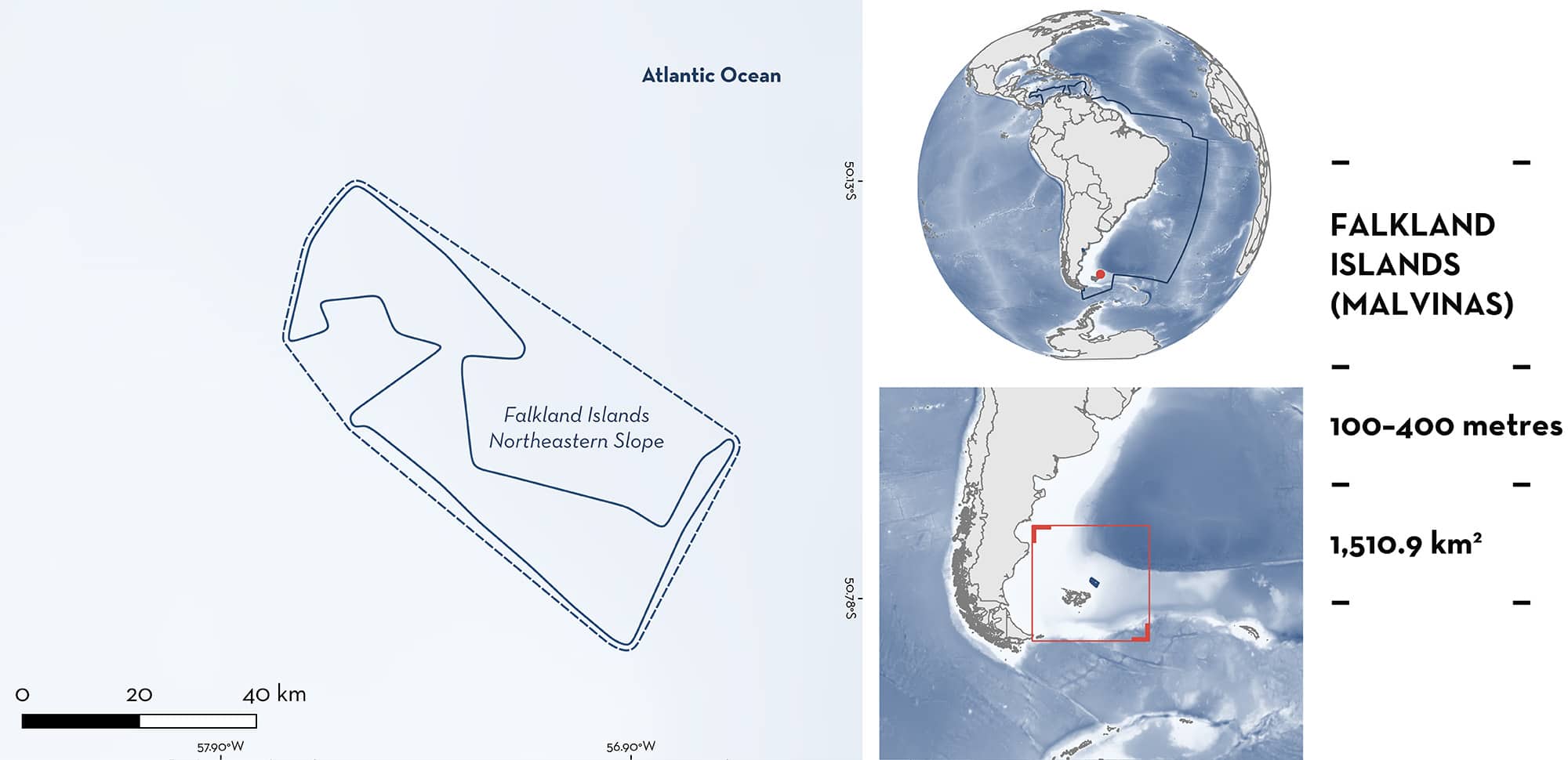
Falkland Islands Northeastern Slope is located along the continental slope east of the Falkland Islands (Malvinas). The area is characterised by sandy and muddy substrates. It is influenced by the transition zone between Patagonian Shelf waters and the surface Sub-Antarctic Water mass of the Falkland-Malvinas Current. Within this area there are: threatened species (e.g., Greytail Skate Bathyraja griseocauda) and range-restricted species (e.g., Southern Thorny Skate Amblyraja doellojuradoi).
Download factsheet
Falkland Islands Northeastern Slope
DESCRIPTION OF HABITAT
Falkland Islands Northeastern Slope is located along the continental slope east of the Falkland Islands (Malvinas). It extends across the northern slope to depths of ~400 m. The area is characterised by sandy and muddy substrates, with a relatively flat terrain in the shallower section (250–350 m) (Arkhipkin et al. 2012). It is influenced by the transition zone between Patagonian Shelf waters and the surface Sub-Antarctic Water mass of the Falkland-Malvinas Current (Arkhipkin et al. 2012). Water temperatures exhibit seasonal variation, ranging from 4.8–5.5°C, with the highest temperatures observed between April–May. Salinity ranges from 34.06–34.11 (Arkhipkin et al. 2012).
This Important Shark and Ray Area is benthic and subsurface and is delineated from 100–400 m based on the bathymetry in the area.
CRITERION A
VULNERABILITY
Two Qualifying Species considered threatened with extinction according to the IUCN Red List of Threatened Species regularly occur in the area. These are the Endangered Greytail Skate (Pollom et al. 2020b) and the Vulnerable White-dotted Skate (Pollom et al. 2020a).
CRITERION B
RANGE RESTRICTED
Falkland Islands Northeastern Slope holds the regular and predictable presence of the Southern Thorny Skate, White-dotted Skate, Broadnose Skate, Greytail Skate, Patagonian Skate, and Cuphead Skate as resident range-restricted species.
Between 2010–2019, biological surveys for skates were conducted during research cruises along the north slope of the Falkland Islands (Malvinas) covering more than ~29,000 km2 in 2010 (October = 12 days, 52 stations sampled), 2013 (November = 17 days, 70 stations sampled), and 2019 (October = 12 days, 48 stations sampled) (Arkhipkin et al. 2010; Pompert et al. 2014; Goyot et al. 2020). Sampling was conducted with a bottom trawl fitted with a 90 mm cod end across several stations (Arkhipkin et al. 2010; Pompert et al. 2014; Goyot et al. 2020). Each trawl was 60 minutes long (seabed time), with an average trawl speed of four knots (Goyot et al. 2020). All shark and ray catches were identified to species level, weighed, measured (disc width [DW]), sexed, and maturity status was determined. Skate biomass estimates were calculated by extrapolating catch density (catch weight per trawl swept area) using a cubic spline algorithm (Arkhipkin et al. 2010; Pompert et al. 2014; Goyot et al. 2020).
Between 2010–2019, Southern Thorny Skate was captured in the area at a higher proportion (n = 672.83 kg, 38% of the total weight catch), compared to the broader region (total weight = 1,731 kg) (J Pompert unpubl. data 2025). Based on Kernel density analysis, the area included hauls with the highest catch weights (max per haul = 86.9 kg) (J Pompert unpubl. data 2025). In 2010, 217 kg was captured (Arkhipkin et al. 2010), with 44.04 kg (20.3%) recorded within the area (J Pompert unpubl. data 2025). In 2013, the total regional catch increased to 517 kg (Pompert et al. 2014), while 157.9 kg (30.5%) was recorded within the area (J Pompert unpubl. data 2025). By 2019, total capture reached 1,033.4 kg (Goyot et al. 2020), with 470.9 kg (45.6%) recorded within the area (J Pompert unpubl. data 2025). In the broader region, captures occurred at depths ranging from 170–640 m, with the highest catches recorded at 345 m in 2010, 287 m in 2013, and 312 m in 2019. Sizes ranged from 7–42 cm DW and neonates, young-of-the-year, and females carrying eggs were captured within the area. Despite these life-stages occurring in this area, further information is required to understand its reproductive importance (Arkhipkin et al. 2010; Pompert et al. 2014; Goyot et al. 2020). The Southern Thorny Skate is distributed across the Patagonian Shelf and Humboldt Current Large Marine Ecosystems (LMEs).
Between 2010–2019, White-dotted Skate was captured in the area at a higher proportion (n = 1,403.7 kg, 21.9% of the total weight catch), compared to the broader region (total weight = 6,419.0 kg) (J Pompert unpubl. data 2025). Based on Kernel density analysis, the area included hauls with the highest catch weights (max per haul = 245 kg) (J Pompert unpubl. data 2025). In 2010, 1,311 kg was captured (Arkhipkin et al. 2010), with 253.4 kg (19.3%) recorded within the area (J Pompert unpubl. data 2025). In 2013, the total regional catch increased to 3,370 kg (Pompert et al. 2014), while 523.0 kg (15.5%) was recorded within the area (J Pompert unpubl. data 2025). In 2019, total capture reached 2,897.4 kg (Goyot et al. 2020), with 645.3 kg (22.3%) recorded within the area (J Pompert unpubl. data 2025). In the broader region, captures occurred at depths ranging from 136–640 m, with the highest catches recorded between 262–325 m. Sizes ranged from 8–59 cm DW (Arkhipkin et al. 2010; Pompert et al. 2014; Goyot et al. 2020). The White-dotted Skate is distributed across the Patagonian Shelf and Humboldt Current LMEs.
Between 2010–2019, Broadnose Skate was captured in the area at a higher proportion (n = 3,688.2 kg, 43% of the total weight catch), compared to the broader region (total weight = 8,573.7 kg) (J Pompert unpubl. data 2025). Based on Kernel density analysis, the area included hauls with the highest catch weights (max per haul = 998.5 kg) (J Pompert unpubl. data 2025). In 2010, 2,441.3 kg was captured (Arkhipkin et al. 2010), with 454.6 kg (18.6%) recorded within the area (J Pompert unpubl. data 2025). In 2013, the total regional catch increased to 7,540 kg (Pompert et al. 2014), while 2,677.8 kg (35.5%) was recorded within the area (J Pompert unpubl. data 2025). In 2019, total capture was 2,342.8 kg (Goyot et al. 2020), with 555.8 kg (23.7%) recorded within the area (J Pompert unpubl. data 2025). In the broader region, captures occurred at depths ranging from 127–541 m, with the highest catches recorded between 237–303 m. Sizes ranged from 8–77 cm DW (Arkhipkin et al. 2010; Pompert et al. 2014; Goyot et al. 2020). The Broadnose Skate is distributed across the Patagonian Shelf and Humboldt Current LMEs.
Between 2010–2019, Greytail Skate was captured in the area at a higher proportion (n = 1,903.2 kg, 19.55% of the total weight catch), compared to the broader region (total weight = 9,733.9 kg) (J Pompert unpubl. data 2025). Based on Kernel density analysis, the area included hauls with the highest catch weights (max per haul = 375.5 kg) (J Pompert unpubl. data 2025). In 2010, a total of 2,378 kg was captured in the region (Arkhipkin et al. 2010), with 377.1 kg (15.9%) recorded within the area (J Pompert unpubl. data 2025). In 2013, the total regional catch was 2,622 kg (Pompert et al. 2014), while 371.4 kg (14.2%) was recorded within the area (J Pompert unpubl. data 2025). In 2019, total capture increased to 4,987.5 kg (Goyot et al. 2020), with 1,154.7 kg (23.1%) recorded within the area (J Pompert unpubl. data 2025). In the broader region, captures occurred at depths ranging from 142–640 m, with the highest catches recorded between 240–434 m. Sizes ranged from 10–109 cm DW (Arkhipkin et al. 2010; Pompert et al. 2014; Goyot et al. 2020). The Greytail Skate occurs in the Patagonian Shelf and Humboldt Current LMEs.
Between 2010–2019, Patagonian Skate was captured in the area at a higher proportion (n = 716.2 kg, 40.1% of the total weight catch), compared to the broader region (total weight = 1,786.0 kg) (J Pompert unpubl. data 2025). Based on Kernel density analysis, the area included hauls with the highest catch weights (max per haul = 245 kg) (J Pompert unpubl. data 2025). In 2010, a total of 210 kg was captured in the region (Arkhipkin et al. 2010), with 21.1 kg (10.0%) recorded within the area (J Pompert unpubl. data 2025). In 2013, the total regional catch increased to 978 kg (Pompert et al. 2014), while 365.6 kg (37.4%) was recorded within the area (J Pompert unpubl. data 2025). In 2019, total capture was 881.3 kg (Goyot et al. 2020), with 329.5 kg (37.4%) recorded within the area (J Pompert unpubl. data 2025). In the broader region, captures occurred at depths ranging from 103–463 m, with the highest catches recorded between 277–420 m (Arkhipkin et al. 2010; Pompert et al. 2014; Goyot et al. 2020). Sizes ranged from 7–42 cm DW (Arkhipkin et al. 2010; Pompert et al. 2014; Goyot et al. 2020). The Patagonian Skate occurs in the Patagonian Shelf and Humboldt Current LMEs.
Between 2010–2019, Cuphead Skate was captured in the area at a higher proportion (n = 515.9 kg, 32.4% of the total weight catch), compared to the broader region (total weight = 1,592.8 kg) (J Pompert unpubl. data 2025). Based on Kernel density analysis, the area included hauls with the highest catch weights (max per haul = 67.7 kg) (J Pompert unpubl. data 2025). In 2010, a total of 405 kg was captured in the region (Arkhipkin et al. 2010), with 69.4 kg (17.1%) recorded within the area (J Pompert unpubl. data 2025). In 2013, the total regional catch increased to 1,449 kg (Pompert et al. 2014), while 237.9 kg (16.4%) was recorded within the area (J Pompert unpubl. data 2025). In 2019, total capture was 679.6 kg (Goyot et al. 2020), with 208.5 kg (30.7%) recorded within the area (J Pompert unpubl. data 2025). In the broader region, captures occurred at depths ranging from 103–463 m, with the highest catches recorded between 114–640 m (Arkhipkin et al. 2010; Pompert et al. 2014; Goyot et al. 2020). Sizes ranged from 11–60 cm DW (Arkhipkin et al. 2010; Pompert et al. 2014; Goyot et al. 2020). The Cuphead Skate is restricted to the Patagonian Shelf LME.
Download factsheet
SUBMIT A REQUEST
ISRA SPATIAL LAYER REQUEST
To make a request to download the ISRA Layer in either a GIS compatible Shapefile (.shp) or Google Earth compatible Keyhole Markup Language Zipped file (.kmz) please complete the following form. We will review your request and send the download details to you. We will endeavor to send you the requested files as soon as we can. However, please note that this is not an automated process, and before requests are responded to, they undergo internal review and authorization. As such, requests normally take 5–10 working days to process.
Should you have questions about the data or process, please do not hesitate to contact us.