ISRA FACTSHEETS
true
ISRA FACTSHEETS
MEDITERRANEAN AND BLACK SEAS REGION
Gulf of Antalya
Summary
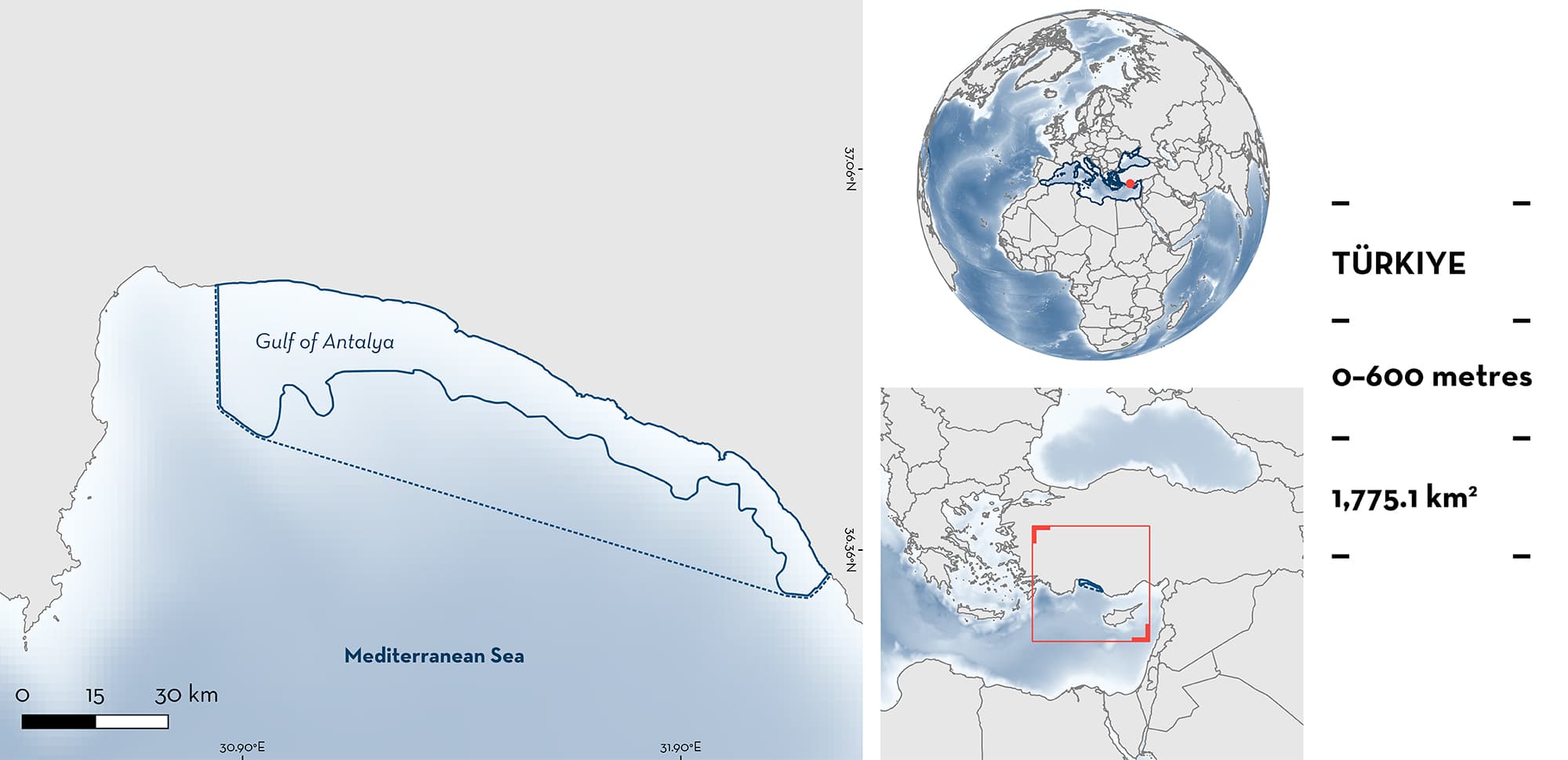
Gulf of Antalya is located on the southern coast of Türkiye in the Levantine Sea. This area is characterised by muddy and sandy substrates with patches of rock and seagrass meadows. Three rivers flow into the area which is dominated by high temperatures, high salinities, and oligotrophic conditions. The area overlaps with an Ecologically or Biologically Significant Marine Area (North-East Levantine Sea) and with three Key Biodiversity Areas. Within the area there are: threatened species (e.g., Velvet Belly Lanternshark Etmopterus spinax); range-restricted species (Rough Skate Raja radula); and reproductive areas (e.g., Blackmouth Catshark Galeus melastomus).
Download factsheet
Gulf of Antalya
DESCRIPTION OF HABITAT
Gulf of Antalya is located on the southern coast of Türkiye in the Levantine Sea (Kabasakal & Bayrı 2019). This area is characterised by muddy and sandy substrates with patches of rock and seagrass meadows (Mutlu et al. 2022a). Three main rivers flow into the area which is dominated by high temperatures, high salinities, and oligotrophic conditions (Kebapçioglu et al. 2010; Özbek et al. 2016).
The area overlaps with an Ecologically or Biologically Significant Marine Area (EBSA), the North-East Levantine Sea (CBD 2023). In addition, it overlaps with three Key Biodiversity Areas: Gazipaşa – Anamur Coast, Kızılot, and Antalya Plains (KBA 2023a, 2023b, 2023c).
This Important Shark and Ray Area is delineated from surface waters (0 m) to a depth of 600 m based on the distribution of the Qualifying Species within the area.
CRITERION A
VULNERABILITY
Two Qualifying Species considered threatened with extinction according to the IUCN Red List of Threatened SpeciesTM regularly occur in the area. These are the Vulnerable Velvet Belly Lanternshark (Finucci et al. 2021) and the Endangered Rough Skate (Mancusi et al. 2016).
CRITERION B
RANGE RESTRICTED
Gulf of Antalya holds the regular presence of one ray species as a range-restricted species. Rough Skate is restricted to the Mediterranean Sea Large Marine Ecosystem and was regularly reported in the catch of trawl nets in the area between 2009–2015. This species had abundances of ∼84 individuals/km2 and was caught year-round mostly at depths <75 m (Kebapcioglu 2021; Mutlu et al. 2022a).
CRITERION C
SUB-CRITERION C1 – REPRODUCTIVE AREAS
Gulf of Antalya is an important reproductive area for two shark species.
Based on data collected from benthic trawlers, 995 Velvet Belly Lanternshark were caught in the area between 2016–2019 (Olguner 2021). Of these individuals, ∼235 were classified as neonates, as they measured the reported size-at-birth for the species (12–14 cm total length [TL]) (Ebert et al. 2021). Sharks were caught from the boreal autumn to spring, with a greater abundance in September, October, and January between 400–600 m depth in the eastern part of the gulf (Olguner 2021). In addition, based on band counts in vertebrae from 235 individuals, four were estimated to be young-of-the-year and 65 as one-year old. This highlights the importance of this area for early lifecycle stages. Mature females (including pregnant individuals) were found in spring and autumn when the majority of neonates were found (Olguner 2021).
Between 2016–2019, 1,821 Blackmouth Catsharks were recorded in benthic trawlers (Olguner 2021). The size-at-birth for this species is unknown, but some individuals (∼60) measured 10–17 cm TL which is similar to the size-at-birth for congeners (Broadfin Sawtail Catshark Galeus nipponensis, 13 cm TL; Mouse Catshark G. murinus, 8–9 cm TL; Gecko Catshark G. eastmani, <17 cm TL; Atlantic Sawtail Catshark G. atlanticus, 15 cm TL; Ebert et al. 2021). These smaller individuals were caught mostly during September, October, February, and March at depths between 300–600 m and in the eastern part of the gulf. In addition, most mature females, including pregnant individuals, were found during autumn. Based on band counts in vertebrae from 208 individuals, two were estimated to be young-of-the-year, and 53 as one-year old (Olguner 2021). Between 2010–2011, individuals measuring ∼13 cm TL were also caught in the area at ∼300 m depth (Mutlu et al. 2022b), confirming the regular presence of these smaller sharks.
Download factsheet
SUBMIT A REQUEST
ISRA SPATIAL LAYER REQUEST
To make a request to download the ISRA Layer in either a GIS compatible Shapefile (.shp) or Google Earth compatible Keyhole Markup Language Zipped file (.kmz) please complete the following form. We will review your request and send the download details to you. We will endeavor to send you the requested files as soon as we can. However, please note that this is not an automated process, and before requests are responded to, they undergo internal review and authorization. As such, requests normally take 5–10 working days to process.
Should you have questions about the data or process, please do not hesitate to contact us.