ISRA FACTSHEETS
ISRA FACTSHEETS
NORTH AMERICAN PACIFIC
Haida – Ts’íidaa Seamount
Summary
Haida – Ts’íidaa Seamount is located off British Columbia, Canada. The area is situated in the Tuzo Wilson Seamount Complex. It is characterised by a dense bamboo coral garden and composed of exposed volcanic, lava-formed basalt substrate (e.g., large structures of pillow and columnar basalt, steep talus slope). Within this area there are: reproductive areas (e.g., Pacific White Skate Bathyraja spinosissima).
Download factsheet
Haida – Ts’íidaa Seamount
DESCRIPTION OF HABITAT
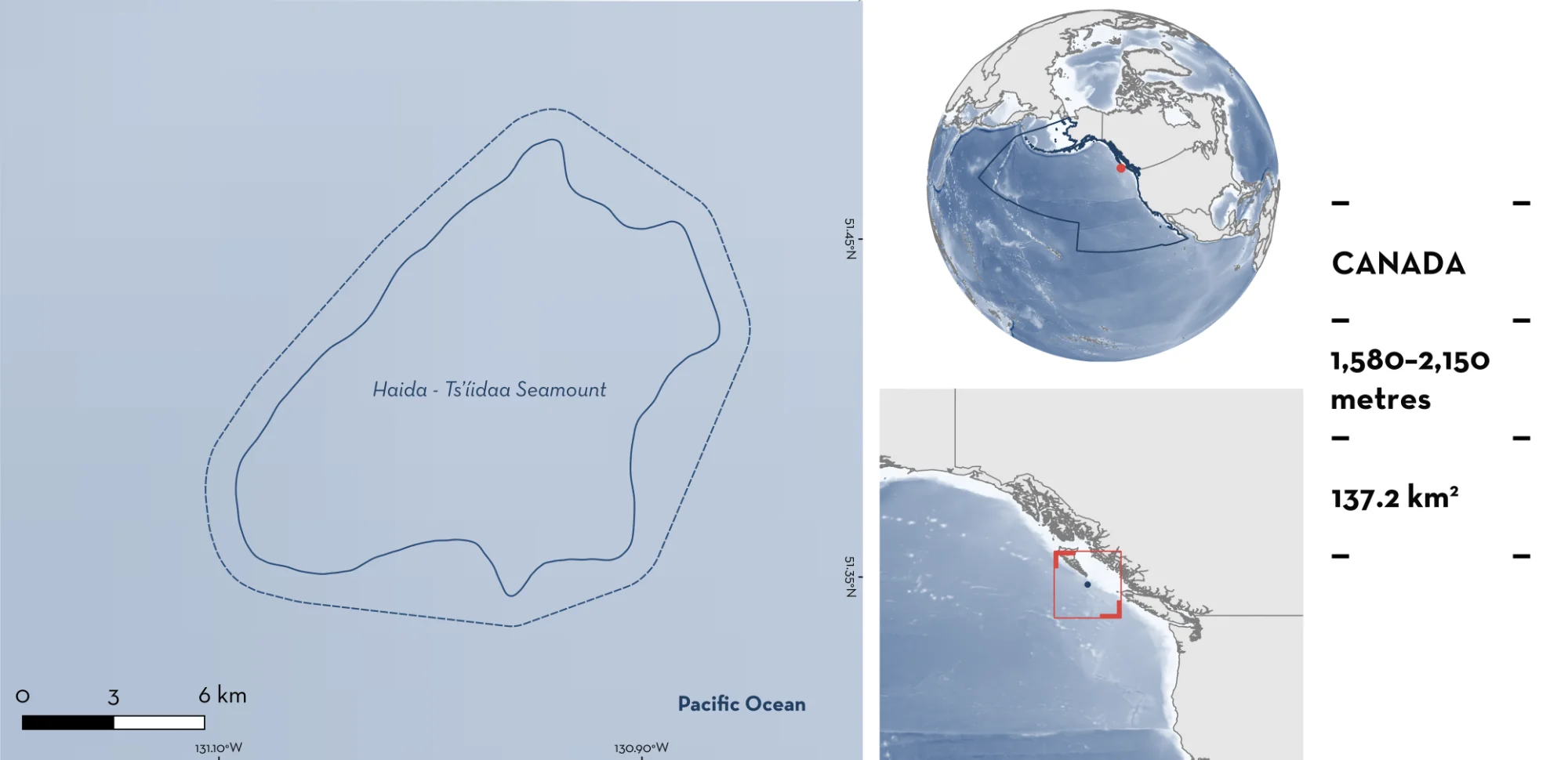
Haida – Ts’íidaa Seamount is located off British Columbia, Canada. It is the southwest seamount of the Tuzo Wilson Seamount Complex which is formed by a second seamount (57) and some small volcanic submarine features. The area is situated at a rare tectonic triple junction between the Pacific, North America, and Explorer plates. It is composed of exposed volcanic, lava-formed basalt substrate (e.g., large structures of pillow and columnar basalt, steep talus slope) (Gartner et al. 2025). It is characterised by an extensive coral garden that provides three-dimensional structural habitat dominated by large colonies of bamboo corals from the family Keratoisididae and by precious coral Hemicorallium sp. (Gartner et al. 2025).
Although more research is needed to explore the extent of the hydrothermal systems in this region, hydrothermal venting is persistent over at least a year with bacterial mats around orifices extruding ‘shimmering’ waters 1–2°C above ambient temperatures. Yellow staining has been observed on the substrate, which is often associated with metals precipitated by hydrothermal venting (Gartner et al. 2025). Due to its location, this area is also influenced by upwelling and downwelling of the continental slope (Gartner et al. 2025).
This Important Shark and Ray Area is benthic, subsurface, and is delineated from 1,580–2,150 m based on the bathymetry of the area.
CRITERION C
SUB-CRITERION C1 – REPRODUCTIVE AREAS
Haida – Ts’íidaa Seamount is an important reproductive area for two ray species.
Between 2021 and 2024, three expeditions were conducted in this area (Gartner et al. 2025). During these expeditions, submersible technology was used to gather imagery and environmental data of the benthic environment, and oceanographic tools were used to sample the surrounding pelagic waters. In June 2021, one dive of 6.04 hours with a tow camera system was conducted; in July 2023, two dives with remotely operated vehicles (ROV) totalling 16.94 hours were conducted; and in August 2023, three ROV dives of 21.91 hours total were conducted (Gartner et al. 2025).
Whole frame annotations from video collected by the submersible dives were made to document the presence/absence of skate egg cases. In total, 5,566 egg cases were counted from 489 non-overlapping images, covering ~4,909 m2 of the seafloor based on laser scale measurement. The average density of egg cases >1,665 m depth was 2.58 egg cases/m2. Using the best available bathymetry, an estimated 824,315 m2 (or ~0.8 km2) of the seamount is >1,665 m depth. Therefore, there is an estimated >2.1 million egg cases on the top 77 vertical metres of the seamount. Areas of high egg case concentrations often have clumps or piles of egg cases, or egg cases are settled in crevices between rocks, indicating that these estimates are lower than what is present. The highest number of egg cases counted in a single image was 105 and the highest density observed in an image was 23 egg cases/m2. Over 60% of the egg cases were unable to be confidently identified in situ due to the lack of visible identifying features. Identifiable egg cases were determined to be Arctic Skate (n = 1,125; 20%) and Pacific White Skate (n = 893; 16%). In total, five egg cases of Arctic Skate and 40 egg cases of Pacific White Skate were collected for taxonomy and future genetic surveys (Gartner et al. 2025).
During the three expeditions (2021, 2023, and 2024), 15 adult Pacific White Skates and 17 adult Arctic Skates were also observed (predominantly females). Two female Pacific White Skate were observed in the process of laying an egg case, as a brightly coloured yellow egg case was observed protruding from their cloacas. She demonstrated a pattern of swimming up into the water column, returning to the seafloor (often brushing along corals, rugose rocky habitat, and/or venting areas), often lifting off again after making contact with the substrate, bowing, often turning, and lifting her tail before beginning an ascent (Gartner et al. 2025).
Download factsheet
SUBMIT A REQUEST
ISRA SPATIAL LAYER REQUEST
To make a request to download the ISRA Layer in either a GIS compatible Shapefile (.shp) or Google Earth compatible Keyhole Markup Language Zipped file (.kmz) please complete the following form. We will review your request and send the download details to you. We will endeavor to send you the requested files as soon as we can. However, please note that this is not an automated process, and before requests are responded to, they undergo internal review and authorization. As such, requests normally take 5–10 working days to process.
Should you have questions about the data or process, please do not hesitate to contact us.