ISRA FACTSHEETS
ISRA FACTSHEETS
NORTH AMERICAN PACIFIC
Southern California Bight
Summary
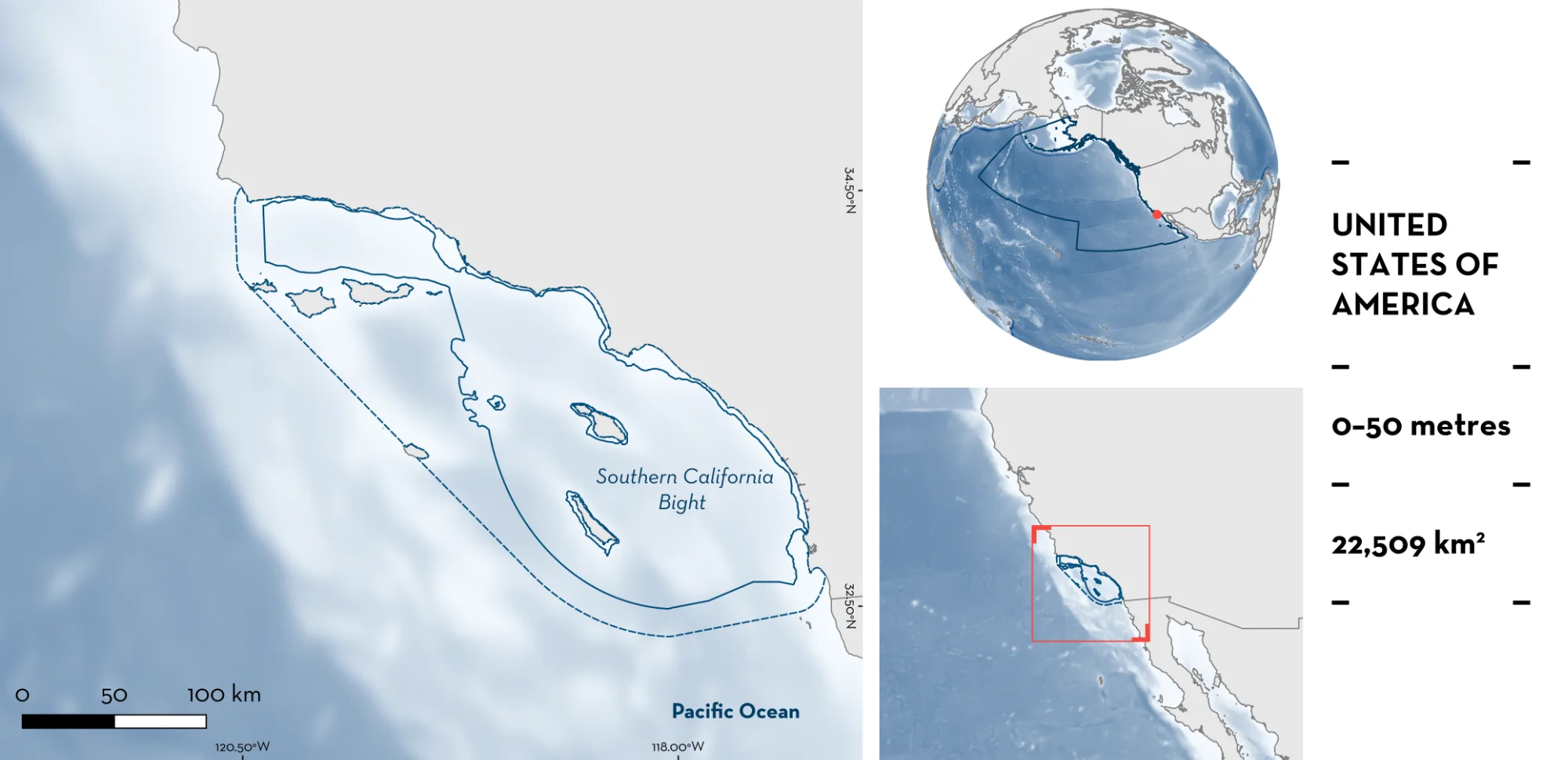
Southern California Bight is located on the coast of southern California, United States of America. It is an open shelf embayment characterised by productive pelagic waters due to an eastern boundary upwelling system. The area overlaps ten protected areas. Within this area there are: threatened species (e.g., Common Thresher Alopias vulpinus); and reproductive areas (e.g., Blue Shark Prionace glauca).
Download factsheet
Southern California Bight
DESCRIPTION OF HABITAT
Southern California Bight is located on the coast of southern California, United States of America (USA). It is an open shelf embayment extending from Point Conception in the north to the border with Mexico in the south. The habitat is characterised by pelagic water with high productivity. The shape of the coastline produces a sheltered area from strong winds present north of Point Conception (Dong et al. 2009).
The area is influenced by the California Current, one of the major eastern boundary upwelling systems. This current carries water equatorward along the North America coast and is characterised by low temperatures, low salinities, and high dissolved oxygen (Lynn & Simpson 1987). In addition, the area is influenced by a nearshore Southern California Countercurrent, characterised by warmer and saltier waters advected from the tropics (Dong et al. 2009). Together, they form the Southern California Eddy. Local surface winds, coastal upwelling during the boreal spring, surface heating, and topography produce high variability in stratification, thermocline depth, and micro-scale cells of water (Di Lorenzo 2003). In addition, the area is exposed to energetic swells during winter and lee energetic swells during summer (Young et al. 2023).
The area overlaps with ten protected areas: Channel Islands National Marine Sanctuary, Santa Barbara Island State Marine Reserve, Matlahuayl State Marine Reserve, Long Point (Catalina Island) State Marine Reserve, Blue Cavern Onshore State Marine Conservation Area, Laguna Beach State Marine Reserve, Point Vicente State Marine Conservation Area, Campus Point State Marine Conservation Area, Footprint (Anacapa Channel) Federal Marine Reserve and Anacapa Island Federal Marine Reserve (UNEP-WCMC & IUCN 2026).
This Important Shark and Ray Area is pelagic and is delineated from inshore and surface waters (0 m) to 50 m based on the bathymetry of the area.
CRITERION A
VULNERABILITY
Two Qualifying Species considered threatened with extinction according to the IUCN Red List of Threatened Species regularly occur in the area. These are the Endangered Shortfin Mako (Rigby et al. 2019) and the Vulnerable Common Thresher (Rigby et al. 2022).
CRITERION C
SUB-CRITERION C1 – REPRODUCTIVE AREAS
Southern California Bight is an important reproductive area for three shark species.
Historically, this area was considered a potential nursery area for Common Thresher, Shortfin Mako, and Blue Shark, based on the regular presence of neonates and young-of-the-year (YOY). Observations of these life-stages have been recorded in commercial and recreational fisheries, fishing surveys, acoustic and satellite telemetry tracking data, and strandings (Cailliet & Bedford 1983; Holts & Bedford 1993; O’Brien & Sunada 1994; Cartamil et al 2010; Lyons et al. 2013; Runcie et al. 2016; Spear 2017; Wells et al. 2017; Nasby-Lucas et al. 2019; Nosal et al. 2019; Steele et al. 2022; LaFreniere et al. 2023).
Between 1976–1982, monitoring of the drift gillnet fishery operating in the area which targeted pelagic sharks was undertaken (Cailliet & Bedford 1983). During this period, vertebrae from 167 Common Threshers were collected, 22 (13.2%) of which measured between 138–185 cm total length (TL) and were considered YOY based on band growth readings (Cailliet & Bedford 1983). Size-at-birth for the species is 120–150 cm TL (Ebert et al. 2021) and growth of 20–30 cm has been reported for the first year of life (Smith et al. 2008). Between 2005–2007, four YOY (119.8–159.0 cm TL) and three juveniles (191.9–205.0 cm TL) were tagged with acoustic transmitters and actively tracked, revealing that YOY spend most of their time inside the area (Cartamil et al. 2010). This was confirmed by catches from the drift gillnet fishery between 1990–2008, where 53% of catches inside this area were of neonate/YOY compared to areas outside (off the shelf) where catches of these life-stages were ~4% of the total catch of the species (Cartamil et al. 2010). Due to the large abundance of YOY and juvenile Common Threshers during the late summer and early autumn in the area, an annual fishing survey (100–hook longlines soaked for 2–3 hours) targeting these life-stages was conducted between 2006–2014 (Spear 2017). During these surveys, 2,488 individuals were recorded, measuring between 83–436 cm TL. Average size was 201 cm TL, indicating that many of the individuals were around the YOY size. In addition, average size was smaller than the size recorded in the commercial gillnet fishery that operates offshore and outside this area (Spear 2017). Of 37 individuals tagged with a chemical marker (OTC) and recaptured, mean size was 188 cm TL (converted from fork length) indicating that the average individual was close to the YOY size (180 cm TL; Spear 2017). These individuals were recaptured inside the area after 192–1,398 days (average = 462 days) showing consistent use across years (Spear 2017).
Between 1994–2015, annual fishing research surveys for Shortfin Mako and Blue Shark were conducted in the area during summer (Runcie et al. 2016; Wells et al. 2017). These surveys were conducted in blocks where high catch-per-unit-effort (CPUE) values for immature individuals of these species had been recorded in commercial fisheries (O’Brien & Sunada 1994) across the whole California Bight, confirming these surveys covered the core abundance area for neonate/YOY and juveniles (Runcie et al. 2016). Surveys consisted of drift longlines (3.7 km long) with 180–210 hooks with leaders ~5 m long and separated 15 m from each other. Longlines were allowed to drift between 3–4 hours and each block was surveyed four times per year. Sharks were measured and most of them were tagged. Nominal CPUE was estimated as number of sharks/100 hooks-hours. In addition, the onboard observer program of the large-mesh drift gillnet fishery operating across the west coast of the USA recorded neonate/YOY for both species between 1990–2017 (Nosal et al. 2019).
During research fishing surveys, 1,726 Shortfin Makos were recorded (Runcie et al. 2016). Of these, ~20% (n = ~345) measured <92 cm total length (TL; converted from fork length). These individuals were considered neonates or YOY as their sizes were close to the reported size-at-birth (60–70 cm TL; Ebert et al. 2021) and YOY size for the region (<100 cm TL; Semba et al. 2009; Wells et al. 2013). In addition, 30% of the individuals recorded were 1-year old sharks (<115 cm TL) according to age-and-growth studies (Wells et al. 2013). A total of 5,441 Shortfin Makos were measured in the observer program across the west coast of USA (Nosal et al. 2019). Of these, 1,559 (28.7%) were classified as YOY based on their size, with 96.2% of YOY (n = 1,500) and 91.7% of 1-year old individuals (n = 1,427) caught inside this area, highlighting its regional importance (south of Point Conception; Nosal et al. 2019). CPUE for YOY was 28.7 times higher inside this area than outside of it. Satellite tagging and catch data revealed that these early life-stages are most commonly observed in spring and early summer (Nosal et al. 2019).
During these same surveys, 2,749 Blue Sharks were recorded. Of these, 45% of females and 38% of males measured <98 cm TL (converted from fork length). These individuals were considered neonates or YOY as their sizes were close to the reported size-at-birth (35–44 cm TL; Ebert et al. 2021) and YOY size for the region (<98 cm TL; Cailliet & Bedford 1983; Blanco-Parra et al. 2008). Further, 43% of females and 42% of males were 1-year old sharks (<128 cm TL) according to age-and-growth studies (Cailliet & Bedford 1983; Blanco-Parra et al. 2008). In addition, 11,787 Blue Sharks were measured in the observer program across the west coast of the USA (Nosal et al. 2019). Of these, 1,192 (10.1%) were classified as YOY based on their size, with 41.2% of YOY (n = 491) and 36.7% of 1-year old individuals (n = 1,209) caught inside this area, highlighting its regional importance (south of Point Conception; Nosal et al. 2019). CPUE for YOY was 2.7 times higher inside this area than outside of it (Nosal et al. 2019).
Fishery closures and commercial fishing reductions in this area since 1990 has resulted in a lack of continuous and standardised data on size frequencies for these three species. However, opportunistic sampling of neonate/YOY (LaFreniere et al. 2023) and anecdotal records from citizen scientists and recreational fishers confirm that early life-stages from these species continue using this area (iNaturalist 2026a, 2026b, 2026c).
Download factsheet
SUBMIT A REQUEST
ISRA SPATIAL LAYER REQUEST
To make a request to download the ISRA Layer in either a GIS compatible Shapefile (.shp) or Google Earth compatible Keyhole Markup Language Zipped file (.kmz) please complete the following form. We will review your request and send the download details to you. We will endeavor to send you the requested files as soon as we can. However, please note that this is not an automated process, and before requests are responded to, they undergo internal review and authorization. As such, requests normally take 5–10 working days to process.
Should you have questions about the data or process, please do not hesitate to contact us.