
ISRA FACTSHEETS
ISRA FACTSHEETS
NORTH AMERICAN PACIFIC
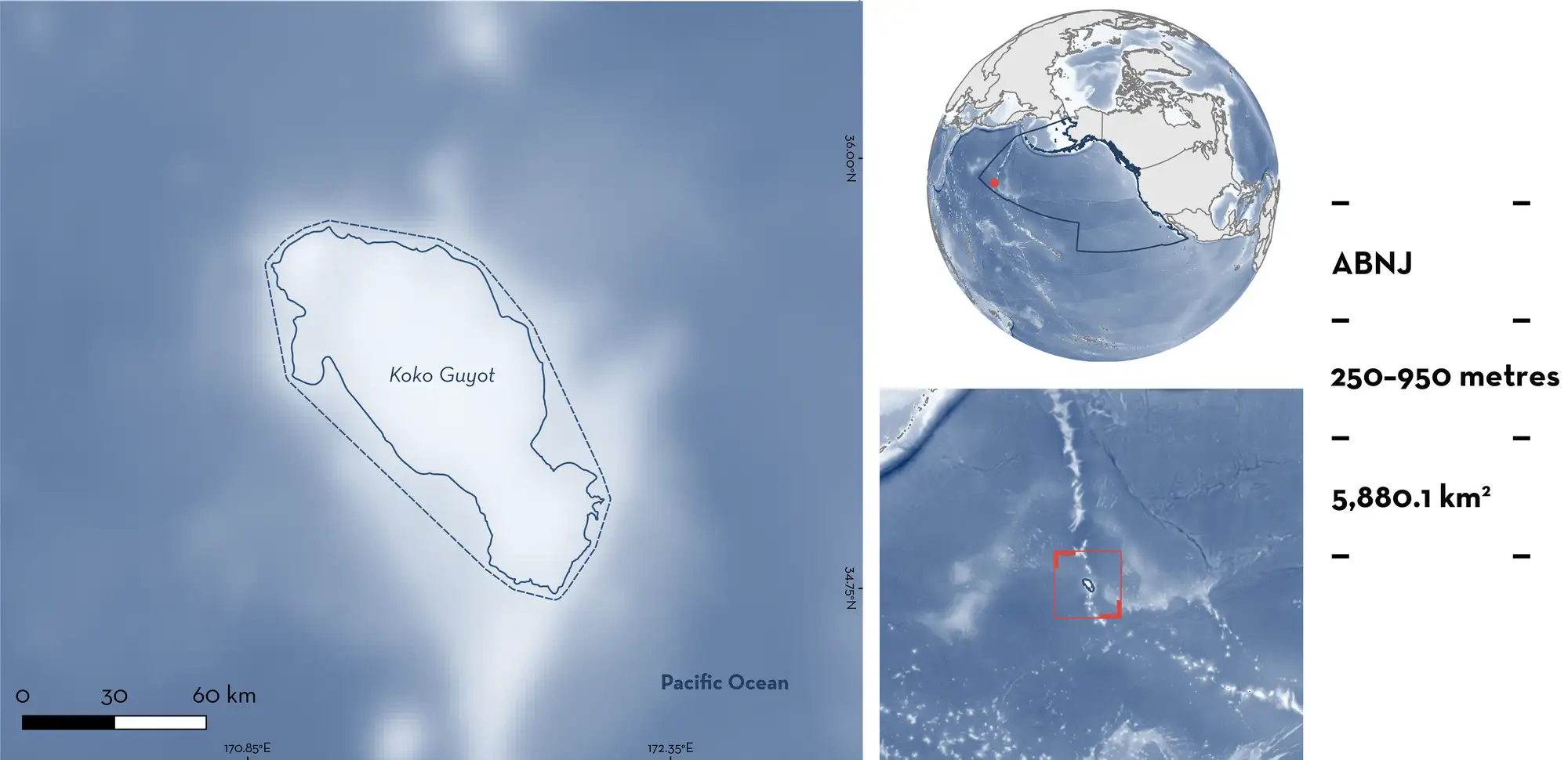
Koko Guyot
Summary
Koko Guyot is located in Areas Beyond National Jurisdiction (ABNJ) in the North Pacific. This ancient underwater volcano is the largest seamount on the Emperor Seamount Chain and rises about 4,700 m from the abyssal plain. The depth at the top of the seamount is ~260 m below the surface. Koko Guyot has a large flat top with gentle slopes which are characterised by abundant small reefs. The area is influenced by the southern boundary of the Subarctic Frontal Zone with an eastward water transport direction in the Kuroshio Extension Current. This area overlaps with two Ecologically or Biologically Significant Marine Areas. Within this area there are: reproductive areas (Laila’s Lanternshark Etmopterus lailae); and undefined aggregations (e.g., Purple Chimaera Hydrolagus purpurescens).
Download factsheet
Koko Guyot
DESCRIPTION OF HABITAT
Koko Guyot is located in Areas Beyond National Jurisdiction (ABNJ) in the North Pacific. This ancient underwater volcano is the largest seamount on the Emperor Seamount Chain. It is situated towards the southern end of the seamount chain and rises about 4,700 m from the abyssal plain (Calgue et al. 1980). The depth at the top of the seamount is ~260 m below the surface (Calgue et al. 1980; Zuenko & Kurnosova 2025). Koko Guyot has a large flat top with gentle slopes which are characterised by abundant small reefs (ODP 2026). It has the highest documented diversity of soft corals (Octocorallia) and the northernmost reef-building stony corals (Scleractinia) on the seamount chain (Dautova 2025).
The area is influenced by the southern boundary of the Subarctic Frontal Zone with an eastward water transport direction in the Kuroshio Extension Current (Zuenko & Kurnosova 2025). The Subarctic Frontal Zone separates cold, fresher, subarctic water to the north from warmer, more saline, subtropical water to the south (Yuan & Talley 1996). Seamounts on the Emperor Seamount Chain have heightened biological productivity relative to surrounding oceanic zones (Zuenko & Kurnosova 2025).
This area overlaps with the Emperor Seamount Chain and Northern Hawaiian Ridge Ecologically or Biologically Significant Marine Area (EBSA) and the North Pacific Transition Zone EBSA (CBD 2026a, 2026b).
This Important Shark and Ray Area is benthic, pelagic, and subsurface and is delineated from 250–950 m based on the depth range of Qualifying Species in the area.
CRITERION C
SUB-CRITERION C1 – REPRODUCTIVE AREAS
Koko Guyot is an important reproductive area for one shark species.
Between 1979–2023, fishing surveys (n = 1,789) were conducted across the Emperor Seamount Chain (Volvenko 2014, 2015; IV Volvenko & AM Orlov unpubl. data 2025). Surveys were conducted in different months across years but in every year except for the periods 1989–1992, 1994–2005, and 2007–2008. Fishing gear consisted of midwater and benthic trawls at depths between 0–1,200 m and 160–1,340 m, respectively. Trawl parameters were variable with haul time ranging <1–12 hours (mean = 1 hour); haul speed ranging 1.5–6.5 knots (mean = 3 knots); and horizontal trawl opening ranging 11–100 m (mean = 28 m). In addition to these trawl surveys, between 2014–2018, catch data from scientific observers on benthic longliners were recorded (215–1,840 m depth; each line was 900 m long with 640 hooks, with 1–12 lines deployed and retrieved per day; IV Volvenko & AM Orlov unpubl. data 2025). Biological data on sharks and rays (length, number of individuals, and sex) were collected between 2009–2018.
Across the broader Emperor Seamount Chain, 7,010 Laila’s Lanternshark were recorded in 188 hauls/sets during these surveys, with 5,781 (82.5%) records originating from contemporary years (2010, 2011, 2013, 2019). Of these, a total of 477 individuals were measured with 132 (27.7%) measuring <28 cm total length (TL). These individuals were classified as neonate/young-of-the-year (YOY) as their sizes are close to the reported size-at-birth for the species (~27 cm TL; Ebert et al. 2021). The largest number of neonate/YOY (n = 70, 53%) across the Emperor Seamount Chain was recorded at Koko Guyot, with individuals caught in all contemporary years during April–June at depths of 258–361 m. The presence of pregnant females in this area is unknown as this condition was not recorded during the surveys.
CRITERION C
SUB-CRITERION C5 – UNDEFINED AGGREGATIONS
Koko Guyot is an important area for undefined aggregations of one shark and one chimaera species.
Between 1979–2023, fishing surveys (n = 1,789) were conducted across the Emperor Seamount Chain with 34.4% occurring inside this area (n = 617; Volvenko 2014, 2015; IV Volvenko & AM Orlov unpubl. data 2025). Surveys were conducted in different months across years but in every year except for the periods 1989–1992, 1994–2005, and 2007–2008. Fishing gear consisted of midwater and benthic trawls at depths between 0–1,200 m and 160–1,340 m, respectively. Trawl parameters were variable with haul time ranging <1–12 hours (mean = 1 hour); haul speed ranging 1.5–6.5 knots (mean = 3 knots); and horizontal trawl opening ranging 11–100 m (mean = 28 m). In addition to these trawl surveys, between 2014–2018, catch data from scientific observers on longliners were recorded (215–1,840 m depth; each line was 900 m long with 640 hooks, with 1–12 lines deployed and retrieved per day; IV Volvenko & AM Orlov unpubl. data 2025). Catch-per-unit-effort (CPUE) was estimated as the number of individuals per area fished during the haul (multiplying the haul time by the haul speed and the horizontal opening of the trawl) and standardised as individuals/km2. For longline sets, CPUE was estimated as the number of individuals caught per 1,000 hooks per 1 hour (ind./1,000 hh).
Deepwater sharks, skates, and chimaeras are known to aggregate with temporal changes related to sex and life-stage segregations (e.g., Yano & Tanaka 1988; Swain & Benoît 2006; Coelho & Erzini 2010; Frisk 2010; Hoff 2010; Finucci et al. 2018). Species can aggregate in high density areas resulting in large catches in specific areas within the broader seascape (e.g., Bizzarro et al. 2014). Elevated CPUE relative to surrounding areas can be used as an indicator of aggregations of deepwater species (Orlov & Volvenko 2022). Specifically for lanternsharks and chimaeras, high densities of individuals have been shown to be indicative of aggregations (Finucci et al. 2018). Through social association analyses, species of Etmopterus and Hydrolagus have been shown to have strong associations between individuals, often between the same life-stage (e.g., juveniles, adults) and sex (Finucci et al. 2018).
Across the broader Emperor Seamount Chain, 69,174 Smooth Lanternsharks were recorded in 800 hauls/sets during these surveys of which 354 hauls/sets (44.2%) were conducted inside this area. Of these records, 67,552 (97.6%) originated from contemporary years (all years between 2010–2019). The second highest CPUE across all the seamount chain (average = 31.5 individuals/km2; max = 2,026.4 individuals/km2) was recorded at Koko Guyot after Kammu Guyot (average CPUE outside the area = 25.4 individuals/km2; max = 873.5 individuals/km2). The presence of aggregations was confirmed when >10 Smooth Lanternsharks were recorded in a single haul/set. Aggregations were recorded in 319 instances (90.1% of the surveys conducted inside this area) with an average of 94 individuals recorded per haul/set and a maximum of 670 individuals. These aggregations were recorded at depths of 462–922 m. The presence of Smooth Lanternshark aggregations may be related to feeding on schools of epipelagic fish migrating from Asia to this area (Volvenko et al. 2025).
Across the broader Emperor Seamount Chain, 333 Owston’s Chimaeras were recorded in 143 hauls/sets during these surveys of which 113 hauls/sets (79.0%) were conducted inside this area. All these records originated from contemporary years (all years between 2011–2018) and 276 individuals were recorded inside this area. The highest CPUE (average = 2.2 individuals/km2; max = 42.1 individuals/km2) across all the seamount chain was recorded in this area (average CPUE outside the area = 0.4 individuals/km2; max = 1.2 individuals/km2). The presence of aggregations was confirmed when >5 Owston’s Chimaeras were recorded in a single haul/set. Aggregations were recorded in 12 surveys (10.7% of surveys) conducted inside this area in contemporary years with an average of three individuals recorded per set and a maximum of 12 individuals. These aggregations were recorded at depths of 258–842 m.
Across the broader Emperor Seamount Chain, 195 Purple Chimaeras were recorded in 77 hauls/sets during these surveys of which 54 hauls/sets (70.1%) were conducted inside this area. Of these records, 188 (96.4%) originated from contemporary years (all years between 2015–2018). The highest CPUE across all the seamount chain (average = 2.6 individuals/km2; max = 45.2 individuals/km2) was recorded in this area (average CPUE outside the area = 0.4 individuals/km2; max = 0.7 individuals/km2). The presence of aggregations was confirmed when >5 Purple Chimaeras were recorded in a single haul/set. Aggregations were recorded in 10 instances (18.5% of the surveys conducted inside this area) with an average of five individuals recorded per set and a maximum of 16 individuals. These aggregations were recorded at depths of 451–823 m.
Additional information is required to understand the nature and function of these aggregations.
Download factsheet
SUBMIT A REQUEST
ISRA SPATIAL LAYER REQUEST
To make a request to download the ISRA Layer in either a GIS compatible Shapefile (.shp) or Google Earth compatible Keyhole Markup Language Zipped file (.kmz) please complete the following form. We will review your request and send the download details to you. We will endeavor to send you the requested files as soon as we can. However, please note that this is not an automated process, and before requests are responded to, they undergo internal review and authorization. As such, requests normally take 5–10 working days to process.
Should you have questions about the data or process, please do not hesitate to contact us.

