ISRA FACTSHEETS
ISRA FACTSHEETS
NORTH AMERICAN PACIFIC
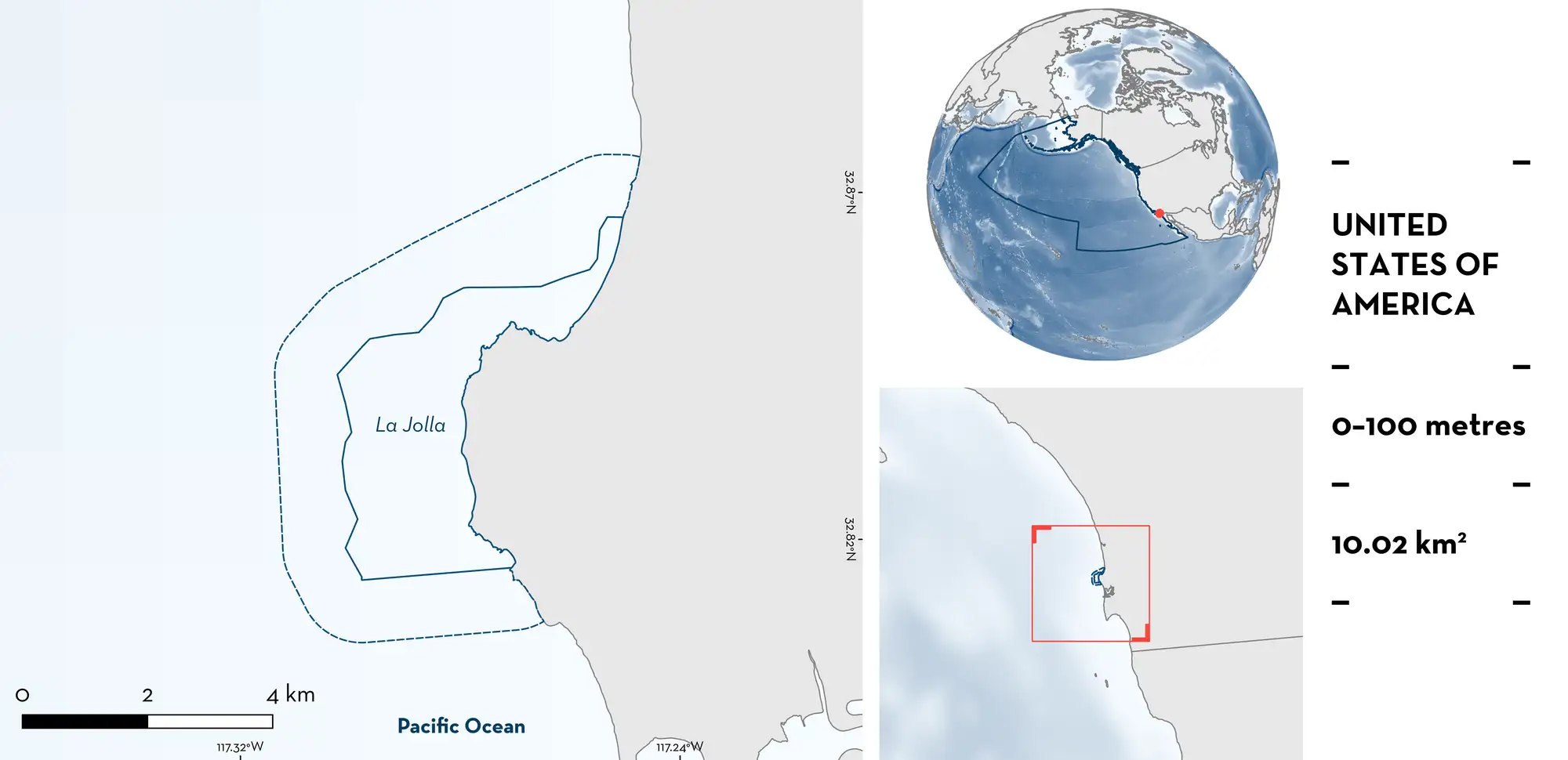
La Jolla
Summary
La Jolla is located in southern California, on the southwest coast of the United States of America. The area is characterised by rocky reefs, kelp forests, sandflats, submarine canyons, and seagrass beds. It overlaps with two marine protected areas. Within this area there are: threatened species (Tope Galeorhinus galeus); range-restricted species (e.g., Shovelnose Guitarfish Pseudobatos productus); reproductive areas (e.g., Leopard Shark Triakis semifasciata); and undefined aggregations (e.g., Bat Ray Myliobatis californicus).
Download factsheet
La Jolla
DESCRIPTION OF HABITAT
La Jolla is located in southern California, on the southwest coast of the United States of America (USA). The area borders the La Jolla Canyon that extends from the shore to the open ocean. The northern portion of the canyon extends southward from the mainland (Smith & Lindholm 2016). The southern part extends south and is composed of rocky substrates along steep walls, loose cobble, and soft substrates (Smith & Lindholm 2016). In the southern part of the area sits one of the major kelp forests on the California coast along sandy substrates and seagrass beds (Blincow et al. 2023; Gong et al. 2023).
The area overlaps with the Matlahuayl State Marine Reserve and the South La Jolla State Marine Reserve (UNEP-WCMC & IUCN 2026).
This Important Shark and Ray Area is benthic and pelagic and is delineated from inshore and surface waters (0 m) to 100 m based on the bathymetry of the area.
CRITERION A
VULNERABILITY
One Qualifying Species considered vulnerable to extinction according to the IUCN Red List of Threatened Species regularly occurs in the area. This is the Critically Endangered Tope (Walker et al. 2020).
CRITERION B
RANGE RESTRICTED
This area holds the regular presence of Leopard Shark, Bat Ray, and Shovelnose Guitarfish as range-restricted species. Based on acoustic telemetry, aerial photography, drone surveys, and hook-and-line fishing surveys conducted between 2007–2011 and 2013–2020, these three species occur year-round and aggregate in the area (Nosal et al. 2013, 2014; Gong et al. 2023). Residency within this area was higher compared to other areas across the California coastline. While aggregations for Leopard Sharks are related to reproductive purposes (Nosal et al. 2013, 2014), the function and nature of Bat Rays and Shovelnose Guitarfish aggregations are unknown (Gong et al. 2023). These three species occur in the California Current Large Marine Ecosystem (LME) and the Gulf of California LME.
CRITERION C
SUB-CRITERION C1 – REPRODUCTIVE AREAS
La Jolla is an important reproductive area for two shark species.
Pregnant Tope regularly occur in the area during the boreal summer as part of their reproductive cycle (Nosal et al. 2021). Between 2013–2017, 34 individuals were surgically implanted with acoustic transmitters and were monitored until the end of 2020 across 337 acoustic receivers deployed along the west coast of the USA (from Washington to California) and down to the Baja California Peninsula in Mexico. Individuals measured between 152–198 cm total length (TL) (mean ± standard deviation = 178 ± 10 cm TL) and all were females, with no males caught or observed. Most, if not all, of these tagged females were sexually mature, based on a size of 158 cm TL for 50% female maturity in southern California (Ripley 1946). For an additional sample of 21 females, pregnancy was confirmed, either by ultrasound (n = 13) or dissection (n = 8) with embryos clearly visible. Tagged individuals were classified as pregnant, as their size was similar to the sizes of confirmed pregnant females and showed distended abdomens. Individuals were detected in southern California during summer and autumn/winter post-tagging with some animals moving south to Mexico (and recaptured there) in the first year after tagging. Most of the Tope (n = 30, 88.2%) were detected along the Central Coast of California during the next two years and 21 individuals (61.8%) returned to La Jolla in Year 3, thus exhibiting triennial philopatry. One individual was detected through two consecutive triennial cycles (Nosal et al. 2021). Pregnant Tope spend multiple months at La Jolla where most of the gestation occurs before moving to pupping areas (Nosal et al 2021).
Between June–November of 2007–2011, 140 Leopard Sharks were caught in the area by hook-and-line (Nosal et al. 2013). Of these, 97.1% were female, measuring between 110–164 cm TL and 2.9% were male between 116–147 cm TL. Pregnancy was confirmed for 17 of these females (12.5%) either by allowing them to give birth naturally in tank facilities or by conducting an ultrasound. Five additional females stranded on the beach were dissected, and all of them were pregnant (Nosal et al. 2013). Aerial photographs of Leopard Shark aggregations were taken in August and September 2010, with up to 120 individuals recorded in a single picture (Nosal et al. 2013), although aggregations may be composed of hundreds of individuals. Most of the individuals (97%) are females (Nosal et al. 2103) with most of them assumed to be pregnant due to the presence of distended abdomens. Between 2009–2012, 20 females were tagged with acoustic transmitters and monitored across 120 km of California’s coastline (Nosal et al. 2014). The highest number of sharks and days detected on the array (7–784 days) were recorded from La Jolla. This area is a known summer aggregation site for Leopard Sharks, mostly near or inshore of the surf line (Nosal et al. 2013, 2014). This aggregation is visited yearly by snorkelers, and drone footage from 2020–2021 confirms the contemporary presence of these aggregations composed of pregnant females. These aggregations may occur in La Jolla so females can take advantage of calm, warm waters, which can promote embryonic development and serve as a refuge for energy conservation (Hight & Lowe 2007; Nosal et al. 2013). No neonate or young-of-the-year individuals have been recorded in the area.
CRITERION C
SUB-CRITERION C5 – UNDEFINED AGGREGATIONS
La Jolla is an important area for undefined aggregations of two ray species.
Between 2014–2017, Bay Rays (n = 6) and Shovelnose Guitarfish (n = 12) were tagged with acoustic transmitters and monitored in an array of 187 acoustic receivers deployed across ~250 km of the California coastline between June 2014–June 2020 (Gong et al. 2023). Bat Rays (0.50 ± 0.41) and Shovelnose Guitarfish (0.55 ± 0.35) exhibited a higher residency index in this area compared to other locations across California (<0.18) and multiple individuals (four and eight, respectively) were detected within the area in a single day (Gong et al. 2023). Individuals were present mostly during the summer in the area before migrating to northern locations and returning to La Jolla the following summer. Four of the tagged Shovelnose Guitarfish (33%) and three Bat Rays (50%) returned to the area between 3–5 consecutive years after being tagged. Drone footage collected in 2020–2021 confirmed the presence of aggregations for Shovelnose Guitarfish (average = 20 individuals) and Bat Rays (average = 50 individuals) forming assemblages with Leopard Sharks in the area (Gong et al. 2023). Aggregations for both species are regularly observed by snorkelers in the area and reported on social media. For Shovelnose Guitarfish, these aggregations may be related to reproductive purposes as mating behaviour has been recorded in the area. Additional information is needed to understand the nature and function of these aggregations.
Download factsheet
SUBMIT A REQUEST
ISRA SPATIAL LAYER REQUEST
To make a request to download the ISRA Layer in either a GIS compatible Shapefile (.shp) or Google Earth compatible Keyhole Markup Language Zipped file (.kmz) please complete the following form. We will review your request and send the download details to you. We will endeavor to send you the requested files as soon as we can. However, please note that this is not an automated process, and before requests are responded to, they undergo internal review and authorization. As such, requests normally take 5–10 working days to process.
Should you have questions about the data or process, please do not hesitate to contact us.