ISRA FACTSHEETS
ISRA FACTSHEETS
ASIA REGION
Komodo Islands
Summary
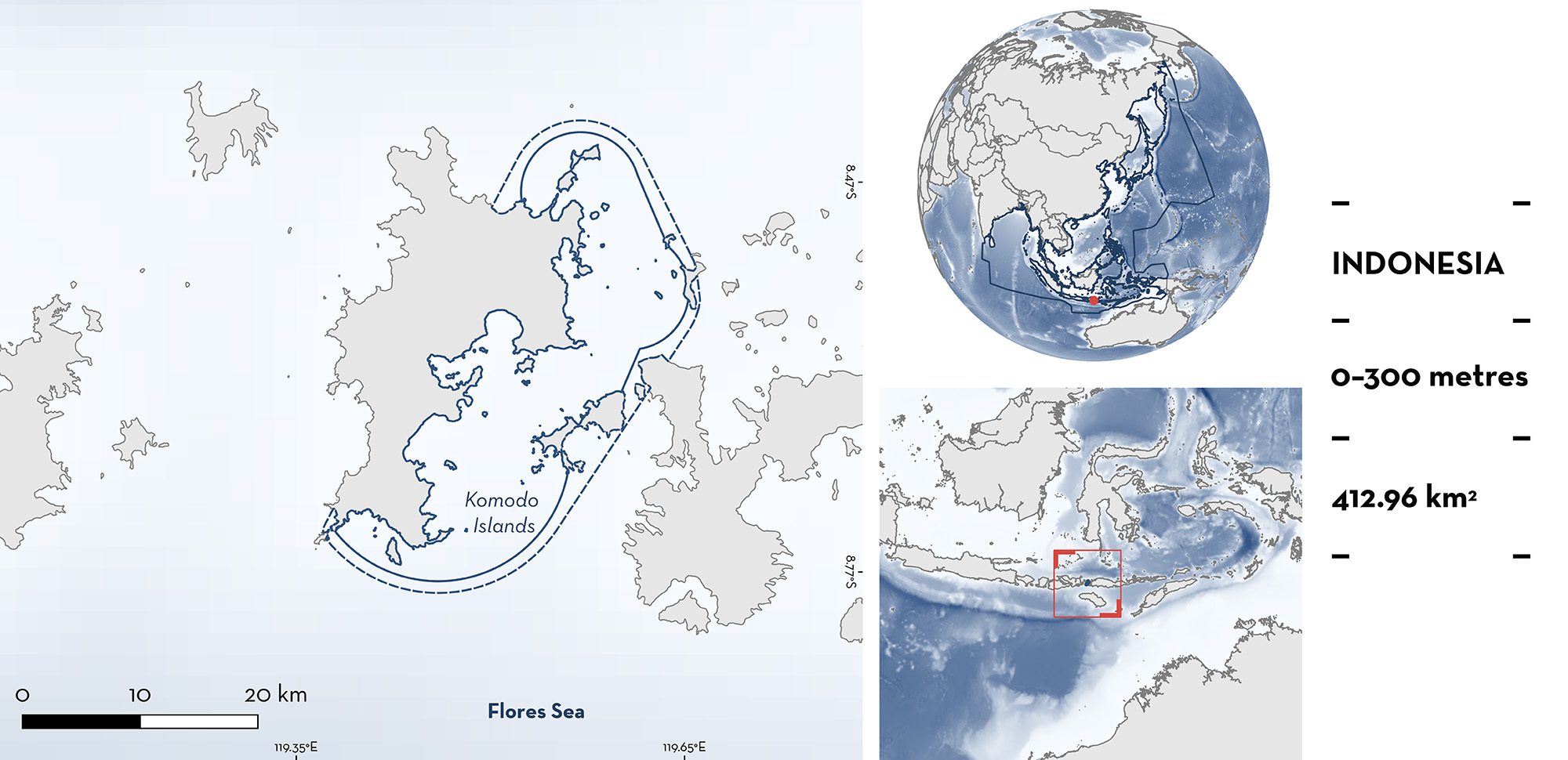
Komodo Islands is located in the Lesser Sunda Islands of Indonesia. It comprises waters off the eastern coast of Komodo Island, as well as several smaller islands. Strong tidal currents, seasonal upwelling, and the Indonesian Throughflow influence this area, leading to high productivity that varies seasonally and on a small spatial scale. Komodo Islands is characterised by flat and sloping coral reefs, reef walls, seagrass beds, sandy habitats, and pelagic waters. The area overlaps with the Perairan Komodo–Rinca Key Biodiversity Area and the Komodo National Park. Within this area there are: threatened species, reproductive areas, feeding areas, and undefined aggregations (Reef Manta Ray Mobula alfredi).
Download factsheet
Komodo Islands
DESCRIPTION OF HABITAT
Komodo Islands is part of the Lesser Sunda Islands located of Indonesia. The area lies on the eastern side of Komodo Island and includes several bays and many smaller islands. The Indonesian Throughflow influences this area, and strong tidal currents drive water from the Indian Ocean flowing northward through the area on the incoming tide and water from the Pacific Ocean flowing southward on the outgoing tide (Erdmann 2004). The monsoon influences seasonal upwelling, being strongest during the southeast monsoon in the south of the area (Ningsih et al. 2013).
Habitat information is available for four core sites: The Cauldron, Karang Makassar, Mawan, and Manta Alley. The Cauldron, located in the northern part of the area, is a shallow channel (<25 m) between two islands with complex bathymetric structure and is strongly affected by tidal currents. Karang Makassar is located in the central part of the area and is a gentle sloping sandy reef (<18 m) that stretches up to 1.5 km, with patchy reefs and coral bommies. Mawan is also in the central part and is a sloping sandy rubble reef (<20 m). Both sites are strongly affected by tidal currents. Manta Alley, in the southern part of the area, is a sloping reef (to ~35 m) that is exposed to surge and tidal currents.
Komodo Islands overlaps with the Komodo National Park which is also listed as a UNESCO World Heritage Centre. It also overlaps with the Perairan Komodo–Rinca Key Biodiversity Area (KBA 2024).
This Important Shark and Ray Area is benthopelagic and extends from inshore and surface waters (0 m) to 300 m based on the observations of Qualifying Species and the bathymetry of the area.
CRITERION A
VULNERABILITY
The one Qualifying Species within the area is considered threatened with extinction according to the IUCN Red List of Threatened Species. The Reef Manta Ray is assessed as Vulnerable (Marshall et al. 2022).
CRITERION C
SUB-CRITERION C1 – REPRODUCTIVE AREAS
Komodo Islands is an important reproductive area for one ray species.
Reef Manta Rays use this area for courtship, mating, and gestation. In-water dive surveys between 2013–2018 (791 survey days) have recorded 4,163 encounters of 1,104 individuals identified using photo-identification (Germanov et al. 2022). Almost all (n = 1,083) were identified at the four core sites within the area. The Cauldron (north), Karang Makassar and Mawan (centre), and Manta Alley (south) appear to be connected, with a total of 104 (10%) individuals having been seen across the three sites. A further 275 (26%) individuals were seen at two sites, one being a central site (Karang Makassar or Mawan) and the other being either Manta Alley or The Cauldron.
Most males (90%) were sexually mature, indicated by the clasper morphology. Although maturity cannot be consistently visually assessed in females, at least 43% of recorded females were sexually mature, as indicated by mating scars on their wing tips, visible pregnancy bulges, or courtship behaviour. Importantly, 18% (n = 92) of adult females were pregnant at least once over the study period. Pregnancies were seen every year. Courtship was observed at three sites throughout the year, peaking in May. Courtship behaviour was not seen at The Cauldron, where mostly juvenile males are encountered (Germanov et al. 2022). Neonates or young-of-the-year were not observed, indicating that this area is important for courtship, mating, and gestating, but not as a nursery ground. It is possible that the proximity of feeding areas and cleaning stations makes this area ideal for gestating females that benefit from conserving energy from travelling shorter distances to feed and clean.
CRITERION C
SUB-CRITERION C2 – FEEDING AREAS
Komodo Islands is an important feeding area for one ray species.
The same in-water dive surveys (791 days between 2013–2018) showed that Reef Manta Rays are commonly observed feeding, particularly at The Cauldron, Karang Makassar, and Manta Alley (Germanov et al. 2022). Feeding has been observed year-round during the survey period. Fine-scale oceanographic conditions, bathymetry, and tidal water movement affect each of the four sites differently, leading to temporal and spatial variation in zooplankton prey availability within the area (Peel et al. 2020). Reef Manta Ray visitation is higher in the southern sites during the southeast monsoon, and higher in the central region during the northwest monsoon (Dewar et al. 2008; Germanov et al. 2022). Up to 30 individuals were recorded feeding together during the northwest monsoon in the central sites that are exposed to direct tidal current changes and associated concentration of plankton. By contrast, feeding behaviour was seen mainly during the southeast monsoon season at The Cauldron. This site is a channel between two islands through which strong tidal currents flow, likely concentrating plankton at the site (Germanov et al. 2022).
CRITERION C
SUB-CRITERION C5 – UNDEFINED AGGREGATIONS
Komodo Islands is an important area for undefined aggregations of one ray species.
Reef Manta Rays are observed engaging in active cleaning behaviour at various reefs. Most of the Reef Manta Rays in this area engage in this behaviour (56% of all encounters). Of the four study sites, Mawan had the highest proportion of observed cleaning behaviour (74% out of 741 encounters in which they were cleaning). Cleaning station reefs and feeding areas were within the same sites. Cleaning behaviour was observed year-round throughout the 2013–2018 study period (Germanov et al. 2022). Cleaning station reefs are commonly also used as ‘social’ sites (i.e., for courtship and mating) and a mean of 3 individuals (range = 3–41) are seen cleaning together at Komodo Islands (Germanov et al. 2019, 2022).
Download factsheet
SUBMIT A REQUEST
ISRA SPATIAL LAYER REQUEST
To make a request to download the ISRA Layer in either a GIS compatible Shapefile (.shp) or Google Earth compatible Keyhole Markup Language Zipped file (.kmz) please complete the following form. We will review your request and send the download details to you. We will endeavor to send you the requested files as soon as we can. However, please note that this is not an automated process, and before requests are responded to, they undergo internal review and authorization. As such, requests normally take 5–10 working days to process.
Should you have questions about the data or process, please do not hesitate to contact us.