ISRA FACTSHEETS
ISRA FACTSHEETS
ASIA REGION
Monad and Kimud Shoals
Summary
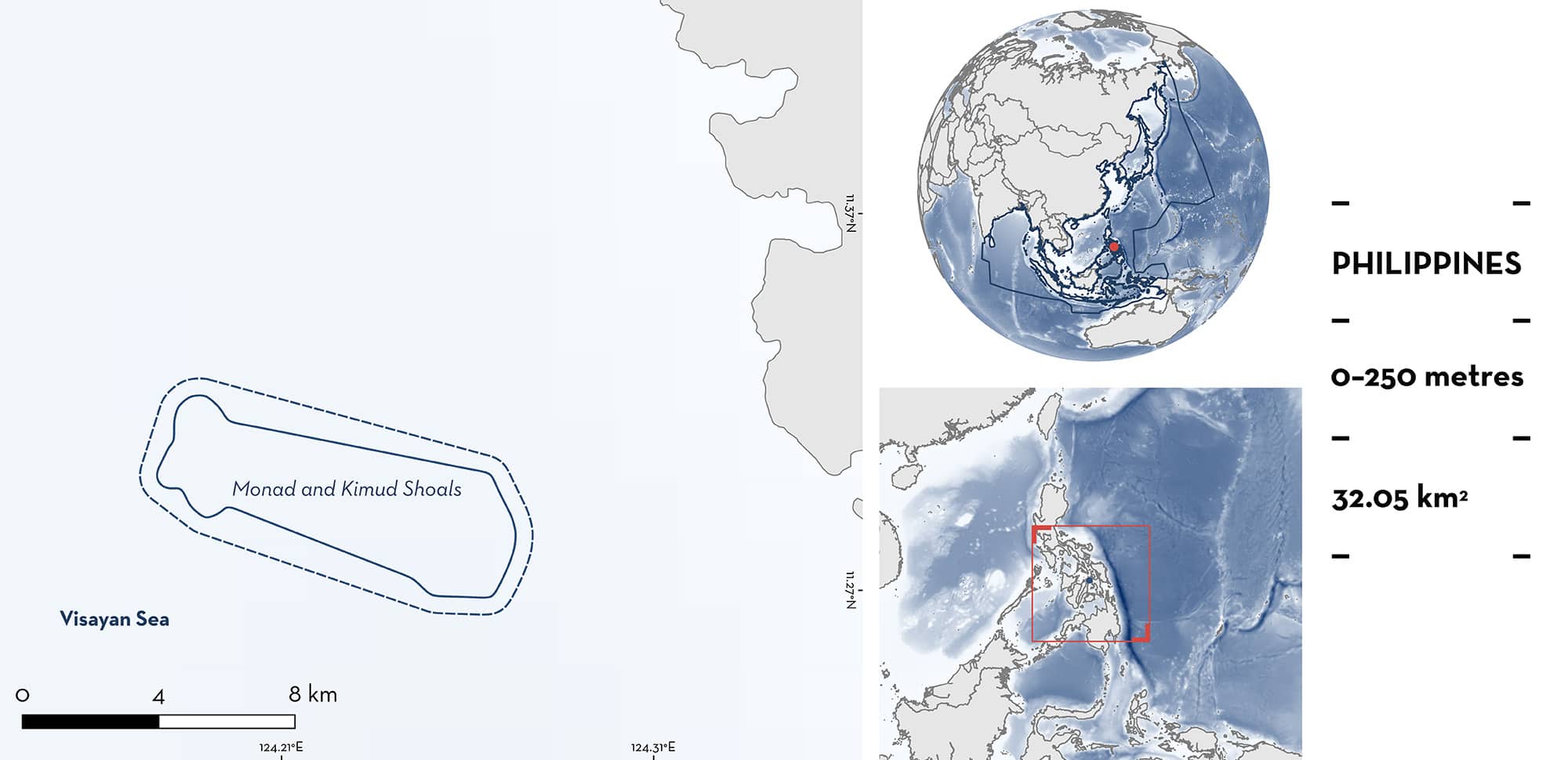
Monad and Kimud Shoals are located southeast of Malapascua Island in the central Visayan Sea, in the Philippines. The Visayan Sea is a relatively shallow area with frequent wind-driven vertical mixing due to its shallow nature, and land-based nutrient run-off which plays an important role in supplementing the overall primary production. Monad & Kimud Shoals are shallow seamounts, 7 km apart. The tops of the seamounts form a plateau at 15–25 m depths. This area overlaps with the Sulu-Sulawesi Marine Ecoregion Ecologically or Biologically Significant Marine Area, and two marine protected areas. Within this area there are: threatened species and distinctive attributes (Pelagic Thresher Alopias pelagicus).
Download factsheet
Monad and Kimud Shoals
DESCRIPTION OF HABITAT
Monad and Kimud Shoals are located southeast of Malapascua Island in the central Visayan Sea, in the central Philippines. The Visayan Sea is a relatively shallow area (Bacalso et al. 2023). There are no identifiable upwelling mechanisms of deep cold water within the Visayan Sea. However, frequent wind-driven vertical mixing occurs due to its shallow nature, and land-based nutrient run-off plays an important role in supplementing the overall primary production (Cordero-Bailey et al. 2004; Willette et al. 2011). The Visayan Sea has a tropical monsoon climate with only two seasons each year: the dry (boreal winter) season that prevails from November to April, and the rainy (summer) season, extending from May to October (Ha et al. 2012). The surface wind of the Sulu Sea is strongly influenced by the East Asian Monsoon System: northeasterly in winter, southwesterly in summer, and highly variable during the transitional periods (Wyrtki 1961).
Monad and Kimud Shoals are shallow seamounts at 8 and 15 km east from Malapascua Island, respectively. These two seamounts are 7 km apart. The tops of the seamounts form a plateau at 15–25 m depths and drop off to ~250 m in Monad Shoal and ~200 m in Kimud Shoal (Oliver et al. 2011).
This area overlaps with Sulu-Sulawesi Marine Ecoregion Ecologically or Biologically Significant Marine Areas (EBSA; CBD 2024). Monad Shoal and Kimud Shoal are two marine protected areas.
This Important Shark and Ray Area is benthopelagic and is delineated from surface waters (0 m) to 250 m based on the bathymetry of the area.
CRITERION A
VULNERABILITY
The one Qualifying Species within the area is considered threatened with extinction according to the IUCN Red List of Threatened Species. The Pelagic Thresher is assessed as Endangered (Rigby et al. 2019).
CRITERION D
SUB-CRITERION D1 – DISTINCTIVENESS
Monad and Kimud Shoals is an important area for distinctive behaviour of one shark species.
From 1,230 hours of observations recorded by remote video camera during 198 days between July 2005 and December 2009, 97 Pelagic Thresher cleaning events were recorded at Monad Shoal (Oliver et al. 2011). Observations of this species interacting with cleaner wrasse fishes (i.e., Labroides dimidiatus, Thalassoma lunare) at the seamount were recorded at all times of day but their frequency declined gradually from morning until evening. Pelagic Thresher ‘clients’ modified their behaviour by stance ‘circular-stance-swimming’ (i.e., wherein sharks initiate cleaning from cleaner fish species through circular swimming) presumably to facilitate cleaner inspections. Five cleaning stations have been identified ~100 m apart on the southeast section of the plateau. In January 2018, from 68.4 hours of video on the edge of Monad Shoal seamount, 118 cleaning events were recorded (Grepp & Oliver 2018; S Oliver unpubl. data 2023). This cleaning behaviour has also been recorded at Kimud Shoal (S Oliver unpubl. data 2023).
Between June to mid-August 2014, 10 Pelagic Threshers were fitted with acoustic tags and their fine-scale movements monitored for 66 days at Monad Shoal (Oliver et al. 2019). Individuals were present at the seamount for 32% of their days at liberty, and 42% of the tagged sharks were still being
detected there at the end of the study in 2014. Tagged Pelagic Threshers showed preferences for visiting specific locations on the seamount where they interact with cleaner fish.
For the past two decades, Pelagic Threshers have been observed by SCUBA divers being cleaned at Monad Shoal year-around (Oliver et al. 2011, 2019). This distinctive behaviour has been studied since 2007 by the Thresher Shark Research and Conservation Project. This area has been one of the most consistent diving destinations around the world for thresher shark sightings (PADI 2024). Across the Asia region, this behaviour has been reported at only one additional location. In other locations worldwide, this behaviour has only been recorded for this shark species in the Maldives within the Fuvahmulah Atoll ISRA (Jabado et al. 2023).
Download factsheet
SUBMIT A REQUEST
ISRA SPATIAL LAYER REQUEST
To make a request to download the ISRA Layer in either a GIS compatible Shapefile (.shp) or Google Earth compatible Keyhole Markup Language Zipped file (.kmz) please complete the following form. We will review your request and send the download details to you. We will endeavor to send you the requested files as soon as we can. However, please note that this is not an automated process, and before requests are responded to, they undergo internal review and authorization. As such, requests normally take 5–10 working days to process.
Should you have questions about the data or process, please do not hesitate to contact us.