ISRA FACTSHEETS
ISRA FACTSHEETS
EUROPEAN ATLANTIC
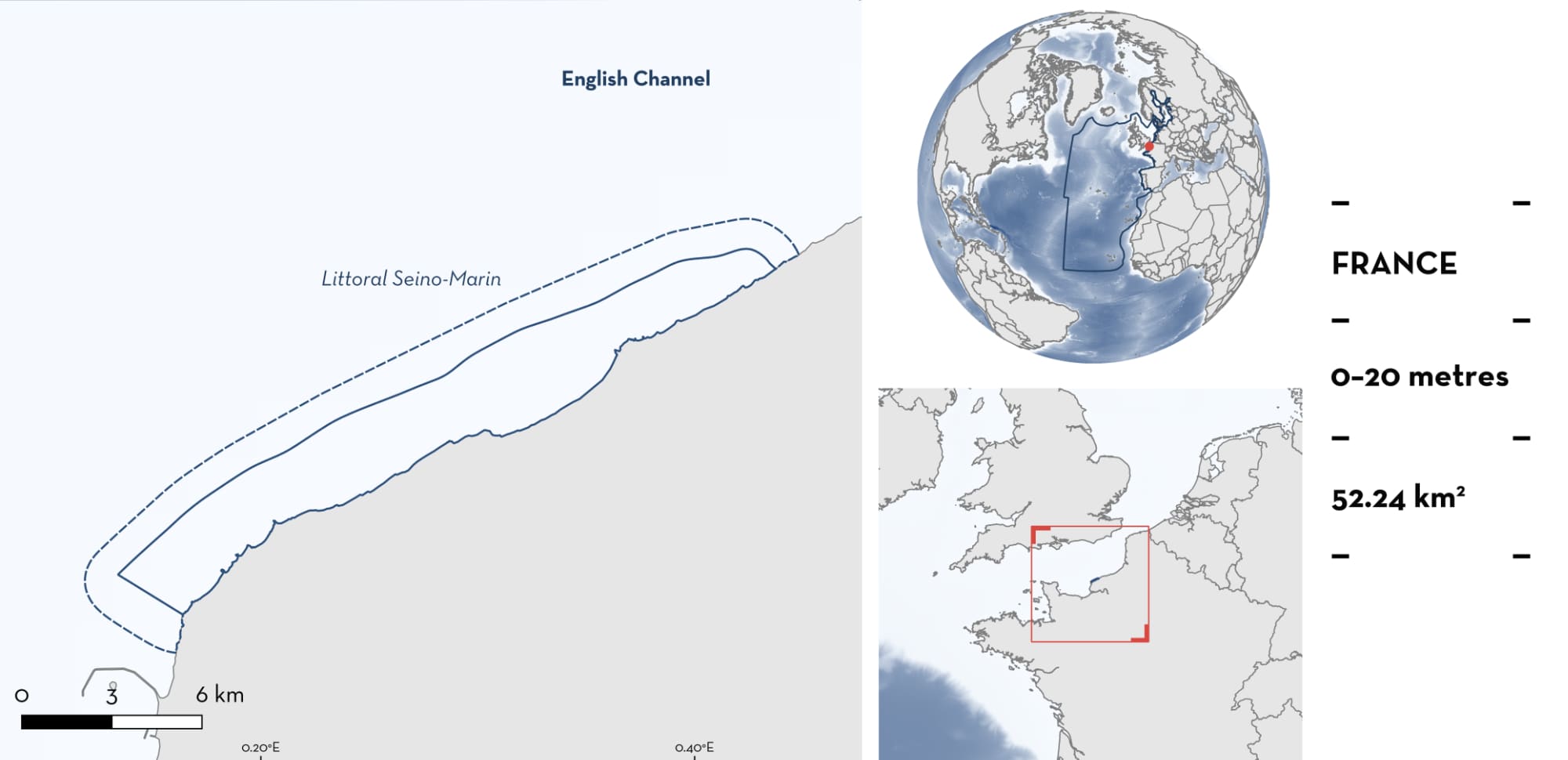
Littoral Seino-Marin
Summary
Littoral Seino-Marin is located in the eastern English Channel in France. This coastal area is influenced by freshwater outflow from the Seine River and by tides and tidal currents. The habitat is characterised by a narrow reef flat that gradually gives way to sand, gravel, and a pebble field. Within this area there are: reproductive areas (e.g., Thornback Skate Raja clavata); and feeding areas (e.g., Spotted Skate Raja montagui).
Download factsheet
Littoral Seino-Marin
DESCRIPTION OF HABITAT
Littoral Seino-Marin is located in the eastern English Channel in France. This coastal habitat is characterised by a narrow reef flat along the coast that gradually gives way to sand, gravel, and a large pebble field (Renault 2011). There are also minor banks of mud and clay along the coast. The area is influenced by a large tidal range between 6–8 m and by associated tidal currents. The base current flows northward but is pushed eastward during the rising tide and westward during the falling tide. Currents are also stronger at the surface (up to 2 m s-1) than at depth (up to 1.25 m s-1) and accelerate slightly in the west of this area (Le Cam & Baraer 2012). The freshwater plume from the Seine River influences this area, forming a ‘Coastal River’ and resulting in a salinity gradient from coastal to offshore waters.
Littoral Seino-Marin is sheltered from Atlantic Ocean swells by the Cotentin Peninsula, and its surface area and geographical position also prevent long swells from forming properly. The most frequent swell direction is towards the northeast, with an average height of 0.5–1.25 m and reaching >2 m. However, the area is exposed to the eastern fringe of the English Channel. Strong winds from the North Sea can sometimes bring significant waves (Le Cam & Baraer 2012). The water temperature ranges from 4.5–17°C (Renault 2011).
This Important Shark and Ray Area is benthic and is delineated from inshore and surface waters (0 m) to 20 m based on the bathymetry of the area.
CRITERION C
SUB-CRITERION C1 – REPRODUCTIVE AREAS
Littoral Seino-Marin is an important reproductive area for two ray species.
Within this area, an observer assessed 17 hauls from a commercial trawler fishing in April, July, and October of 2016 and 2017 (Biton-Porsmoguer 2020). The trawler used a 20 m long net with an 8 cm mesh size. For comparison, 48 hauls from the wider English Channel, outside the area, were also assessed (Biton-Porsmoguer 2020). The reproductive status of female skates was assessed through dissection, with gravid skates defined as carrying egg cases.
A total of 74 female Thornback Skates were collected and 70% were gravid (n = 52), highlighting the importance of this area for the reproduction of the species. Thornback Skates lay eggs in pairs on sand or mud, in the inshore part of this area, between February–September, peaking in June (mainly in the boreal spring and early summer). Hatching takes place after 4–5 months of incubation (Biton-Porsmoguer 2020). Hauls made outside the area found fewer gravid females (14%; S Biton-Porsmoguer unpubl. data 2025), showing that Littoral Seino-Marin is important for the gestation and potentially for egg laying and hatching of Thornback Skates.
A total of 121 female Spotted Skates were captured and 55% were gravid (n = 66). Observations showed that females are gravid between April–July. The oblong egg capsules are preferably deposited in sandy or muddy substrates, which is available in the inshore part of this area. Spotted Skates are caught on sandy and hard substrates to a limited depth in this area (Biton-Porsmoguer 2020). Hauls made outside the area found fewer gravid females (26%; S Biton-Porsmoguer unpubl. data 2025), highlighting the importance of this area for the gestation of Spotted Skates.
CRITERION C
SUB-CRITERION C2 – FEEDING AREAS
Littoral Seino-Marin is an important feeding area for two ray species.
Thornback Skates (n = 72) and Spotted Skates (n = 61) were captured in 17 trawl hauls in this area and 48 hauls outside of it in April, July, and October of 2016 and 2017, and their diet was assessed through dissection (Biton-Porsmoguer 2020).
A higher proportion of Thornback Skates with non-empty stomachs were observed inside the area (79%; n = 15 of 19) than outside the area (26%; n = 14 of 53). The stomach contents of these 15 mature individuals with a size of >75 cm total length (TL) was strongly dominated by crustaceans and fishes (Biton-Porsmoguer 2020). The size-at-maturity for the species is 60–85 cm TL (Last et al. 2016). Importantly, the state of digestion of prey items showed that the prey were recently eaten (S Biton-Porsmoguer pers. obs. 2025), indicating that Littoral Seino-Marin is an important feeding area for this species.
A higher proportion of Spotted Skates with non-empty stomachs was observed inside the area (89%; n = 16 of 18) than outside the area (40%; n = 17 of 43). Spotted Skates were a mix of juveniles and adults with a size of <60 cm TL. The size-at-maturity for the species is 40 cm TL (Last et al. 2016). Their diet was strongly dominated by crustaceans, mainly decapods (crabs and shrimps), mysids, and amphipods (Biton-Porsmoguer 2020). The offshore part of this area is characterised by sand and gravel (Renault 2011), with a high biodiversity of benthic fauna (Foveau 2009) and fishes (ICES 2025). The abundance of prey depends on the characteristics and quality of the sediments and benthic environment (Buhl-Mortensen & Buhl-Mortensen 2018) and is thus likely to be higher inside the area than outside it. Additionally, the intact state of prey items showed that the prey were recently eaten (S Biton-Porsmoguer pers. obs. 2025), indicating that this is an important feeding area for Spotted Skates.
Download factsheet
SUBMIT A REQUEST
ISRA SPATIAL LAYER REQUEST
To make a request to download the ISRA Layer in either a GIS compatible Shapefile (.shp) or Google Earth compatible Keyhole Markup Language Zipped file (.kmz) please complete the following form. We will review your request and send the download details to you. We will endeavor to send you the requested files as soon as we can. However, please note that this is not an automated process, and before requests are responded to, they undergo internal review and authorization. As such, requests normally take 5–10 working days to process.
Should you have questions about the data or process, please do not hesitate to contact us.