ISRA FACTSHEETS
ISRA FACTSHEETS
NORTH AMERICAN PACIFIC
Lusitania Bank
Summary
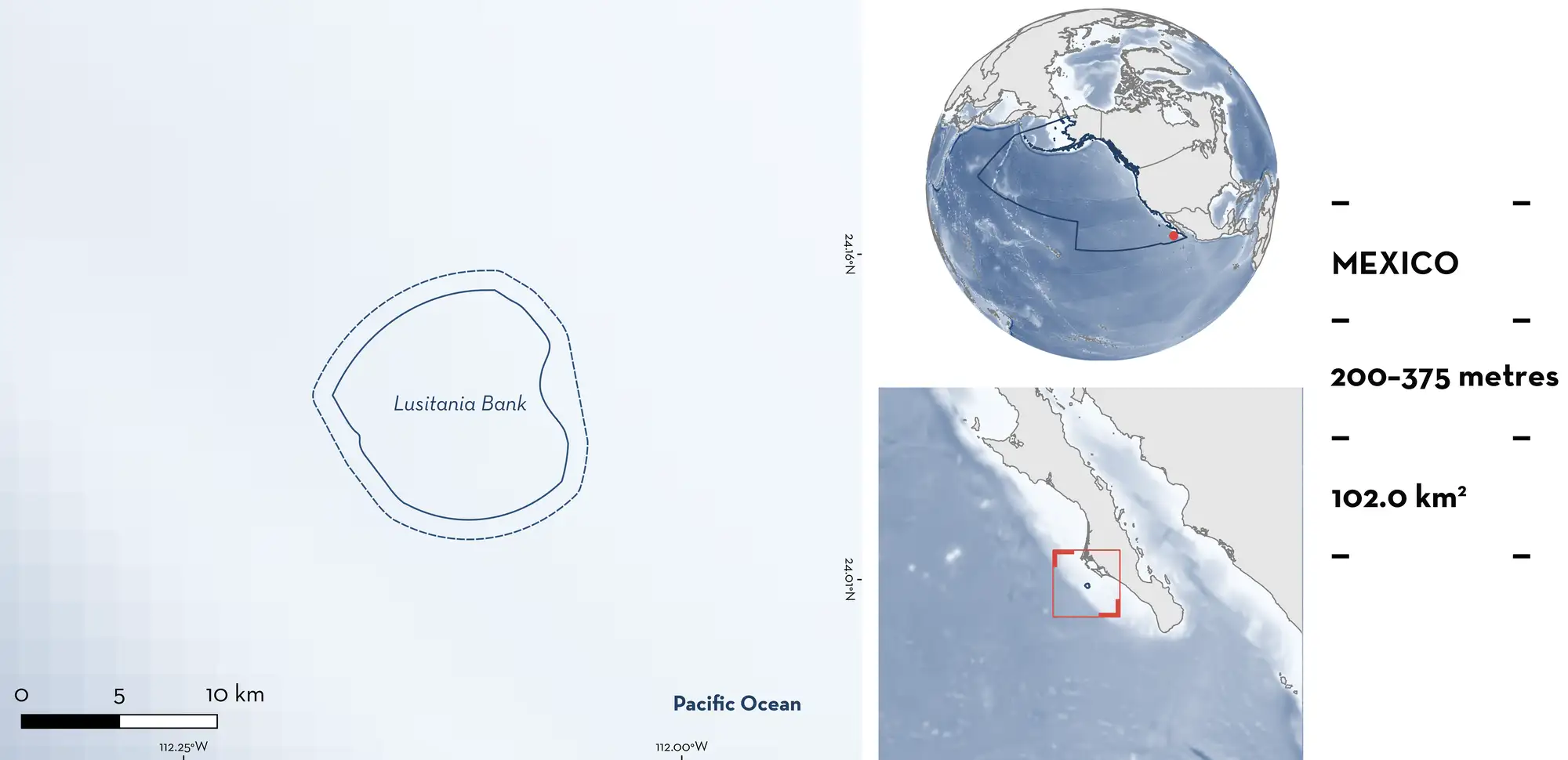
Lusitania Bank is located off the Pacific Ocean coast of Baja California Sur, Mexico. The habitat is characterised by the outer continental shelf, upper slope, and part of the Lusitania Bank with predominantly volcanic and rocky substrates. The area is influenced by the California Current and the California Counter Current, and wind-driven coastal upwelling. It overlaps with the Coastal Waters Off Baja California Ecologically or Biologically Significant Marine Area. Within this area there are: range-restricted species (Lollipop Catshark Cephalurus cephalus).
Download factsheet
Lusitania Bank
DESCRIPTION OF HABITAT
Lusitania Bank is located off the Pacific Ocean coast of Baja California Sur, Mexico. The habitat is characterised by the outer continental shelf, upper slope, and part of the Lusitania Bank with predominantly volcanic and rocky substrates (Bizzarro 2005).
The area is influenced by the California Current and the California Counter Current, with wind-driven coastal upwelling. The California Current is a surface current (0–300 m deep) transporting cool, low salinity, oxygen-rich water towards the south, while the California Counter Current is a northward-flowing nearshore current of warm, high salinity, and low oxygen characteristics. Upwelling systems occur more intensely during the boreal spring and early summer (March–June), although they persist episodically throughout the year (Bakun & Nelson 1977).
This area overlaps with the Coastal Waters Off Baja California Ecologically or Biologically Significant Marine Area (EBSA; CBD 2026).
This Important Shark and Ray Area is benthic and subsurface and is delineated from 200–375 m based on the depth range of Qualifying Species in the area.
CRITERION B
RANGE RESTRICTED
The area holds the regular presence of Lollipop Catshark as a resident range-restricted species. In June–July 2015 and July 2017, a total of 441 Lollipop Catshark were incidentally captured in the area during exploratory surveys for the North Pacific Hake Merluccius productus fishery using epibenthic trawl nets during 40 min tows (Jaime-Rivera et al. 2019; Morales-Ávila et al. 2023). These surveys were conducted along the shelf and slope in the area and surrounding waters (Jaime-Rivera et al. 2019; Morales-Ávila et al. 2023).
In 2015, a total of 14 sets were conducted in adjacent locations, with just one set within the area. Lollipop Catshark (n = 132) were captured only within this area at a depth of 365 m (Morales-Ávila et al. 2023). Lollipop Catshark ranged in size from 7–24.5 cm total length (TL) comprising neonates, juveniles, and adults (Morales-Ávila et al. 2023). Size-at-birth is ~8–10 cm TL while size-at-maturity is ~19 cm TL for males and ~24 cm TL for females (Ebert et al. 2021). Additionally, in 2017, 309 Lollipop Catsharks were captured in the area during the same exploratory North Pacific Hake fishing campaign at 365 m depth (Jaime-Rivera et al. 2019). A total of 122 individuals were males and 187 females (Jaime-Rivera et al. 2019). Females were 8.3–36.7 cm TL (average = 15.6 cm TL) and males were 8.5–24.5 cm TL (average = 13.2 cm TL). Based on this, these individuals ranged between neonates to adults. Despite survey efforts along the shelf and slope of the Pacific coast of Baja California Sur, Lollipop Catshark were only reported in large numbers within the area, compared to adjacent areas where 11 and 24 individuals were reported in the 1980s and 1995, respectively (Castro-Aguirre 1981; Balart et al. 2000; Jaime-Rivera et al. 2019; Morales-Ávila et al. 2023). Additional groundfish bottom trawl surveys (n = 8,338 tows) at depths ranging from 55 to 1,280 m along the United States of America west coast between 2011–2025 did not capture this species (Keller et al. 2017; NOAA NWFSC FRAM 2026). Lollipop Catshark is restricted to the Gulf of California Large Marine Ecosystem (LME) and the California Current Shelf LME.
Download factsheet
SUBMIT A REQUEST
ISRA SPATIAL LAYER REQUEST
To make a request to download the ISRA Layer in either a GIS compatible Shapefile (.shp) or Google Earth compatible Keyhole Markup Language Zipped file (.kmz) please complete the following form. We will review your request and send the download details to you. We will endeavor to send you the requested files as soon as we can. However, please note that this is not an automated process, and before requests are responded to, they undergo internal review and authorization. As such, requests normally take 5–10 working days to process.
Should you have questions about the data or process, please do not hesitate to contact us.