ISRA FACTSHEETS
ISRA FACTSHEETS
NORTH AMERICAN PACIFIC
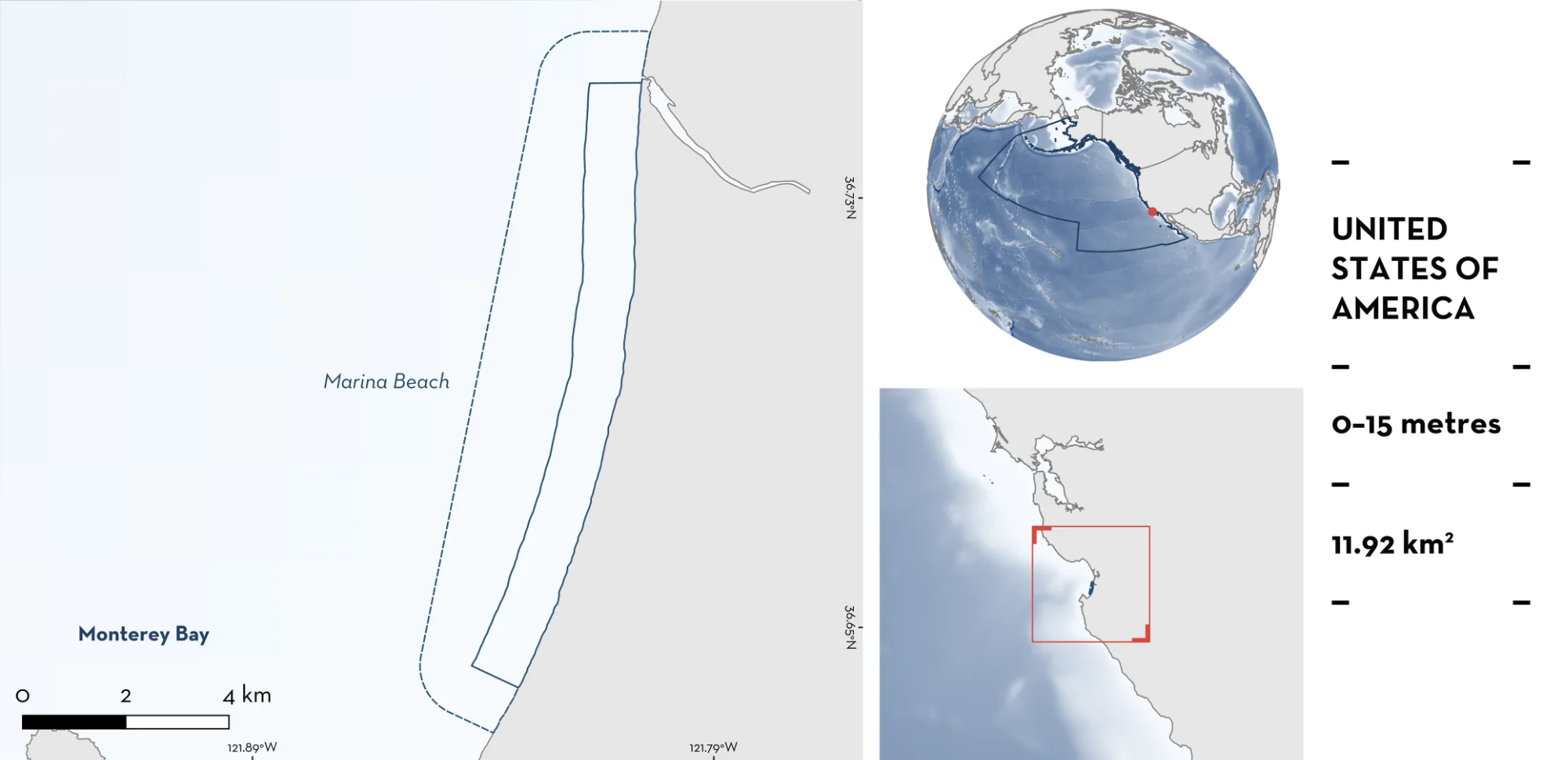
Marina Beach
Summary
Marina Beach is located on the coast of California, United States of America. The area sits in Monterey Bay and is characterised by sandy substrates. It is influenced by wind-driven upwelling mostly in the boreal spring and summer. Within this area there are: threatened species and undefined aggregations (White Shark Carcharodon carcharias).
Download factsheet
Marina Beach
DESCRIPTION OF HABITAT
Marina Beach is located on the coast of California, United States of America (USA). The area sits in Monterey Bay and extends from the Salinas River mouth in the north to Fort Ord Dunes State Park in the south. The coastline is characterised by sandy substrates.
The area is influenced by wind-driven upwelling, which is strongest during the boreal spring and summer (April–July) and almost absent during winter (Harcourt-Baldwin & Diedericks 2006). Circulation is dominated by the southward-flowing California Current, with associated upwelling bringing cool, nutrient-rich water to the surface which is enhanced by the Monterey Submarine Canyon (Castro et al. 2018). The region experiences seasonal current reversals, with the poleward-flowing Davidson Current becoming active during autumn and winter months (Johnson et al. 2015).
This Important Shark and Ray Area is benthic and pelagic and is delineated from inshore and surface waters (0 m) to 15 m based on the bathymetry of the area.
CRITERION A
VULNERABILITY
One Qualifying Species considered threatened with extinction according to the IUCN Red List of Threatened Species regularly occurs in the area. This is the Vulnerable White Shark (Rigby et al. 2019).
CRITERION C
SUB-CRITERION C5 – UNDEFINED AGGREGATIONS
Marina Beach is an important area for undefined aggregations of one shark species.
Acoustic tagging, boat-based surveys, and drone surveys have confirmed the regular presence of White Shark aggregations in the area (DiGiacomo et al. 2025, 2026). Surveys (n = 41) conducted between 2023–2025 recorded the presence of 69 White Sharks in the area. Based on their size, the majority of these were either juveniles (n = 41; 59.4%) or sub-adults (n = 25; 36.2%) (DiGiacomo et al. 2025, 2026). Juveniles in the region range between 175–300 cm total length (TL) while sub-adults measure between 300–360 cm TL for males and 300–450 cm TL for females (DiGiacomo et al. 2026). The average number of White Sharks recorded per day shows the presence of aggregations in 2023 (mean ± standard deviation [SD] = 3.7 ± 2.5 individuals/day), 2024 (7.3 ± 6.0 individuals/day), and 2025 (3.1 ± 2.1 individuals/day). Aggregations were confirmed with acoustic telemetry monitoring between September 2024–April 2025. Of 47 individuals tagged in the area or in other areas of central California, aggregations were detected in 10 instances (DiGiacomo et al. 2026; BA Block et al. unpubl. data 2026). These were defined as the presence of >3 unique White Sharks on the same receiver (detection range between 250–500 m) within the same 5-minute window. There was a seasonal signal from boat and drone surveys, with more aggregations recorded in late summer (July–September). While sub-adult and adult White Shark aggregations are known to occur regularly around islands and in coastal areas of central California (Andrzejaczek et al. 2025), aggregations of juveniles in the Monterey Bay region have appeared recently with this area having the second largest aggregations in Monterey Bay after New Brighton (~25 km north). Additional information is required to understand the nature and function of these aggregations.
Download factsheet
SUBMIT A REQUEST
ISRA SPATIAL LAYER REQUEST
To make a request to download the ISRA Layer in either a GIS compatible Shapefile (.shp) or Google Earth compatible Keyhole Markup Language Zipped file (.kmz) please complete the following form. We will review your request and send the download details to you. We will endeavor to send you the requested files as soon as we can. However, please note that this is not an automated process, and before requests are responded to, they undergo internal review and authorization. As such, requests normally take 5–10 working days to process.
Should you have questions about the data or process, please do not hesitate to contact us.