ISRA FACTSHEETS
ISRA FACTSHEETS
NORTH AMERICAN PACIFIC
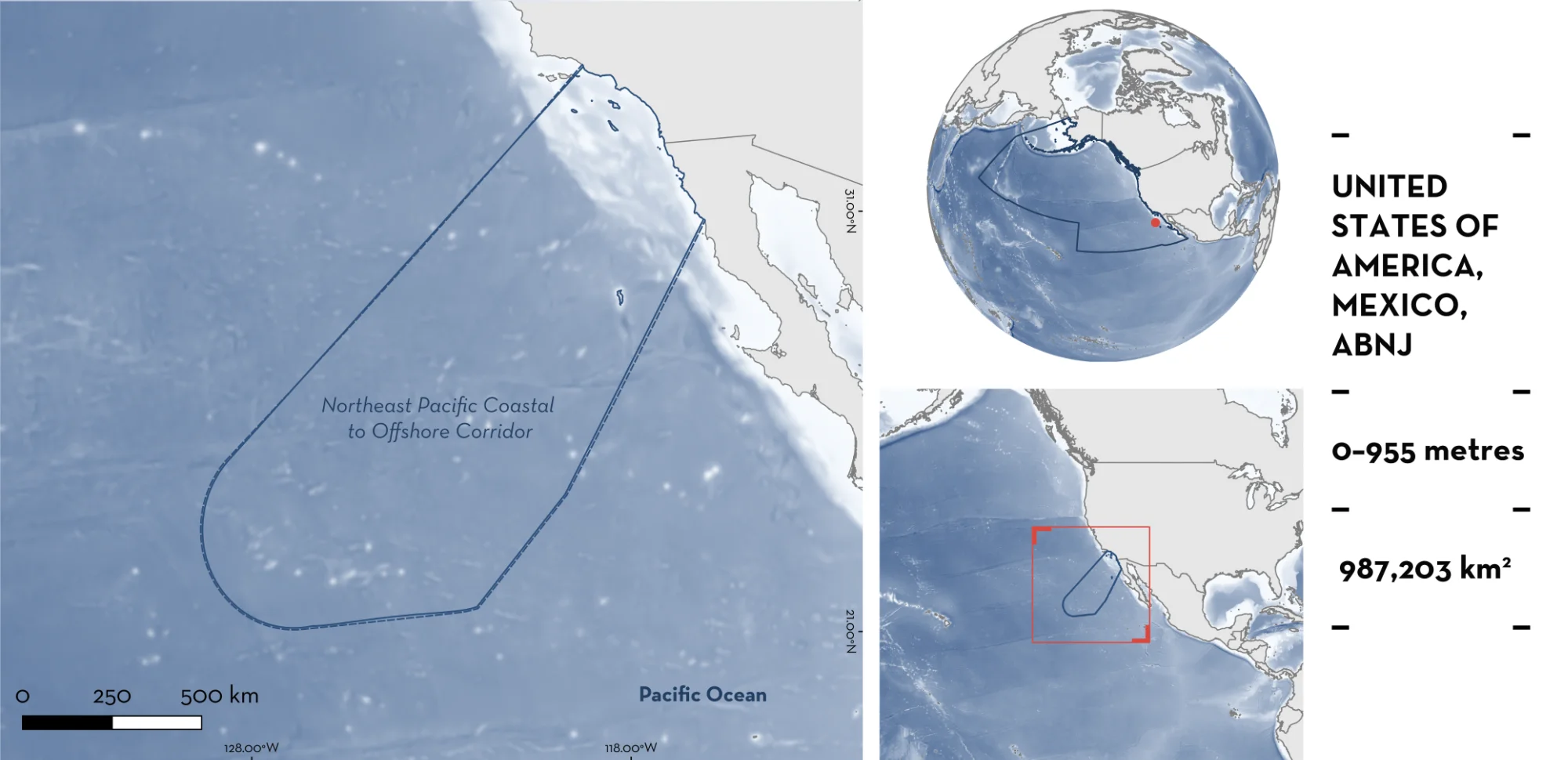
Northeast Pacific Coastal to Offshore Corridor
Summary
Northeast Pacific Coastal to Offshore Corridor is located off the southwest coast of North America, in the United States of America, Mexico, and areas beyond national jurisdiction (ABNJ). This area stretches from nearshore waters in the Southern California Bight towards the southeast into offshore waters. The habitat is characterised by pelagic waters, and by many seamounts, escarpments, canyons, ridges, and plateaus. It is mainly influenced by the California Current, the California Undercurrent, and the eastern part of the North Pacific subtropical gyre. Within this area there are: threatened species and areas important for movement (Bigeye Thresher Alopias superciliosus).
Download factsheet
Northeast Pacific Coastal to Offshore Corridor
DESCRIPTION OF HABITAT
Northeast Pacific Coastal to Offshore Corridor is located off the southwest coast of North America. This movement area stretches from nearshore waters in the exclusive economic zones (EEZs) of the United States of America and Mexico between southern California and northwestern Mexico into offshore waters in areas beyond national jurisdiction (ABNJ). The western-most boundary is almost halfway between southern Baja California and Hawaii. The eastern extent of the area is the Southern California Bight. The habitat is characterised by pelagic waters over the narrow continental shelf, slope, and abyssal plain, and by many seamounts, escarpments, canyons, ridges, and plateaus.
This area is influenced by regional circulation within the California Current System, with the California Current flowing equatorward at the surface through the Southern California Bight and the California Undercurrent flowing poleward along the slope (Hickey 1979; Checkley & Barth 2009). Seasonal upwelling in the boreal spring and summer along the outer bight is driven by wind forcing (Checkley & Barth 2009). Offshore waters are influenced by the eastern portion of the clockwise North Pacific subtropical gyre, as well as by mesoscale eddies that propagate westward from the California Current System (Strub & James 2000; Chelton et al. 2011).
This Important Shark and Ray Area is pelagic and is delineated from inshore and surface waters (0 m) to 955 m based on the global depth range of Qualifying Species.
CRITERION A
VULNERABILITY
One Qualifying Species considered threatened with extinction according to the IUCN Red List of Threatened Species regularly occurs in the area. This is the Vulnerable Bigeye Thresher (Rigby et al. 2019).
CRITERION C
SUB-CRITERION C4 – MOVEMENT
Northeast Pacific Coastal to Offshore Corridor is an important movement area for Bigeye Threshers.
Bigeye Threshers regularly move through this area, connecting seasonal nearshore feeding sites with offshore habitats (Sepulveda et al. 2019; Aalbers et al. 2021; SA Aalbers unpubl. data 2026). A study tagged 28 Bigeye Threshers in the Southern California Bight between 2016–2021 to assess post-release survival. Tags included six pop-up archival satellite tags (miniPATs) and 22 survivorship pop-up archival tags (sPATs), with a track duration of 16–41 days (average = 25 days). Tagged sharks comprised six males, four females, and 18 for which sex was not determined, and they ranged from 147–230 cm fork length (256–402 cm total length; Liu et al. 1998) including five juveniles and nine adults (SA Aalbers unpubl. data 2026). Sharks were tagged between July–December during a six-year period, with most tagged in August (55%; n = 15). The seasonality corresponds with the seasonal occurrence of the species in nearshore southern California in summer and autumn (Sepulveda et al. 2019). The Southern California Bight appears to be a feeding site for the species, with stomach content analysis suggesting they feed on a variety of epipelagic, mesopelagic, epi-benthic, and deep-scattering-layer species (Preti et al. 2008). Two tags did not report, leaving 26 sharks with a tag deployment and pop-up location. Tracks using light-level-based geolocation are not available because the species remains in the dark, staying deep during the day and shallow at night (Aalbers et al. 2021; SA Aalbers unpubl. data 2026).
Almost all tracked Bigeye Threshers (23 of 26; 88%) showed fast and directional movement from the Southern California Bight heading into offshore waters (Aalbers et al. 2021; SA Aalbers unpubl. data 2026). Four of these sharks moved directly south, outside of the area, while the remaining 19 individuals swam southeast through this movement corridor. The end point of the corridor corresponds to a seamount complex, with seamounts recognised as being hotspots of pelagic biodiversity (Morato et al. 2010). There were no clear differences between sexes or life-stages. The 19 individuals swimming through this corridor covered an average straight-line distance of 1,232 km (range 733–1,525 km) over their average 25-day track and had an average speed of 54 km day-1. This fast horizontal movement is in addition to extensive diel vertical migration between surface waters and depths of ~400–500 m. While there are no intermediate positions between deployment and pop-up locations, the fast and directional movement, as well as the recurring movement pattern for most tracked individuals, highlight that this is an important movement corridor. It is possible that Bigeye Threshers move further into offshore waters, past the boundaries of this area, since track duration was short. However, available tracking data support this corridor as an important movement area that links seasonal nearshore feeding habitat with offshore waters (Aalbers et al. 2021; SA Aalbers unpubl. data 2026).
Download factsheet
SUBMIT A REQUEST
ISRA SPATIAL LAYER REQUEST
To make a request to download the ISRA Layer in either a GIS compatible Shapefile (.shp) or Google Earth compatible Keyhole Markup Language Zipped file (.kmz) please complete the following form. We will review your request and send the download details to you. We will endeavor to send you the requested files as soon as we can. However, please note that this is not an automated process, and before requests are responded to, they undergo internal review and authorization. As such, requests normally take 5–10 working days to process.
Should you have questions about the data or process, please do not hesitate to contact us.