ISRA FACTSHEETS
ISRA FACTSHEETS
NORTH AMERICAN PACIFIC
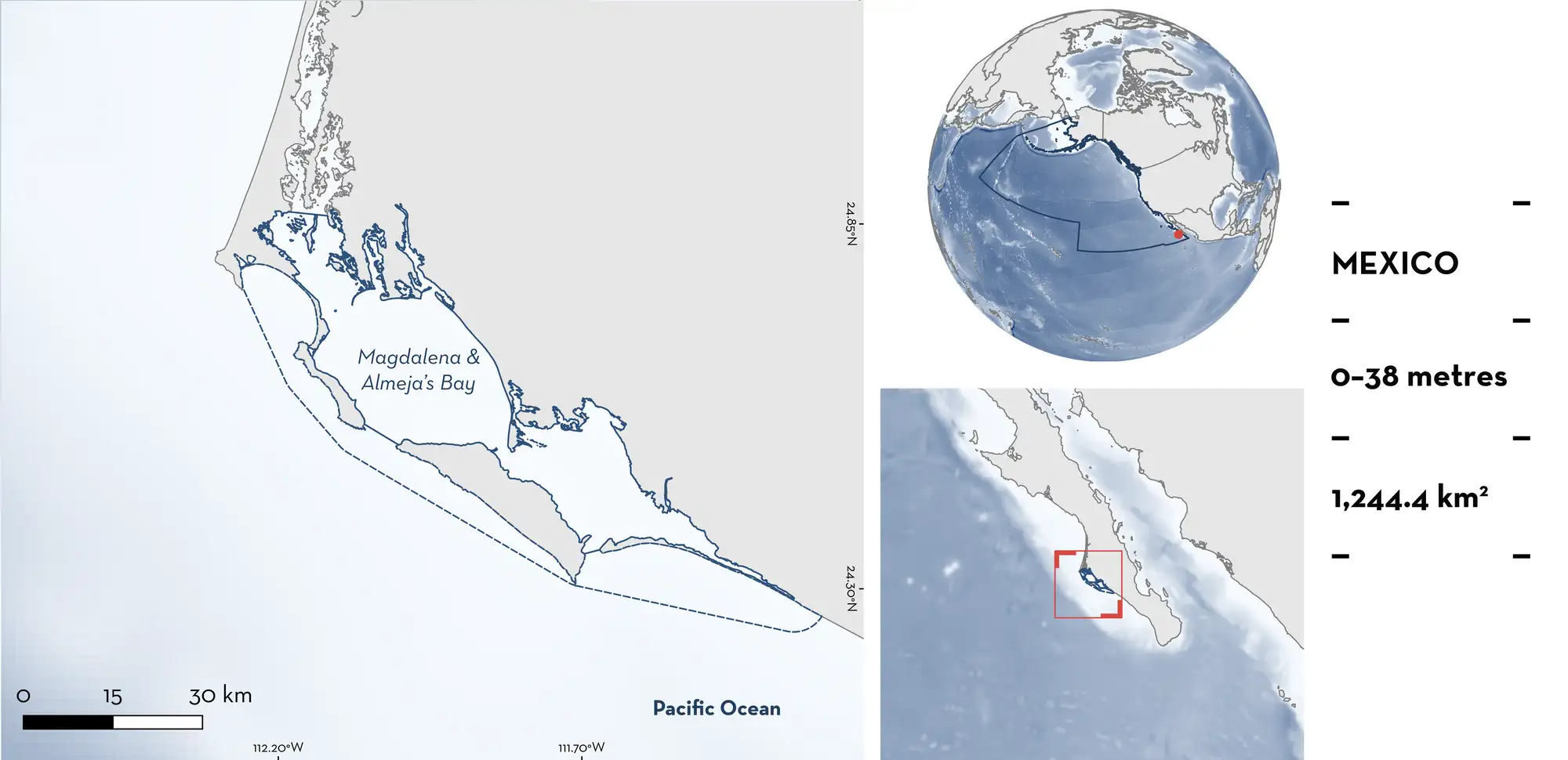
Magdalena & Almeja’s Bay
Summary
Magdalena & Almeja’s Bay is located on the Pacific Ocean coast of Baja California Sur, Mexico. The area is bounded by a series of barrier islands and sandbars. It is characterised by shallow channels, intertidal sand flats, mangrove-lined canals, seagrass, and sand substrates with rocky outcrops. It is influenced by the California Current, California Countercurrent, and wind-driven coastal upwelling. It overlaps with the Coastal Waters Off Baja California Ecologically or Biologically Significant Marine Area. Within this area there are: threatened species (Bull Shark Carcharhinus leucas); range-restricted species (Shovelnose Guitarfish Pseudobatos productus); and reproductive areas (e.g., Shovelnose Guitarfish).
Download factsheet
Magdalena & Almeja’s Bay
DESCRIPTION OF HABITAT
Magdalena & Almeja’s Bay is located on the Pacific Ocean coast of Baja California Sur, Mexico. The area encompasses the largest embayment along the western margin of the Baja California Peninsula. The area is bounded by a series of barrier islands and sandbars. The habitat is characterised by shallow channels, intertidal sand flats, mangrove-lined canals, seagrass, and sand substrates with rocky outcrops largely confined to the western margins of the bay (Bizzarro 2005). Magdalena Bay is bordered by Isla Magdalena to the west and Isla Santa Margarita to the south and is connected to the Pacific Ocean through a central channel, Boca de Entrada (~5.5 km wide), which reaches depths of 38 m. Almeja’s Bay is bordered by Isla Santa Margarita and is connected to the ocean by a shallower entrance (Boca) of 3 m depth (Downton-Hoffmann 2007). Within the bay, interior canals and channels are narrow (0.2–2.0 km wide) and shallow, with a mean depth of ~3.5 m (Bizzarro 2005).
The area is influenced by estuarine waters with higher salinity than the surrounding open waters year-round. The area is influenced by the California Current during the boreal spring and summer months, while in autumn and winter it is influenced by the California Countercurrent, with wind-driven coastal upwelling systems also affecting the physical characteristics of the west-central portion of the area inside the bays. Upwelling systems occur more intensely during spring and early summer (March-June), although it persists episodically throughout the year (Bakun & Nelson 1977).
This area overlaps with the Coastal Waters Off Baja California Ecologically or Biologically Significant Marine Area (EBSA; CBD 2026).
This Important Shark and Ray Area is benthic and pelagic and is delineated from inshore and surface waters (0 m) to 38 m based on the bathymetry of the area.
CRITERION A
VULNERABILITY
One Qualifying Species considered threatened with extinction according to the IUCN Red List of Threatened Species regularly occur in the area. This is the Vulnerable Bull Shark (Rigby et al. 2021).
CRITERION B
RANGE RESTRICTED
The area holds the regular presence of Shovelnose Guitarfish as a seasonally resident range-restricted species. A review of official catch statistics was conducted to compile both monthly and annual records of live-weight artisanal fisheries landings of Shovelnose Guitarfish for the period 2006–2014 (CONAPESCA 2014; Medina-Trujillo 2021). Because the generic category used in the catch database may include multiple guitarfish species, reported catch weights were standardised by applying species-specific proportions derived from landing-site composition data for the region (1998–2010; Medina-Trujillo 2021). The highest total landings of Shovelnose Guitarfish along the Pacific coast of Baja California Sur were recorded in this area, with 995.71 tons recorded between 2006–2014 and annual catches ranging from 20.87 to 89.77 tons (Medina-Trujillo 2021). Landings were strongly seasonal, with 68% of the total catch concentrated in June, July, and August during 2006–2012. After 2012, a fishing ban was established from May to July and peak landings (55%) shifted to April and August (Medina-Trujillo 2021).
Shovelnose Guitarfish are restricted to the Gulf of California Large Marine Ecosystem (LME) and the California Current Shelf LME.
CRITERION C
SUB-CRITERION C1 – REPRODUCTIVE AREAS
Magdalena & Almeja’s Bay is an important reproductive area for one shark and one ray species.
Young-of-the-year (YOY) and juvenile Bull Sharks are regularly observed in this area (Pelagios Kakunjá unpubl. data 2026). Historical research identified the area as a nursery area for Bull Sharks in 1998–1999 based on traditional ecological knowledge from fishers and records of neonate Bull Sharks (n = 3). Animals ranged in size between 72–87 cm total length (TL) and were reported from artisanal fishery landings sampled in summer months (Bizzarro 2005). The size-at-birth for the species is 56–81 cm TL (Ebert et al. 2021) and individuals <99 cm TL are typically classified as YOY in the western Pacific (Pillans et al. 2020). Fishers indicated that pregnant females entered these bays from March through May and pup in the late spring and early summer months before departing (Bizzarro 2005). Between 2023–2026, small Bull Sharks were recorded and photographs posted online from this area. They were captured in artisanal fishing nets in shallow and protected parts of the area linked to channels and mangrove systems. At least 12 YOY Bull Sharks, with visually estimated sizes of <90 cm TL were observed in the lagoon during the months of October–March during this period. Due to the implementation of a seasonal fishing ban for shark and rays in the area during the summer months (May–July), neonates and YOY are likely underreported during this period. Additionally, between 2025–2026, two interviews were conducted with local artisanal fishers operating within the area, each with more than 25 years of experience and representing multi-generational knowledge (Pelagios Kakunjá unpubl. data 2026). Fishers indicated that although sharks are not the primary target species for some fisheries, small Bull Sharks are regularly incidentally captured in nets or observed during routine fishing activities. Low numbers likely reflect limited survey effort and the absence of formal monitoring in the area. The area represents the only suitable habitat for neonate and YOY Bull Sharks along the southern coast of the Baja California Peninsula, comprising shallow lagoons with extensive mangrove coverage and pronounced estuarine gradients (Zaitsev et al. 2010). Contemporary records indicate that Magdalena Bay continues to be used by small Bull Sharks in a regular and predictable manner.
Shovelnose Guitarfish use the area seasonally as a pupping and mating ground based on historical data (1990–2002), while contemporary data (2011–2014) shows the seasonal prevalence of the species in the area (Villavicencio-Garayzar 1993; Downton-Hoffmann 2007; CONAPESCA 2014; Medina-Trujillo 2021). Between 1990–1991, six surveys were conducted at the artisanal landing site of Puerto Viejo within the area during August, October, and December (1990), and March and June–August (1991). Fishing was carried out using gillnets with mesh sizes ranging from 10 to 30 cm (Villavicencio-Garayzar 1993). A total of 429 Shovelnose Guitarfish were captured, the majority (n = 419) between June and August (Villavicencio-Garayzar 1993). Of these, 96 females were measured, ranging from 83–137 cm TL, and pregnancy was confirmed in 32 individuals during June. Males ranged from 74–98 cm TL (Villavicencio-Garayzar 1993). The reported size-at-birth in the area ranges from 20 to 24 cm TL (Downton-Hoffmann 2007). Size-at-maturity is 57–99 cm TL for females and 63–110 cm TL for males (Villavicencio-Garayzar 1993; Downton-Hoffmann 2007). The adult sex ratio in June was strongly female-biased (53:1) while, by July, with the arrival of mature males carrying sperm, the ratio shifted to 1.66 females per male (Villavicencio-Garayzar 1993). Histological analyses, combined with seasonal patterns of abundance in the area and traditional ecological knowledge from fishers, indicate that the Shovelnose Guitarfish gives birth during July–August, followed almost immediately by ovulation and mating. After reproduction, females leave the bay carrying fertilised eggs. Embryonic development appears to slow or temporarily arrest from mid-August through April, resuming in April–May when females return to the area to complete gestation (Villavicencio-Garayzar 1993). By early June, embryos were either absent or measured only 1.5–4.0 cm TL, and females sampled in October and December contained eggs but no visible embryos (Villavicencio-Garayzar 1993). Additional sampling conducted in 1992, 1993, 1998, and 2002 at the same landing site recorded 916 females (40–142 cm TL) and 320 males (40–112 cm TL), with surveys carried out throughout the year (Downton-Hoffmann 2007). Peak abundance (89.1%) occurred between May and August. Only adult females were recorded in June (>400 individuals), while adult males appeared from late July to early August. Pregnant females were recorded in June–July 1992 (n = 66 pregnant females carrying 340 embryos), 1993 (n= 36), 2002 (n = 243 carrying 225 embryos), and 2004 (n = 25 carrying 180 embryos; Downton-Hoffmann 2007). Due to the lack of dedicated contemporary surveys, as well as the implementation of a fishing ban (May–July, in place since 2012) that coincides with the period of highest abundance, recent data for this species in the area are limited. However, landings of the species were recorded through 2014, highlighting the regular and continuous use of this area as a reproductive habitat along the western coast of the Baja California Peninsula (Villavicencio-Garayzar 1993; Downton-Hoffmann 2007; CONAPESCA 2014; Medina-Trujillo 2021).
Download factsheet
SUBMIT A REQUEST
ISRA SPATIAL LAYER REQUEST
To make a request to download the ISRA Layer in either a GIS compatible Shapefile (.shp) or Google Earth compatible Keyhole Markup Language Zipped file (.kmz) please complete the following form. We will review your request and send the download details to you. We will endeavor to send you the requested files as soon as we can. However, please note that this is not an automated process, and before requests are responded to, they undergo internal review and authorization. As such, requests normally take 5–10 working days to process.
Should you have questions about the data or process, please do not hesitate to contact us.