ISRA FACTSHEETS
ISRA FACTSHEETS
AUSTRALIA AND SOUTHEAST INDIAN OCEAN
Magnetic Island
Summary
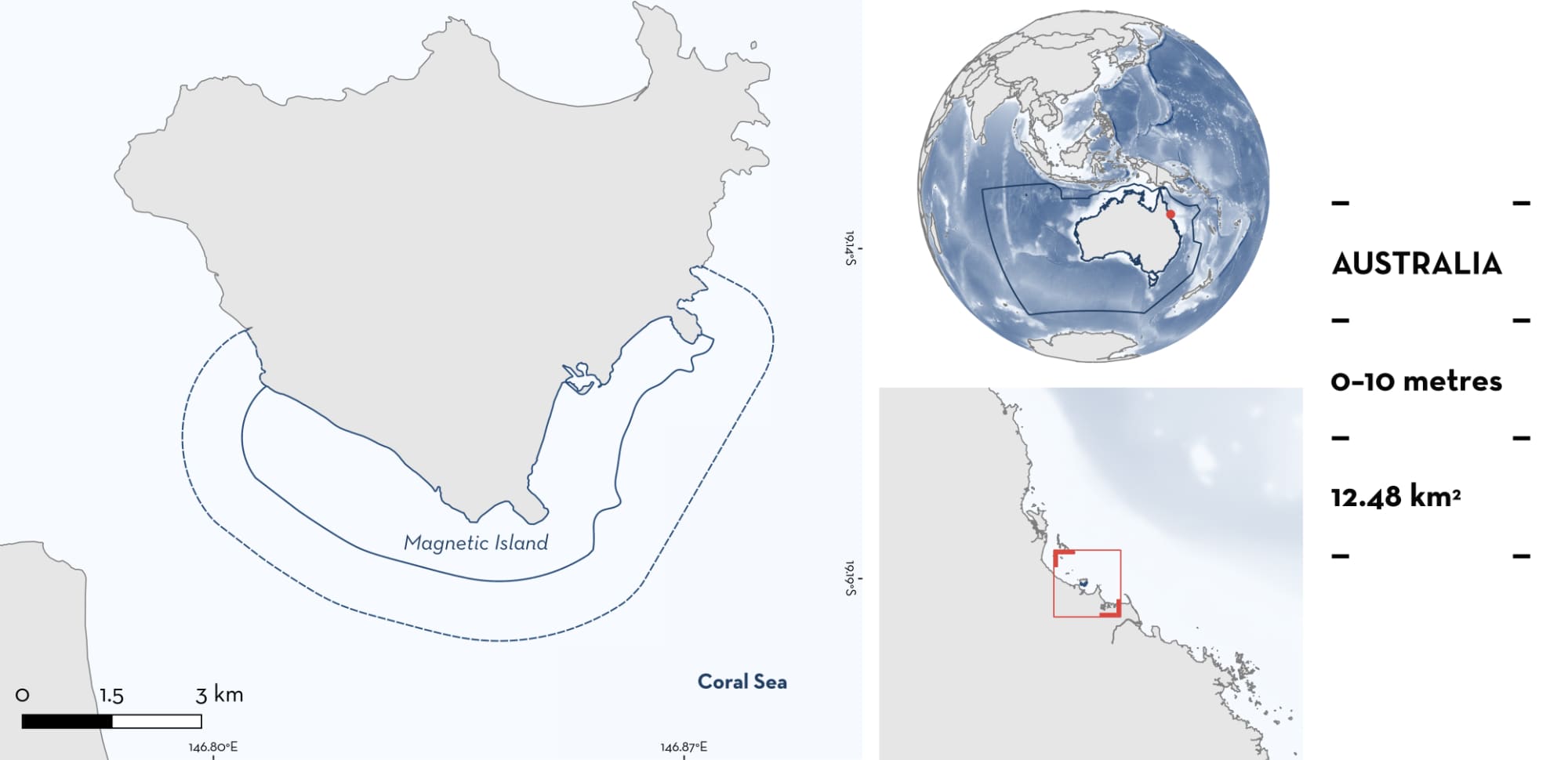
Magnetic Island is located on the southern coast of Magnetic Island, Queensland, Australia. It encompasses Cockle, Nelly, and Geoffrey bays. The area is characterised by subtidal fringing coral reefs, sand and mud substrates, fringing mangroves, and intertidal and subtidal seagrass beds. The area is influenced by wet season freshwater flood plumes, southeast dry season winds, and daily tidal cycles, which result in a prevailing turbid environment. It overlaps with the Great Barrier Reef Marine Park. Within this area there are: threatened species (e.g., Blacktip Reef Shark Carcharhinus melanopterus); and reproductive areas (e.g., Spotted Eagle Ray Aetobatus ocellatus).
Download factsheet
Magnetic Island
DESCRIPTION OF HABITAT
Magnetic Island is located on the southern coast of Magnetic Island, Queensland, Australia. The area encompasses Cockle, Nelly, and Geoffrey bays. The area is characterised by subtidal fringing coral reefs, intertidal foreshores, flats with coral rubble, rock, sand, and mud substrates, fringing mangroves, and intertidal and subtidal seagrass beds (Chin 2013; Chin et al. 2016). Coral boulder fields and fringing reefs occur along the outer edges of the bay (Chin et al. 2016).
The area is intermittently influenced by freshwater flood plumes in the wet season (January–March) from the Townsville catchment region, along with southeast dry season winds and tidal cycles (~2.0–3.5 m in magnitude), which increase turbidity (with underwater visibility typically <1 m) and limit available habitat during low tides (Chin 2013; Chin et al. 2016). Mean (± standard deviation) annual water temperature is 26.3 ± 2.3°C (Chin 2013).
Magnetic Island overlaps with the Great Barrier Reef Marine Park – Marine National Park Zone (UNEP-WCMC & IUCN 2025).
This Important Shark and Ray Area is benthic and pelagic and is delineated from inshore and surface waters (0 m) to 10 m based on the bathymetry of the area.
CRITERION A
VULNERABILITY
Two Qualifying Species considered threatened with extinction according to the IUCN Red List of Threatened Species regularly occur in the area. This is the Endangered Spotted Eagle Ray (Finucci et al. 2024) and the Vulnerable Blacktip Reef Shark (Simpfendorfer et al. 2020).
CRITERION C
SUB-CRITERION C1 – REPRODUCTIVE AREAS
Magnetic Island is an important reproductive area for one shark and one ray species.
Between October 2008–March 2011, Blacktip Reef Sharks were captured during monthly surveys using benthic-set longlines of 500 m in length (Chin 2013; Chin et al. 2013a). A total of 165 longline sets with 6,712 hooks and 207 hours were reported (Chin 2013; Chin et al. 2013a). Data on sex, presence of mating scars on females, and identification of neonates by open umbilical scars, were collected (Chin 2013; Chin et al. 2013a). During this period, a total of 127 Blacktip Reef Sharks were captured in the area with 69 individuals classified as immature (Chin 2013; Chin et al. 2013a). Size-at-birth for the species is estimated at 58.7 cm total length (TL) (Chin 2013; Chin et al. 2013b) and young-of-the-year (YOY) are up to 70 cm TL based on growth curves (Chin 2013; Chin et al. 2013b). Neonates with open umbilical scars comprised 16% of immature sharks (8.7% of the total catch) and were captured in 2009 (n = 3), 2010 (n = 3), and 2011 (n = 5). Open umbilical scars were most frequently observed in November–December. Scar closure occurred between January and March, coinciding with the period (February–March) when most neonates (n = 8) were captured (Chin 2013). Young-of-the-year (n = 32) were identified based on size (65.1–70 cm TL) (Chin 2013). Additionally, mating scars were observed in adult females ranging in size from 128–148 cm TL in March and April 2009 (n = 4) and December 2009 (n = 2). Mating and parturition in the area occurs during the austral summer (Chin 2013; Chin et al. 2013a).
During the same survey effort between 2009–2012 (Chin 2013; Chin et al. 2013a), 27 individuals ranging in size 65.5 to 155 cm TL were acoustically monitored within an array of 69 receivers covering an area of 140 km2 which included this area (Chin et al. 2016). Nine neonates, YOY, and juveniles (33.3%) were detected in the area almost daily, indicating high site fidelity, until permanent departure occurred (Residency Index mean ± standard error = 0.34 ± 0.11; Chin et al. 2013c, 2016).
Between 2023–2025, drone flights were conducted around Magnetic Island across 100 days year-round (L Scheele & O Scheele unpubl. data 2025). The drone flew an altitude (20 m) that allowed species identification and size estimation through comparison with surrounding objects. A total of ~85 neonate and YOY Blacktip Reef Sharks were observed ranging in size between 50–70 cm TL (L Scheele & O Scheele unpubl. data 2025). Neonate and YOY were observed between December 2023 and June 2025 across 13 days. Additionally, 30 small juveniles measuring up to 75 cm TL were also observed in the area.
Magnetic Island represented the area with the highest captures of Blacktip Reef Shark neonates and YOY on the east coast of Australia within a regional survey conducted between 2007–2014 (A Chin unpubl. data 2014). The resident population of Blacktip Reef Sharks is comprised of neonates, juveniles (up to 95 cm TL), and adult females year-round (Chin 2013, 2015; Chin et al. 2016; L Scheele & O Scheele unpubl. data 2025). The presence of early life-stages is also supported by regular citizen science records of individuals ranging in size between 35–60 cm TL aggregating in murky waters in coastal habitats such as mangroves, seagrass beds, and coastal mudflats within the area (iNaturalist 2025).
Between 2023–2025, 34 neonate and YOY Spotted Eagle Rays (74% of total individuals) were observed during drone flights within the area ranging in size between 40–65 cm disc width (DW; L Scheele & O Scheele unpubl. data 2025). The size-at-birth for this species is highly variable (between 18–50 cm DW) and males mature at 100–130 cm DW and females at 150–160 cm DW (Last et al. 2016). Neonates (n = 17) were visually estimated to be less than 50 cm DW and were recorded between November–August across the three years (L Scheele & O Scheele unpubl. data 2025). Aggregations (n = 6) of neonates and YOY were observed swimming together with adult individuals, with early life-stages ranging between 2–7 individuals within the larger group (11 individuals). These aggregations were observed in November 2023, June 2024, and August 2024. Although drone surveys around Magnetic Island totalled ~100 flight days per year, the area encompassed the highest rate of neonate and YOY sightings on the island, with only a single additional sighting recorded on the west coast. The regular presence of early life-stage Spotted Eagle Rays in the area highlights the reproductive importance of the area.
Download factsheet
SUBMIT A REQUEST
ISRA SPATIAL LAYER REQUEST
To make a request to download the ISRA Layer in either a GIS compatible Shapefile (.shp) or Google Earth compatible Keyhole Markup Language Zipped file (.kmz) please complete the following form. We will review your request and send the download details to you. We will endeavor to send you the requested files as soon as we can. However, please note that this is not an automated process, and before requests are responded to, they undergo internal review and authorization. As such, requests normally take 5–10 working days to process.
Should you have questions about the data or process, please do not hesitate to contact us.