ISRA FACTSHEETS
ISRA FACTSHEETS
AUSTRALIA AND SOUTHEAST INDIAN OCEAN
Middle Arm Reef
Summary
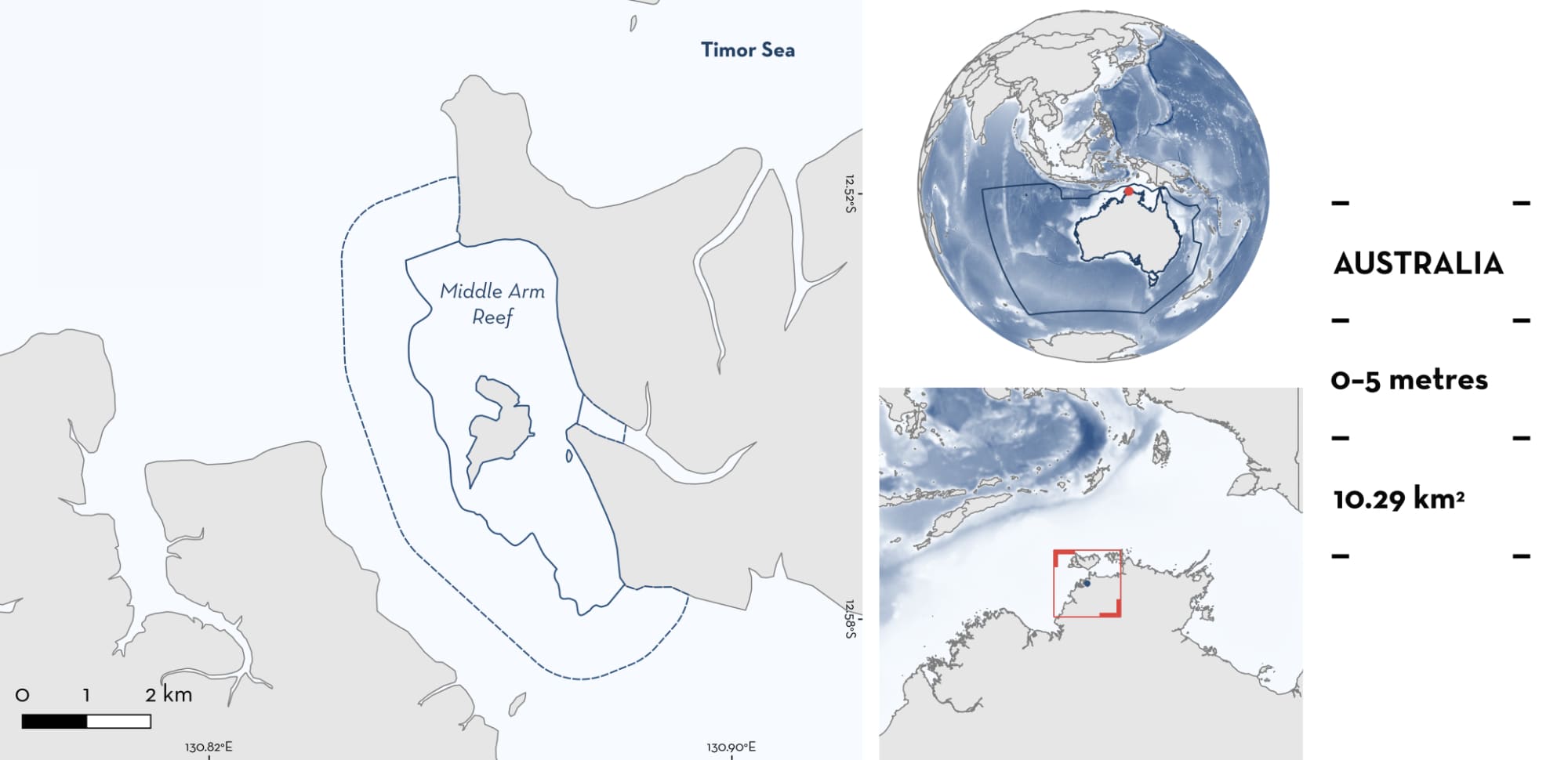
Middle Arm Reef is located in the Northern Territory, Australia. The area encompasses Channel Island which sits in Middle Arm of Darwin Harbour. The habitat isis characterised by shallow rocky reefs, macroalgae, sponges, octocorals, and filter feeder communities. It is subject to large tidal amplifications and seasonal freshwater input from the Blackmore River. Within the area there are: range-restricted species (Network Wobbegong Orectolobus reticulatus).
Download factsheet
Middle Arm Reef
DESCRIPTION OF HABITAT
Middle Arm Reef is located in the Northern Territory, Australia. The area encompasses Channel Island which sits in Middle Arm of Darwin Harbour and is characterised by shallow rocky reefs, macroalgae, sponges, octocorals, and filter feeder communities (Lucieer et al. 2025). The region is subject to a monsoonal wet-dry climate, with ~90% of rainfall occurring in the wet season (roughly November–April) (Nicholls et al. 1982). The wet season is also characterised by tropical storm activity and periodic cyclones.
Darwin Harbour is a large embayment opening to Beagle Gulf in the Timor Sea, Eastern Indian Ocean. Considerable freshwater input from the Elizabeth River and Blackmore River occur during the wet season. The harbour is subject to large semi-diurnal tidal amplifications, with a maximum tidal range of 0.1–7.8 m and tidal currents ranging from 0.25–1.40 ms-1 (Semeniuk 1985). Water temperatures may reach 36°C at high tide, with tide pools exceeding 43°C at low tide (Ferns 2016). As such, reef flats in Darwin Harbour are subjected to a wide variety of daily and seasonal fluctuations in temperature, light availability, and sedimentation (Ferns 2016).
This Important Shark and Ray Area is benthic and is delineated from inshore and surface waters (0 m) to 5 m based on the depth range of habitat in the area.
CRITERION B
RANGE RESTRICTED
Middle Arm Reef holds the regular presence of Network Wobbegong as a resident range-restricted species. Records were collated from the citizen science database iNaturalist (iNaturalist 2025), the Atlas of Living Australia (ALA 2025), and unpublished observations (SR Amini unpubl. data 2024). These records come from direct observations, recreational fishing catches, and vouchered museum specimens. Records within the area were compared to all records for the Northern Territory and across the species’ entire distribution.
Of the 13 available observations of Network Wobbegong across the Northern Territory, 10 are from Middle Arm Reef, with 19 individuals being observed in total (Last et al. 2008; ALA 2025; iNaturalist 2025; SR Amini unpubl. data 2024). Of these, there are six iNaturalist observations in the area from 2023 (n = 1 observation; 1 individual), 2024 (n = 3; 7 individuals), and 2025 (n = 2; 5 individuals), in the months of April, May, June, and July (iNaturalist 2025). There is a single preserved specimen collected from the area in July 2015 (ALA 2025) and an additional three unpublished observations of five individuals made in 2024 during April, June, and July (SR Amini unpubl. data 2024). Although the citizen science monitoring effort is not standardised, this area has the highest concentration of iNaturalist records (55%) across the species’ entire range (Northern Territory and Western Australia; iNaturalist 2025) and represents one of only two locations of preserved specimens from the Northern Territory (ALA 2025). This species was originally described from four specimens collected across its known geographic range, with only one specimen from Darwin Harbour prior to 2015 (Last et al. 2008; Last & Stevens 2009). Available records are restricted to these sources as Network Wobbegong is a rare and data poor species (Kyne et al. 2021), with no dedicated research projects and there are no available fishery data. This species is of no commercial value and is not subject to catch monitoring, although fishery interactions are suspected to be limited due to its habitat and occurrence in very shallow waters outside of commercial fishing grounds (Kyne et al. 2021). Network Wobbegong are restricted to the North Australian Shelf Large Marine Ecosystem (LME) and the Northwest Australian Shelf LME.
Download factsheet
SUBMIT A REQUEST
ISRA SPATIAL LAYER REQUEST
To make a request to download the ISRA Layer in either a GIS compatible Shapefile (.shp) or Google Earth compatible Keyhole Markup Language Zipped file (.kmz) please complete the following form. We will review your request and send the download details to you. We will endeavor to send you the requested files as soon as we can. However, please note that this is not an automated process, and before requests are responded to, they undergo internal review and authorization. As such, requests normally take 5–10 working days to process.
Should you have questions about the data or process, please do not hesitate to contact us.