ISRA FACTSHEETS
ISRA FACTSHEETS
AUSTRALIA AND SOUTHEAST INDIAN OCEAN
Milman Island
Summary
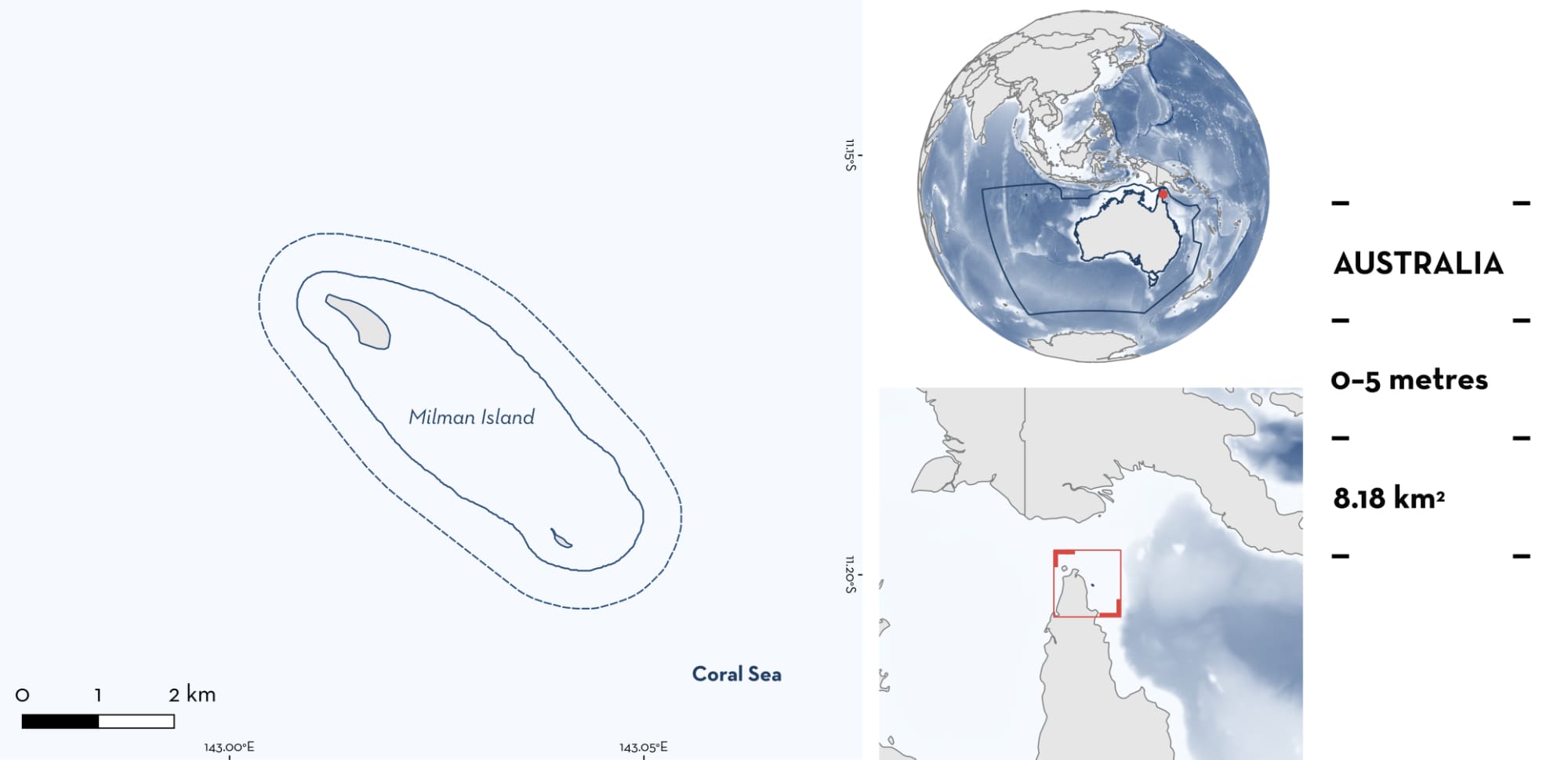
Milman Island is located off Cape York Peninsula, Queensland, Australia. It encompasses Milman Island and Aplin Islet and is part of the Denham group of islands. The area is characterised by a large reef flat, fringed with a rubble reef crest. It is influenced by strong tidal and wind-driven currents, seasonal wind regimes, and a restricted circulation. It overlaps with the Cape York to Cape Grenville Islands Key Biodiversity Area and the Great Barrier Reef Marine Park. Within this area there are: threatened species (e.g., Blacktip Reef Shark Carcharhinus melanopterus); and reproductive areas (e.g., Giant Guitarfish Glaucostegus typus).
Download factsheet
Milman Island
DESCRIPTION OF HABITAT
Milman Island is located off Cape York Peninsula, Queensland, Australia. It is situated 45 km offshore of Cape York Peninsula. The area encompasses Milman Island and Aplin Islet and is part of the Denham group of islands. It is an uninhabited, densely wooded sand cay connected to Aplin Islet, a small coral rubble island. The area is characterised by a large reef flat with sand, fringed with a rubble reef crest that extends around most of the island and dries during low tide (Freeman 2019; Freeman & Wright 2021).
The area is influenced by strong tidal and wind-driven currents, seasonal wind regimes, and a restricted circulation with the Coral Sea due to the presence of a barrier reef, functioning as a semi-enclosed shelf (Wolanski & Lambrechts 2020). During the trade wind season (austral winter), consistent south-easterly winds intensify northward-flowing currents and slow southward-flowing currents. In the monsoon season (during summer), there is little effect on currents from surface winds (Steinberg 2023).
Milman Island overlaps with Cape York to Cape Grenville Islands Key Biodiversity Area (KBA 2025) and the Great Barrier Reef Marine Park – Marine National Park Zone (UNEP-WCMC & IUCN 2025).
This Important Shark and Ray Area is benthic and pelagic and is delineated from inshore and surface waters (0 m) to 5 m based on the bathymetry of the area.
CRITERION A
VULNERABILITY
Two Qualifying Species considered threatened with extinction according to the IUCN Red List of Threatened Species regularly occur in the area. These are the Critically Endangered Giant Guitarfish (Kyne et al. 2019) and the Vulnerable Blacktip Reef Shark (Simpfendorfer et al. 2020).
CRITERION C
SUB-CRITERION C1 – REPRODUCTIVE AREAS
Milman Island is an important reproductive area for one shark and one ray species.
Between 2019–2021, three research expeditions were conducted around Milman Island to monitor sea turtles, during which opportunistic observations of Blacktip Reef Sharks were obtained (Freeman & Wright 2021; A Freeman unpubl. data 2025). Body sizes of animals were visually estimated (Freeman & Wright 2021). Over four weeks in January–February 2020, nine aggregations of between 5–10 neonate and young-of-the-year (YOY) Blacktip Reef Sharks with an estimated size of 50 cm total length (TL) were observed in very shallow water (0.5 m) adjacent to a sandy beach (Freeman & Wright 2021). Published size-at-birth for the species in the region ranges between 51─54 cm TL (Chin et al. 2013), indicating that these were neonates or YOY. In northern Australia, Blacktip Reef Sharks give birth from December to March (Chin et al. 2013). Aggregations of neonates/YOY (estimated size 50 cm TL) were also recorded in February 2021, ranging from 6–7 individuals, while similar sized individuals were also recorded in February 2019. However, in 2019 only solitary individuals were sighted (A Freeman unpubl. data 2025). During all turtle monitoring field trips in 2019–2021 during January and February, adult and juvenile Blacktip Reef Sharks were also regularly observed in the area (A Freeman unpubl. data 2025).
Between 2015–2023, four turtle monitoring field trips were conducted on the island, during which opportunistic observations of Giant Guitarfish were obtained. In 2019, standardised surveys specific for Giant Guitarfish (n = 22) were carried out along a 450 m beach transect for 10-min at the water’s edge. Individuals were counted during the day and night, with a maximum of two transects surveyed per day (Freeman 2019). Size data were obtained by comparing a subset of individuals (n = 15) against a submerged builder’s tape laid on the benthos, while prior to 2019, sizes were visually estimated (Freeman 2019). Between 2015–2023, an estimated 487 neonate and YOY Giant Guitarfish were observed, though this estimate may include duplicate counts across some transects (Freeman 2019; A Freeman unpubl. data 2025). Measured individuals ranged between 35─45 cm TL (Freeman 2019). Size-at-birth for the species ranges between 38─40 cm TL (Last et al. 2016), and nearly all the animals recorded were within this size range, indicating they were neonates or YOY. The number of individuals counted per transect ranged between 1–61 with the highest estimates coinciding with the highest tides when the lagoon was 1.5─3.0 m deep (Freeman 2019). In 2019, the average number of animals counted when tide height was less than 2 m was 7.6 individuals, while higher than 2 m, the mean number of rays was 28 individuals (Freeman 2019). Giant Guitarfish occurred in extremely shallow water, sometimes as little as 0.1 m deep at high tide, occasionally exposing their dorsal fins, and exhibited behaviours ranging from burying in the sand to moving parallel to the shoreline. The shoreline margin may provide a critical resting area and a refuge from predators. Several predators are present in the wider area, including small to medium-sized Estuarine Crocodiles Crocodylus porosus, which have occasionally been sighted in the lagoon, as well as Whitetip Reef Sharks Triaenodon obesus and Blacktip Reef Sharks (A Freeman unpubl. data 2025).
Download factsheet
SUBMIT A REQUEST
ISRA SPATIAL LAYER REQUEST
To make a request to download the ISRA Layer in either a GIS compatible Shapefile (.shp) or Google Earth compatible Keyhole Markup Language Zipped file (.kmz) please complete the following form. We will review your request and send the download details to you. We will endeavor to send you the requested files as soon as we can. However, please note that this is not an automated process, and before requests are responded to, they undergo internal review and authorization. As such, requests normally take 5–10 working days to process.
Should you have questions about the data or process, please do not hesitate to contact us.