
ISRA FACTSHEETS
ISRA FACTSHEETS
CENTRAL AND SOUTH AMERICAN PACIFIC REGION
Humboldt Current and Transition Zone
Summary
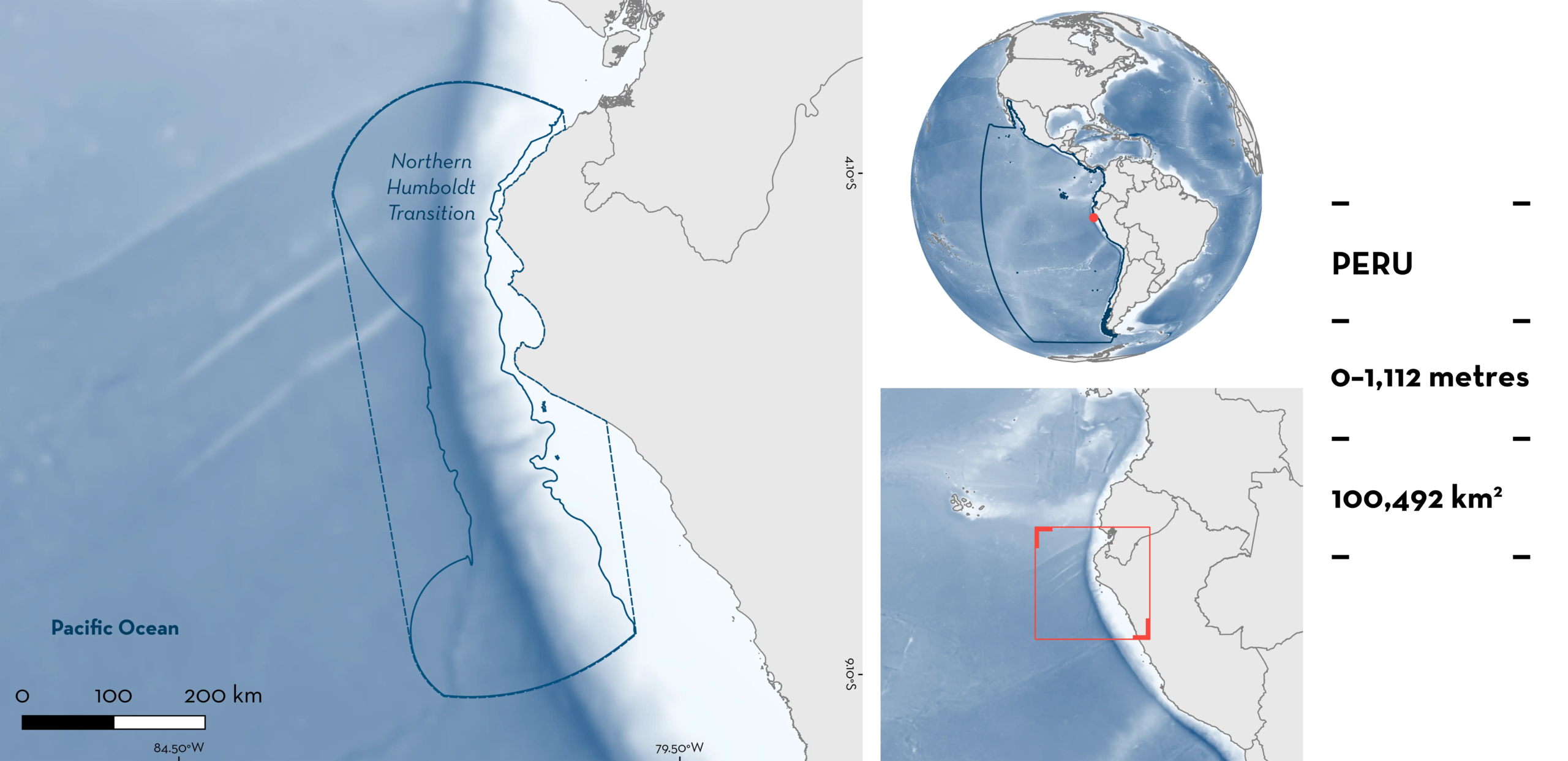
Northern Humboldt Transition is located in northern Peru. The area is characterised by several oceanographic features, including the Equatorial Front and the Northern Humboldt Current System, within which major upwelling centres are located. It also is influenced by the Gulf of Guayaquil which constitutes the most important estuary associated to the largest fluvial system of the entire western slope of the Andes. Within this area there are: threatened species (e.g., Munk’s Pygmy Devil Ray Mobula munkiana); reproductive areas (Spinetail Devil Ray Mobula mobular); feeding areas (e.g., Common Thresher Alopias vulpinus) and, undefined aggregations (e.g., Bentfin Devil Ray Mobula thurstoni).
Download factsheet
Humboldt Current and Transition Zone
DESCRIPTION OF HABITAT
Northern Humboldt Transition is located in northern Peru (Tumbes, Piura, Lambayeque, and La Libertad regions). The Equatorial Front is a transition zone between the water masses transported by the El Niño and Humboldt currents. Unique hydrography features of the Equatorial Front enhance the high biomass of zooplankton (i.e., copepods and euphausiids) associated to the southern part of the front (Jimenez & Bonilla 1980). The highest level of primary production occurs during the austral summer and autumn (Pennington et al. 2006).
The Gulf of Guayaquil is the largest and most important estuary on the southeast Pacific coast (Stevenson 1981). It is characterised by a great biological productivity due to the oceanographic conditions associated with the Equatorial Front, and interaction of various types of water (i.e., oceanic and freshwater) (CBD 2020). In the gulf, 23 hydrographic basins discharge and the Guayas River Basin constitutes the most important fluvial system of the Andes western slope. The area contains high phytoplankton diversity and fish eggs and larvae abundance (Jimenez & Bonilla 1980).
Globally, the Northern Humboldt Current System (NHCS) is one of the most productive systems due to a marine-coastal upwelling that produces high zooplankton abundance (Pennington et al. 2006). The endemic Humboldt Krill Euphausia mucronata plays a keystone role in the food web of the Humboldt Current System as a principal prey for filter-feeding fishes (Antezana 2010; Massing et al. 2022). Within the NHCS, six major upwelling centers have been identified (CBD 2020). The upwellings tend to be associated with coastline irregularities (Chavez & Messie 2009). These centres are crucial for the NHCS to re-establish itself after an El Niño event and serve as a refuge to marine organisms, given the persistence of the upwelling (CBD 2020). In this area, one of the six major upwelling centres are located (i.e., Punta Illescas). Punta Illescas represents the northern most upwelling centre with unique coastal topography and contains the narrowest part of the continental shelf (Jacox & Edwards 2011). Along the Peruvian continental margin, the area between -5.25 to -7.5 has the highest number and the largest size of marine canyons (Gutierrez et al. 2009) which enhances local production causing pelagic predators to aggregate for feeding (Fernandez-Arcaya et al. 2017).
The area overlaps with four Ecologically or Biologically Significant Marine Areas (EBSAs): Equatorial Front, Gulf of Guayaquil, Northern Humboldt Current System (NHCS), and Major Upwelling Centers and Seabirds Associated with the NHCS (CBD 2020).
This Important Shark and Ray Area is pelagic and is delineated from surface waters (0 m) to a depth of 1,112 m based on the global depth range of Qualifying Species.
CRITERION A
VULNERABILITY
Five Qualifying Species considered threatened with extinction according to the IUCN Red List of Threatened Species regularly occur in the area. Threatened sharks comprise one Endangered species, and one Vulnerable species; threatened rays comprise one Vulnerable species and two Critically Endangered species (IUCN 2025).
CRITERION C
SUB-CRITERION C1 – REPRODUCTIVE AREAS
Northern Humboldt Transition is an important reproductive area for one ray species.
Northern Peru has been identified as one of the three most important habitats for Spinetail Devil Ray across the eastern Pacific (Lezama-Ochoa et al. 2019a, 2019b, 2020). Peruvian fisheries that operate along the coast of this area captured and landed 98% of Spinetail Devil Rays reported nationally between 1997–2015 (Alfaro-Cordova et al. 2017; Gonzalez-Pestana et al. 2022). A total of 1,444 individuals were sampled between 2012–2016 and 2018 (IMARPE 2015; Rojas-Perea 2016; Alfaro-Cordova et al. 2017; MINAM 2021; Córdova-Zavaleta 2022; Gonzalez-Pestana et al. 2022). Throughout the years, the catch was mostly composed of neonates, young-of-the-year, and juveniles (sex ratio: 1:1). The smallest individuals measured 60 cm disc width (DW) while, over that period, the average size ranged between 143–185 cm DW. Size-at-birth has been reported as 70–85 cm DW (Notarbartolo-di-Sciara 1988) or 90–160 cm DW (Marshall et al. 2022). Based on national landing statistics and interviews with fishers and merchants, the catch reportedly increases in the austral summer (Gonzalez-Pestana et al. 2016; MINAM 2021). Data indicate that this area functions as a seasonal nursery area during the summer (Gonzalez-Pestana et al. 2016; MINAM 2021).
CRITERION C
SUB-CRITERION C2 – FEEDING AREAS
Northern Humboldt Transition is an important feeding area for two shark and one ray species.
Northern Peru has been identified as one of the three most important habitats for Spinetail Devil Ray in the eastern Pacific (Lezama-Ochoa et al. 2019a, 2019b, 2020). Peruvian fisheries operating along the coast of this area captured and landed 98% of Spinetail Devil Rays reported nationally between 1997–2015, representing the second most captured ray species by Peruvian fisheries (Alfaro-Cordova et al. 2017; Gonzalez-Pestana et al. in press). The species’ distribution is associated with productive upwelling systems in which Peru contains one of the largest aggregations (Alfaro-Cordova et al. 2017; Lezama-Ochoa et al. 2019a, 2019b, 2020). The most important prey of Spinetail Devil Ray is the endemic euphausiid Humboldt Krill during the summer and winter (90–92% IRI) and copepods during the spring (47% Index of Relative Importance [IRI]) (Coasaca-Cespedes 2019). This euphausiid concentrates in the coastal upwelling of the Northern Humboldt Current System with an high abundance (specially between 5°–13°S) (Antezana 2010) overlapping with the southern part of this area. Also, the northern part of this area has high zooplankton biomass (Aronés et al. 2019). Macro-zooplankton abundance (includes euphausiids and copepods) seems highly resilient to El Niño events (Alegre et al. 2015). The NHCS is important for filter-feeding fishes, as the Peruvian Anchoveta Engraulis ringens, as well as other pelagic species, get most of their caloric energy from zooplankton (for Peruvian Anchoveta it is mostly euphausiids, followed by copepods) when compared with small pelagic fish in other upwelling ecosystems (Espinoza & Bertrand 2008; Espinoza et al. 2009). This might be one of the key factors why Peru produces more fish per surface unit than any other marine ecosystem (Chavez et al. 2008). The highly productive waters within this area represent an important feeding area for filter-feeding species.
Within this area, adult Common and Pelagic Threshers feed mainly on Humboldt Squid Dosidicus gigas (64–65% Prey Specific Index of Relative Importance [PSIRI]) (Elliot et al. 1996; Gonzalez-Pestana et al. 2019). Results indicate that 85% of the stomachs analysed included food items. In one thresher shark stomach captured in this area, twenty beaks of Humboldt Squid were found (Adriana Gonzalez-Pestana pers. obs. 2022). In Ecuador and Mexico, thresher sharks feed mainly on cephalopods with the Humboldt Squid being one of the most important prey items (Polo-Silva et al. 2009; Galván-Magaña et al. 2013; Calle-Morán et al. 2022). The Humboldt Squid represents one of the most abundant marine resources as this is the most caught invertebrate species worldwide and Peru has the largest volumes captured (FAO 2022). Within Peru, historically the largest fishery has been concentrated in northern Peru (Csirke et al. 2018) within this area. During warm periods (El Niño events or summers), Humboldt Squids aggregate in the most northern Major Upwelling Centers Associated with the NHCS EBSA (located in the central area of this area; traditional ecological knowledge from fishers), as these centres serve as a refuge, given the persistence of upwelling in them (CBD 2017; Jian et al. 2020). Therefore, this area represents an important feeding area for these species in the Eastern Pacific, as their main prey is exceptionally abundant. Common Thresher and Pelagic Thresher have been the fourth most captured shark species in Peruvian fisheries and the second most frequently captured shark species off northern Peru between 1997–2010 (Gonzalez-Pestana et al. 2014). Until 2020, the most important landing points for these species overlapped with this area (up to 89% of total landings).
CRITERION C
SUB-CRITERION C5 – UNDEFINED AGGREGATIONS
Northern Humboldt Transition is important for undefined aggregations of two ray species.
Between 1993–2014, the tuna purse seine fishery in the Eastern Pacific was assessed using data from the observer program of the Inter-American Tropical Tuna Commission (IATTC) (Lezama-Ochoa et al. 2019a). This area hosts one of the largest known aggregations of Munk’s Pygmy Devil Ray and Bentfin Devil Ray, as indicated by the number of individuals observed per set, with reported catches of 20–50 and more than 50 individuals per set. Therefore, this area was identified as one of the three most important habitats for these two species within their distribution in the Eastern Pacific (Lezama-Ochoa et al. 2019a). The largest aggregations of Munk’s Pygmy Devil Ray have been recorded in this area (Lezama-Ochoa et al. 2019a).
Between 2000–2023, mobulid ray landings along the coast of Peru were assessed through analyses of historical catch records, monitoring of landing sites, and interviews with fishers (n = 37) (Rojas-Perea et al. 2025). Peru ranked among the top mobulid fisheries globally, for which the Munk’s Pygmy Devil Ray and Bentfin Devil Ray were among the most captured species, after the Spinetail Devil Ray (Rojas-Perea et al. 2025). The largest landing sites were located in Tumbes and Piura and La Libertad, adjacent to this area.
Munk’s Pygmy Devil Ray pregnant females have been reported while monitoring landing sites representing 15% (eight pregnant females) (Rojas-Perea 2016) and 14% (twenty-one pregnant females) (Rojas-Perea et al. 2025) of the total number of individuals sampled in each study. This area might be also functioning as an important feeding area as their abundance is associated with a productive upwelling system (Lezama-Ochoa et al. 2019a). Further information is required to understand the nature and function of these aggregations.
Download factsheet
SUBMIT A REQUEST
ISRA SPATIAL LAYER REQUEST
To make a request to download the ISRA Layer in either a GIS compatible Shapefile (.shp) or Google Earth compatible Keyhole Markup Language Zipped file (.kmz) please complete the following form. We will review your request and send the download details to you. We will endeavor to send you the requested files as soon as we can. However, please note that this is not an automated process, and before requests are responded to, they undergo internal review and authorization. As such, requests normally take 5–10 working days to process.
Should you have questions about the data or process, please do not hesitate to contact us.

