ISRA FACTSHEETS
ISRA FACTSHEETS
NORTH AMERICAN PACIFIC
Northwest Baja California Canyons
Summary
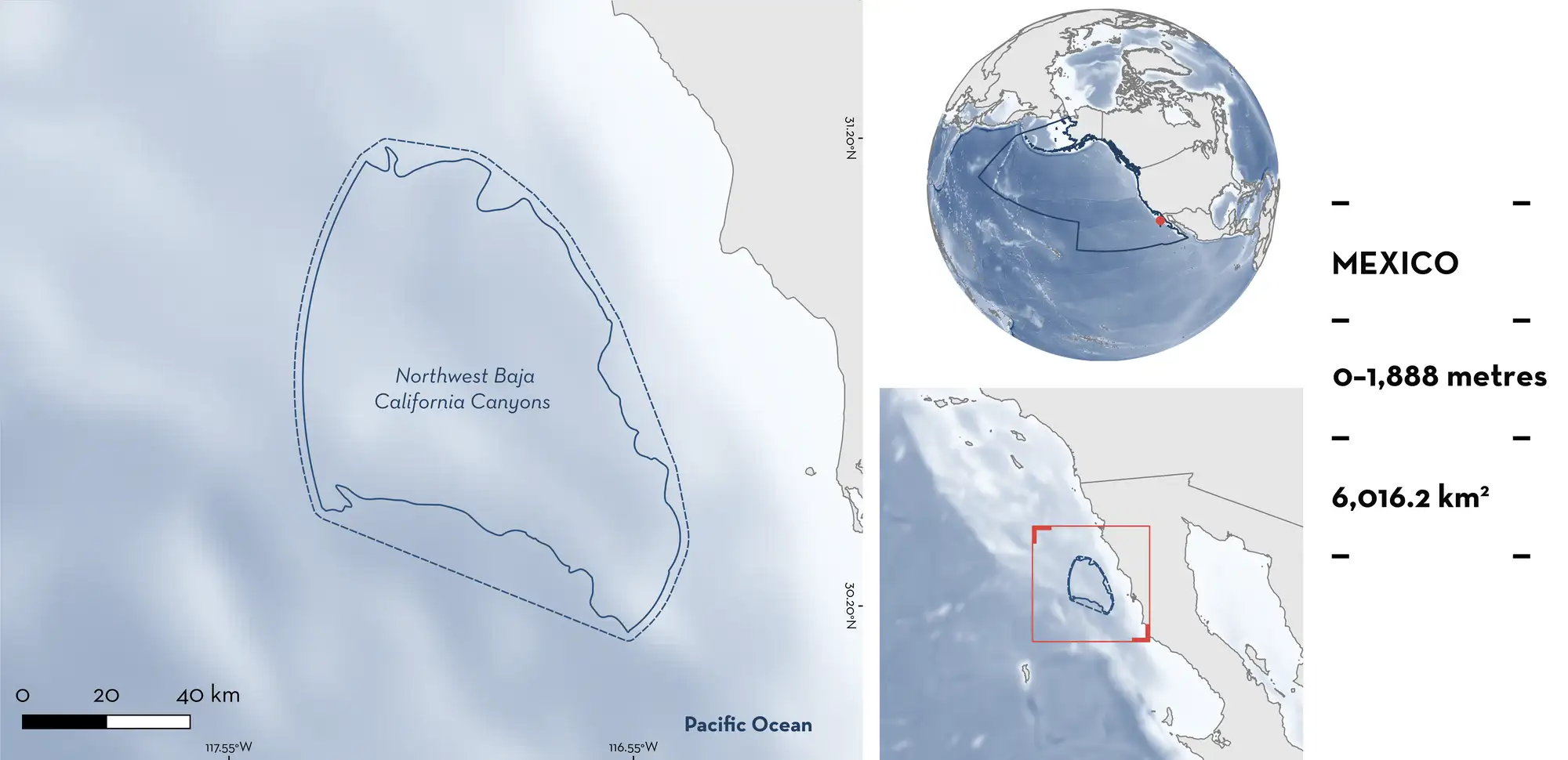
Northwest Baja California Canyons is located in oceanic waters off Baja California, Mexico. This area is highly productive and characterised by multiple canyons and escarpments. The influence of the California Current brings upwelling events during the boreal spring and summer. Within this area there are: threatened species and reproductive areas (Shortfin Mako Isurus oxyrinchus).
Download factsheet
Northwest Baja California Canyons
DESCRIPTION OF HABITAT
Northwest Baja California Canyons is located in oceanic waters off Baja California, Mexico. It is situated ~50 km off the coast extending from Santo Tomás to San Quintín. The area is characterised by multiple canyons and escarpments.
This area is influenced by the dynamics of the California Current, a surface current carrying water equatorward along the Pacific coast of North America, which is characterised by low temperatures, low salinities, and high dissolved oxygen (Lynn & Simpson 1987). It is a highly productive area due to high levels of upwelling, especially during boreal spring and summer (Zaytsev et al. 2003).
This Important Shark and Ray Area is pelagic and is delineated from surface waters (0 m) to 1,888 m based on the global depth range of Qualifying Species.
CRITERION A
VULNERABILITY
One Qualifying Species considered threatened with extinction according to the IUCN Red List of Threatened Species regularly occurs in the area. This is the Endangered Shortfin Mako (Rigby et al. 2019).
CRITERION C
SUB-CRITERION C1 – REPRODUCTIVE AREAS
Northwest Baja California Canyons is an important reproductive area for one shark species.
Neonate and young-of-the-year (YOY) Shortfin Makos have been regularly recorded in the area (Carreón-Zapiain et al. 2018). Industrial shark longline fisheries operating off the west coast of the Baja California Peninsula were monitored by on-board observers between 2006–2013 (Carreón-Zapiain et al. 2018). During this period, 5,740 Shortfin Makos were measured, ranging between 70–362 cm total length (TL; Carreón-Zapiain et al. 2018). The smallest individuals had similar sizes to the reported size-at-birth for the species (60–70 cm TL; Ebert et al. 2021). YOY were defined as individuals <100 cm TL which coincides with age-and-growth studies from the region (Rodríguez-Madrigal et al. 2023). Of the individuals measured, ~530 (~9.2%) were classified as neonate/YOY. Northwest Baja California Canyons was the area with the highest number of neonate/YOY recorded across the whole west coast of the Baja California Peninsula and these life-stages were recorded in higher numbers between July–December (Carreón-Zapiain et al. 2018). This species is caught inside the area by the longline fleet based in Ensenada, Baja California (Carrillo-Colín et al. 2021). Between 2006–2018, 3,116 Shortfin Makos were measured by on-board observers monitoring this fleet, of which ~610 (19.6%) measured between 60–100 cm TL and were classified as neonate/YOY. Shortfin Makos were caught in the same months (July–November) and fishing areas as the previous report suggesting this area is still important for early life-stages (Carrillo-Colín et al. 2021).
Download factsheet
SUBMIT A REQUEST
ISRA SPATIAL LAYER REQUEST
To make a request to download the ISRA Layer in either a GIS compatible Shapefile (.shp) or Google Earth compatible Keyhole Markup Language Zipped file (.kmz) please complete the following form. We will review your request and send the download details to you. We will endeavor to send you the requested files as soon as we can. However, please note that this is not an automated process, and before requests are responded to, they undergo internal review and authorization. As such, requests normally take 5–10 working days to process.
Should you have questions about the data or process, please do not hesitate to contact us.