
ISRA FACTSHEETS
ISRA FACTSHEETS
NORTH AMERICAN PACIFIC
Petrel Bank
Summary
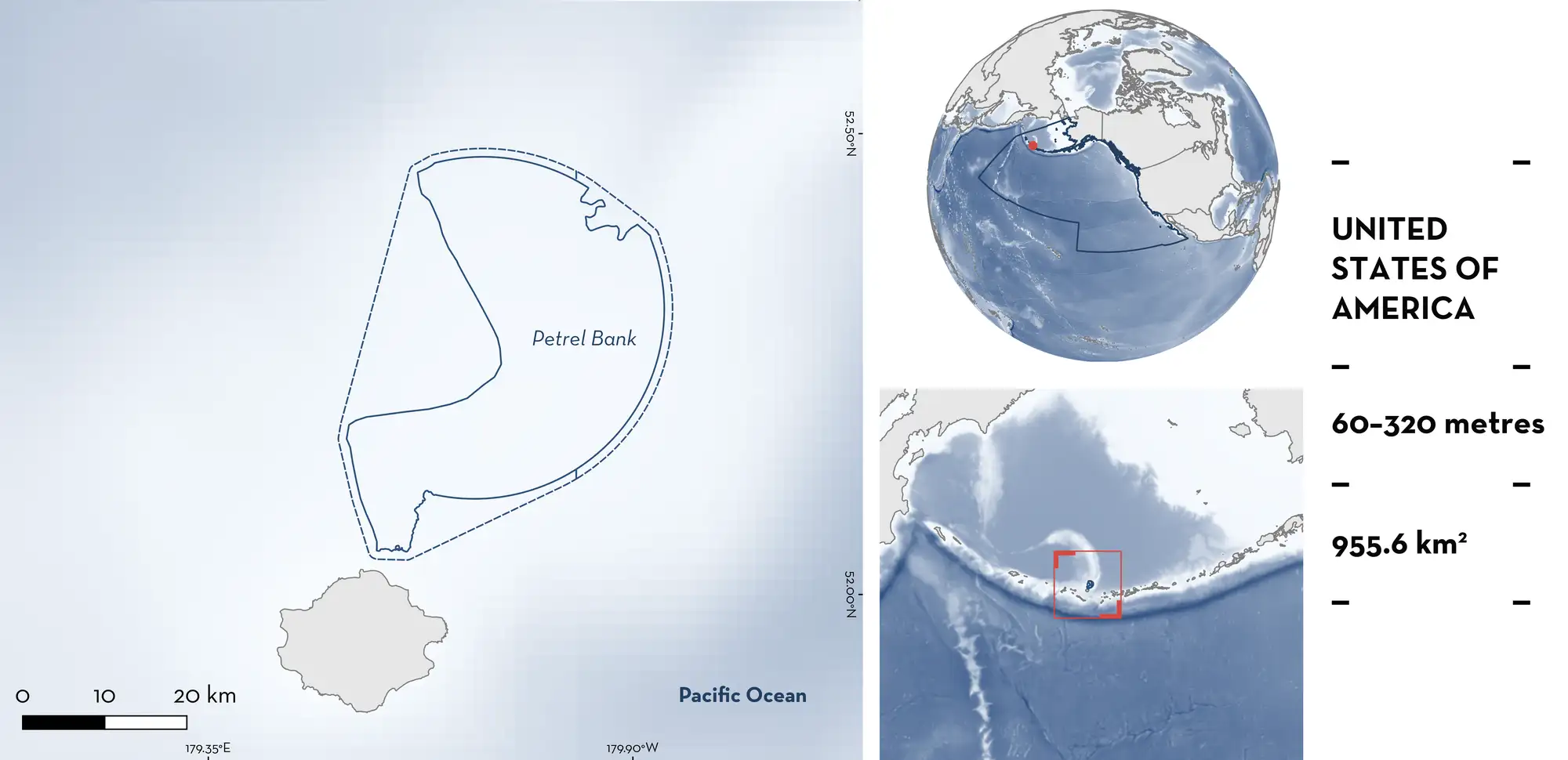
Petrel Bank is located in Alaskan waters of the United States of America. It is situated north of Semisopochnoi Island and next to the Amchitka Pass, in the western part of the Aleutian Archipelago. The area is characterised by sandy and rocky substrates, coral and sponge communities, and strong eddy activity that promotes primary productivity. Within this area there are: range-restricted species (Leopard Skate Bathyraja panthera).
Download factsheet
Petrel Bank
DESCRIPTION OF HABITAT
Petrel Bank is located in Alaskan waters of the United States of America. It is situated north of Semisopochnoi Island (one of the nine islands within the Rat Islands group) and sits next to the Amchitka Pass, in the western part of the Aleutian Archipelago (Zimmermann & Prescott 2020). This is the largest pass in the region and separates the Aleutian Trench (Pacific Ocean) and the Bering Sea (Hunt & Stabeno 2005; Khudyakova et al. 2025). The area is characterised by sandy and rocky substrates with sponge and coral communities (Rooper et al. 2014; NOAA-AFSC 2026).
This area is influenced by the Alaska Stream, an intense boundary current flowing westward along the shelf break and the Aleutian Trench (Budyansky et al. 2022). This current enters into the Bering Sea through the deepest straits of the Aleutian Archipelago, including Near Strait (Khudyakova et al. 2025). It has strong eddy activity that transports relatively warm, salty, and nutrient-rich waters promoting primary production and defining the water flow through all the straits in the Aleutian Islands (Rogachev & Shlyk 2018; Mordy et al. 2023). Bottom water temperature ranges ~3–5°C (NOAA-AFSC 2026)
This Important Shark and Ray Area is benthic, subsurface, and is delineated from 60–320 m based on the depth range of Qualifying Species in the area.
CRITERION B
RANGE RESTRICTED
This area holds the regular presence of Leopard Skate as a resident range-restricted species. This species has been regularly recorded during trawl surveys conducted in the area for several decades. Between 1982–2025, the Alaska Fisheries Science Center (AFSC) – National Oceanic and Atmospheric Administration (NOAA) conducted trawl surveys during late boreal spring and summer in the Bering Sea, the Aleutian Islands, and the Gulf of Alaska. Temporal coverage of the surveys varies by region, with most conducted annually (e.g., continental shelf surveys in the Bering Sea), or biennially (e.g., Gulf of Alaska) since 1999 (Hoff 2016; Siple et al. 2024; Markowitz et al. 2025; Dowlin et al. 2026). The continental slope survey in the Bering Sea stopped in 2016 (Markowitz et al. 2025). Surveys were conducted at fixed stations or following a stratified random survey design and covering depths from 0–1,000 m divided into multiple depth strata across 300–500 stations per region. In general, otter trawls of ~25 m headrope and ~34 m footrope were used and tows lasted between 15–30 minutes at a speed of ~3 knots. Catch-per-unit-effort (CPUE) was estimated as the number of individuals/number of egg cases per square kilometre (no/km2) and the area swept (km2) as the linear distance towed, multiplied by the mean net width (Hoff 2016; Siple et al. 2024; Markowitz et al. 2025; Dowlin et al. 2026).
Between 2006–2024, the presence of Leopard Skates was recorded in 300 tows during trawl surveys. Of these tows, 16 (5.3%) were recorded inside this area in all biennial surveys conducted up to 2018 (NOAA-AFSC 2026). The second highest mean CPUE (mean = 159.1 individuals/km2; 34.8–754.3 individuals/km2) for Leopard Skate in the whole region was reported from this area (average CPUE outside the area = 86.4 individuals/km2; 34.4–559.1 individuals/km2) after Stalemate Bank (average CPUE = 338.4 individuals/km2; 37.2–1,078.7 individuals/km2).
Skates are known to aggregate, with temporal changes in aggregations related to sex and life-stage segregations (Swain & Benoît 2006; Frisk 2010; Hoff 2010). Skate aggregations are usually related to high density areas where large catch quantities occur (Bizzarro et al. 2014). In surveys undertaken in 2022 and 2024, sizes of Leopard Skates have ranged between 20–110 cm total length (TL; Dowlin et al. 2026). While size-at-birth and size-at-maturity for the species are unknown, the lengths recorded suggest that all life-stages occur in the area. Individuals were caught at depths between 60–320 m and bottom temperatures of 3.1–5.7°C (NOAA-AFSC 2026). This species occurs primarily in the Aleutian Islands Large Marine Ecosystem (LME) and marginally in the West Bering Sea LME and Eastern Bering Sea LME.
Download factsheet
SUBMIT A REQUEST
ISRA SPATIAL LAYER REQUEST
To make a request to download the ISRA Layer in either a GIS compatible Shapefile (.shp) or Google Earth compatible Keyhole Markup Language Zipped file (.kmz) please complete the following form. We will review your request and send the download details to you. We will endeavor to send you the requested files as soon as we can. However, please note that this is not an automated process, and before requests are responded to, they undergo internal review and authorization. As such, requests normally take 5–10 working days to process.
Should you have questions about the data or process, please do not hesitate to contact us.

