
ISRA FACTSHEETS
ISRA FACTSHEETS
NORTH AMERICAN PACIFIC
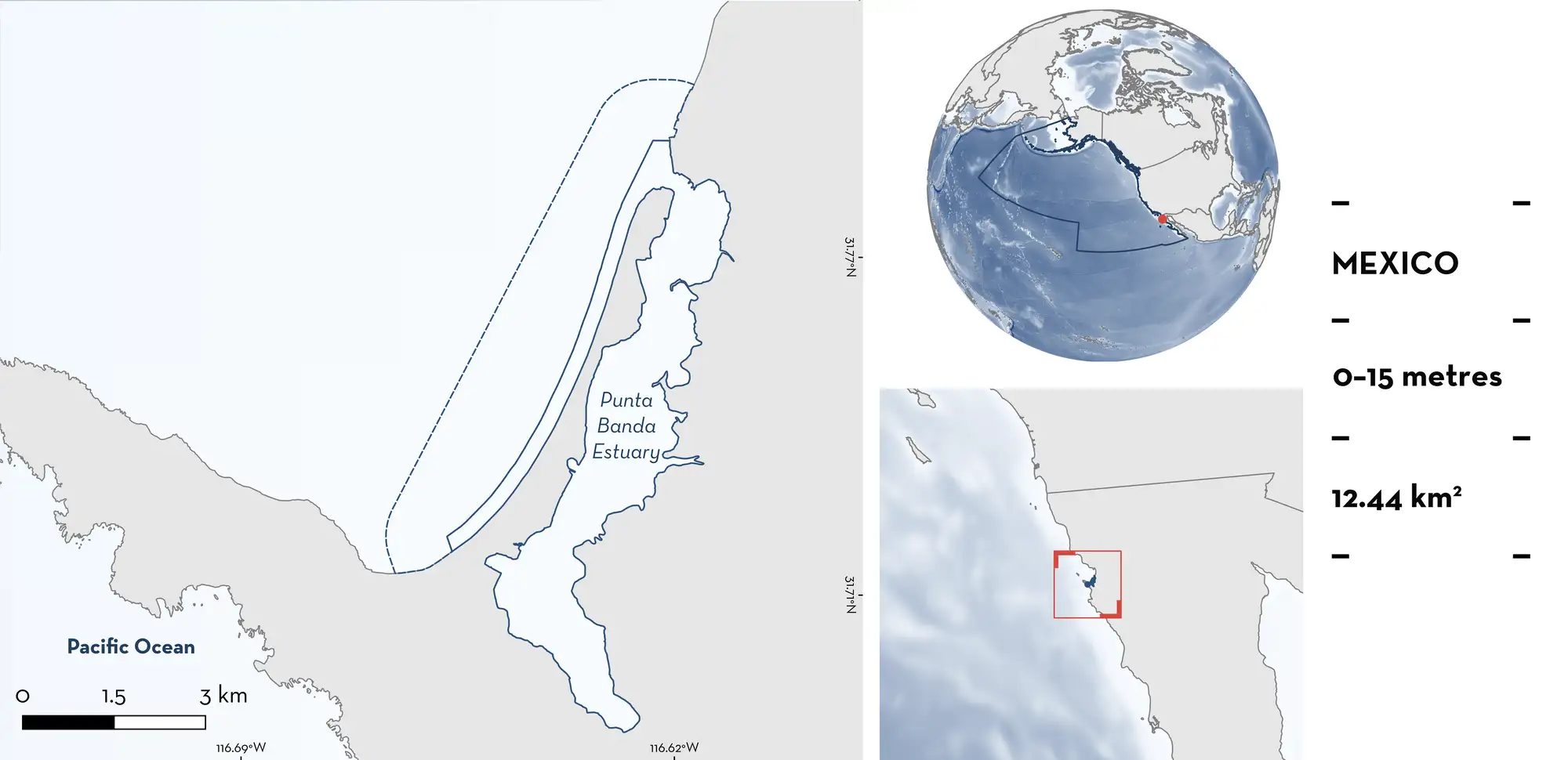
Punta Banda Estuary
Summary
Punta Banda Estuary is located in northwest Baja California, Mexico. It is a coastal lagoon connected to Todos Santos Bay by a long sandbar and is characterised by sandy substrates, marshes, mudflats, and seagrass meadows. Water exchange is primarily influenced by tides and receives productive upwelled waters from the bay, especially during the boreal spring. Within this area there are: range-restricted species (e.g., California Butterfly Ray Gymnura marmorata).
Download factsheet
Punta Banda Estuary
DESCRIPTION OF HABITAT
Punta Banda Estuary is located in northwest Baja California, Mexico. It is an L-shaped coastal lagoon in the south part of Todos Santos Bay. It connects to the bay by a 7-km-long sandbar, which contains its single inlet. The area is characterised by sandy substrates, marshes, mudflats, and seagrass meadows (Beltrán-Felix et al. 1986).
Water exchange is primarily influenced by tides, with ebb tides reaching speeds of ~1.5 m/s. Nutrient-rich waters enter into the area from the bay especially during the peak upwelling events in the boreal spring (Durazo 2009). The estuary averages 800 meters in width, ranging from 345 m at mean lower low tide to 1,100 m at mean upper high tide (Pritchard et al. 1978; González-Calvillo 1980). Sea surface temperature ranges between ~11°C in December to ~26°C in August (Solana-Arellano et al. 2009).
This Important Shark and Ray Area is benthic and pelagic and is delineated from inshore and surface waters (0 m) to 15 m based on the bathymetry of the area.
CRITERION B
RANGE RESTRICTED
This area holds the regular presence of California Butterfly Ray, Bat Ray, Shovelnose Guitarfish, and Thornback Ray as resident range-restricted species. These species occur year-round in the area and are regularly caught by shore-fishing anglers (E García-Rodríguez unpubl. data 2026). Historically, these species were recorded during fishing surveys conducted in the area between 1982–1983 (Navarro-Mendoza 1985; Beltrán-Félix et al. 1986). Surveys were conducted with otter trawls, gillnets, and beach seines. During these surveys (n = 54), 143 California Butterfly Rays, 115 Bat Rays, 80 Shovelnose Guitarfish, and 65 Thornback Rays were captured. All species were recorded year-round with California Butterfly Ray catches peaking in April–May and Shovelnose Guitarfish between April–August (Navarro-Mendoza 1985; Beltrán-Félix et al. 1986). Contemporary data indicate that these species are still caught in shore-fishing activities. Since 2020, observations of recreational fishers congregating in the area, especially during the weekends, and capturing all four species from the shore have been recorded (E García-Rodríguez pers. obs. 2026). While these species are caught every week, catches have not been quantified. Records from fish forums also highlight the regular catches of these species since 2021 and show that these species are not caught in other nearby areas as substrates are mostly rocky and are not generally associated with benthic-dwelling rays (Fishbrain 2026). These species are known to aggregate in shallow bays and lagoons (Farrugia et al. 2011; Last et al. 2016; Medina-Trujillo 2021), and Punta Banda Estuary is the only lagoon in the region with the closest being Bahía San Quintín (~150 km south). These species occur in the California Current Large Marine Ecosystem (LME) and the Gulf of California LME.
Download factsheet
SUBMIT A REQUEST
ISRA SPATIAL LAYER REQUEST
To make a request to download the ISRA Layer in either a GIS compatible Shapefile (.shp) or Google Earth compatible Keyhole Markup Language Zipped file (.kmz) please complete the following form. We will review your request and send the download details to you. We will endeavor to send you the requested files as soon as we can. However, please note that this is not an automated process, and before requests are responded to, they undergo internal review and authorization. As such, requests normally take 5–10 working days to process.
Should you have questions about the data or process, please do not hesitate to contact us.

