ISRA FACTSHEETS
ISRA FACTSHEETS
NORTH AMERICAN PACIFIC
Santa Catalina Island
Summary
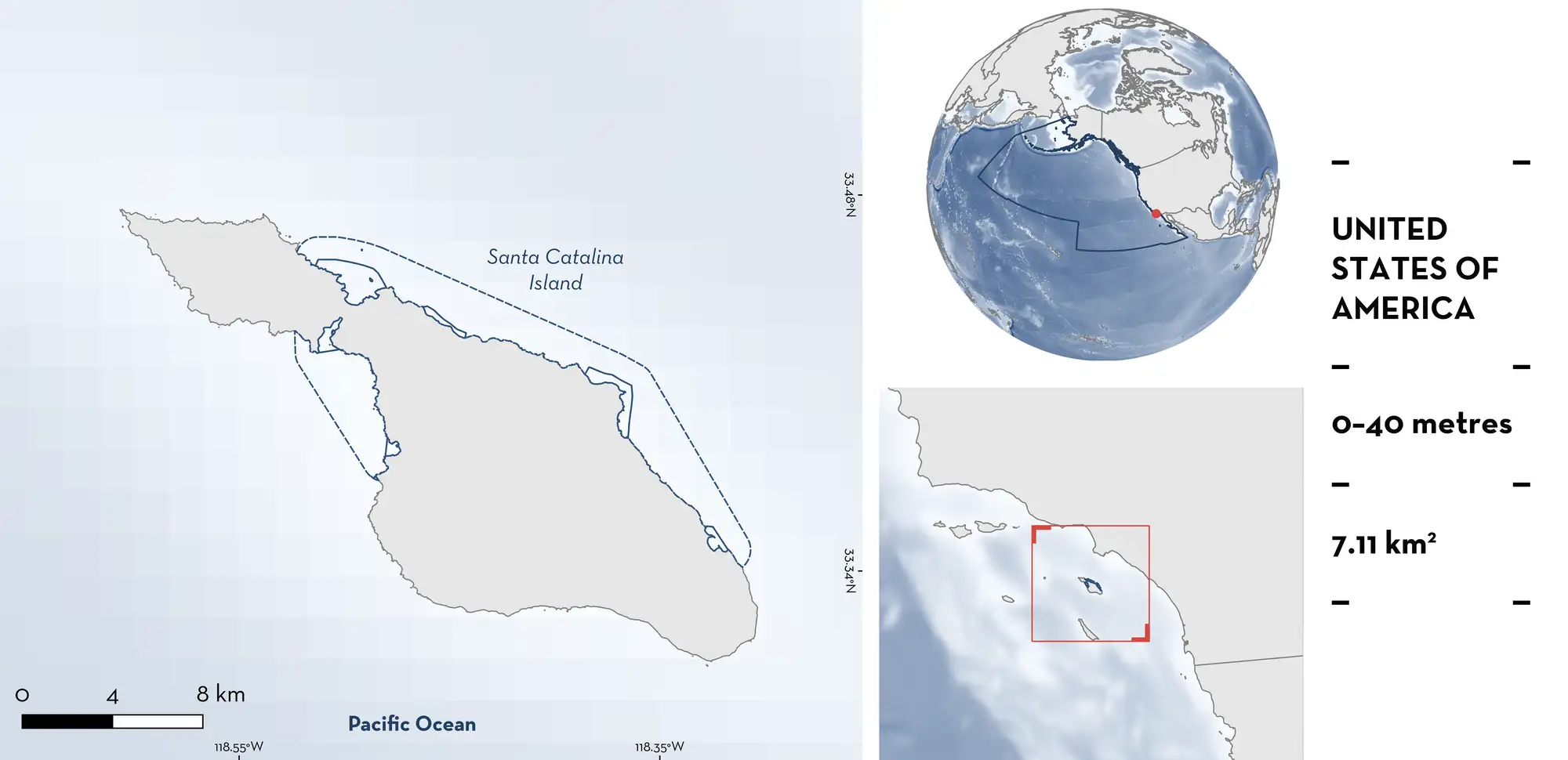
Santa Catalina Island is located in Southern California, United States of America. The island is situated ~45 km from the mainland coast. It is characterised by shallow sandy beaches, coves, small bays, rocky reefs, and kelp forests. The area overlaps with two marine protected areas. Within this area there are: range-restricted species (e.g., Bat Ray Myliobatis californicus); reproductive areas (Horn Shark Heterodontus francisci); and resting areas (e.g., Shovelnose Guitarfish Pseudobatos productus).
Download factsheet
Santa Catalina Island
DESCRIPTION OF HABITAT
Santa Catalina Island is located in Southern California, United States of America. It is situated ~45 km from the mainland coast. The island is surrounded by a narrow insular shelf that steeply drops off and can reach depths over 1,000 m. The area is characterised by shallow sandy beaches and bays, rocky reefs, and kelp forests. It includes multiple small coves (e.g., Big Fisherman’s Cove, Shark Cove) around the area with steep rocky reefs that extend between 0–40 m. Seafloor water temperatures range between 10.3–26.1°C in the boreal summer.
The area overlaps with the Blue Cavern Onshore State Marine Conservation Area, and the Long Point (Catalina Island) State Marine Reserve (UNEP-WCMC & IUCN 2026).
This Important Shark and Ray Area is benthic and pelagic and is delineated from inshore and surface waters (0 m) to 40 m based on the bathymetry of the area.
CRITERION B
RANGE RESTRICTED
This area holds the regular presence of Horn Shark, Leopard Shark, Bat Ray, and Shovelnose Guitarfish as resident range-restricted species. These species have been regularly recorded in underwater visual surveys (UVC) and from active and passive acoustic telemetry showing that residency is higher inside the small coves of the area (Manley 1995; Meese & Lowe 2019, 2020a, 2020b; May 2022). These species form resting aggregations mostly in the summer and during daytime before moving to potential foraging areas during the night. These species only occur in the California Current Large Marine Ecosystem (LME) and the Gulf of California LME.
CRITERION C
SUB-CRITERION C1 – REPRODUCTIVE AREAS
Santa Catalina Island is an important reproductive area for one shark species.
Egg cases of Horn Sharks are regularly observed in the area according to social media records (iNaturalist 2026a). No formal studies have been conducted in the area to record the presence of egg cases and the data available are from opportunistic records from citizen science posts. Of 99 records of the species reported from this area between 2018–2025, 12 (12.1%) were of egg cases deposited in the substrate between rocks and around vegetated areas (iNaturalist 2026a). Small Horn Sharks (n = 4), presumably young-of-the-year (YOY) based on their size of ~20 cm total length (TL) which is close to the reported size-at-birth for the species (~15–16 cm TL; Ebert et al. 2021) have also been recorded by divers in the area. In addition, of 69 Horn Sharks recorded between 2016–2017, 33 (47.8%) were immature and of 13 females tagged in those same years, all but one were immature (Meese & Lowe 2020a, 2020b). It has been reported that there is a population structure between islands and the California mainland for this species with Horn Sharks rarely moving across deep channels and open waters (Canfield et al. 2022). In addition, rocky reefs and kelp forest in the area provide suitable habitat for egg deposition as this area has one of the largest coverages of kelp in Southern California (Kelpwatch 2026). This highlights the importance of this area for the deposition of egg cases and early life-stages of the species
CRITERION C
SUB-CRITERION C3 – RESTING AREAS
Santa Catalina Island is an important resting area for two sharks and three ray species.
Horn Sharks rest in the area mostly during the day before moving to foraging areas at night according to active acoustic tracking and acceleration data loggers (ADL) deployed in 21 individuals during 2016 and 2017 in the area (Meese & Lowe 2020a). This process is also supported by calibrated laboratory experimentation for signal recognition of metabolic rates (Luongo & Lowe 2018). On average, females spent 88 ± 1.3% of the day resting while males spent 93.3 ± 2.2% of the day resting. Nighttime daily and core activity areas were significantly greater than during daytime, confirming resting during the day. In addition, underwater visual censuses (UVC; n = 55) consisting of 100 m transects were conducted in summer 2016 and 2017 (Meese & Lowe 2020b). In these surveys, 73 Horn Sharks were recorded with a frequency of occurrence of 56.5% in 2016 and 59.4% in 2017. All individuals rested in water temperatures between 15.7–23.0°C. Immature Horn Sharks (<58 cm TL) rested in shallower and warmer sites nearshore compared to larger individuals that were found in deeper and colder offshore reefs in the area (Meese & Lowe 2020b).
Aggregations of mature female Leopard Sharks occur regularly in the area during summer (Hight & Lowe 2007; May 2022). Between July–August 2003, visual surveys (conducted three times per day for 34 days) recorded the presence of resting aggregations of Leopard Sharks inside the area with an average (± standard deviation) of 22 ± 8 individuals and a maximum of 36 sharks recorded (Hight & Lowe 2007). In addition, during summer of 2018 and 2019, drone surveys (n = 84) were conducted in two locations inside the area, recording aggregations of 60.1 ± 7.3 and 21.5 ± 7.3 individuals (May 2022). These aggregations were associated with warm waters (22–24°C). Sixteen Leopard Sharks were tagged with a mix of acoustic tags for passive tracking (between 2004–2005) and tags with sensors to record body temperature and depth during short periods (<20 days in 2004; Hight & Lowe 2007). Tagged individuals showed an increased fidelity to thermal refugees in shallow coves inside the area during the day, compared to night when they moved outside of the area. This same pattern was already described during summer 1993 when 10 Leopard Sharks were acoustically tracked (1–23 days; Manley 1995). Individuals had smaller activity spaces and smaller movement rates in the area during the day, before moving outside the area at night and returning to the area the following morning (Manley 1995). Female Leopard Sharks use shallow and warm coves (e.g., Big Fisherman’s Cove) in the area during the day to rest before they move to deeper areas at night to potentially forage. These shallow waters in the area may provide thermal advantages that potentially increases digestion and gestation rate (Hight & Lowe 2007).
UVCs conducted in summer and fall of 2013 and 2014 revealed that Bat Rays, Shovelnose Guitarfish, and Haller’s Round Rays rest in the area (Meese & Lowe 2019). UVCs consisted of belt transects spanning 0.02 km2 and extended up to 165 m from the shore at depths <20 m. Daily abundances recorded in UVCs showed the presence of aggregations composed of 38 ± 29 Bat Rays, 18 ± 10 Shovelnose Guitarfish, and 26 ± 16 Haller’s Round Stingrays. The three species were found together resting in sandy substrates at temperatures between 18.0–18.2°C but Bat Rays were most abundant at seafloor temperatures of 20°C and also rested in areas with macroalgae coverage and seagrass beds (Meese & Lowe 2019). All these species have been regularly recorded resting in the area by citizen scientists between 2020–2025 confirming their regular presence in the area (iNaturalist 2026b, 2026c, 2026d). These species have been observed shuttling between habitat types, utilising different substrates for their ‘hunt warm – rest cool’ bioenergetic strategy (Meese & Lowe 2019).
Download factsheet
SUBMIT A REQUEST
ISRA SPATIAL LAYER REQUEST
To make a request to download the ISRA Layer in either a GIS compatible Shapefile (.shp) or Google Earth compatible Keyhole Markup Language Zipped file (.kmz) please complete the following form. We will review your request and send the download details to you. We will endeavor to send you the requested files as soon as we can. However, please note that this is not an automated process, and before requests are responded to, they undergo internal review and authorization. As such, requests normally take 5–10 working days to process.
Should you have questions about the data or process, please do not hesitate to contact us.