ISRA FACTSHEETS
ISRA FACTSHEETS
AUSTRALIA AND SOUTHEAST INDIAN OCEAN
Point Peron
Summary
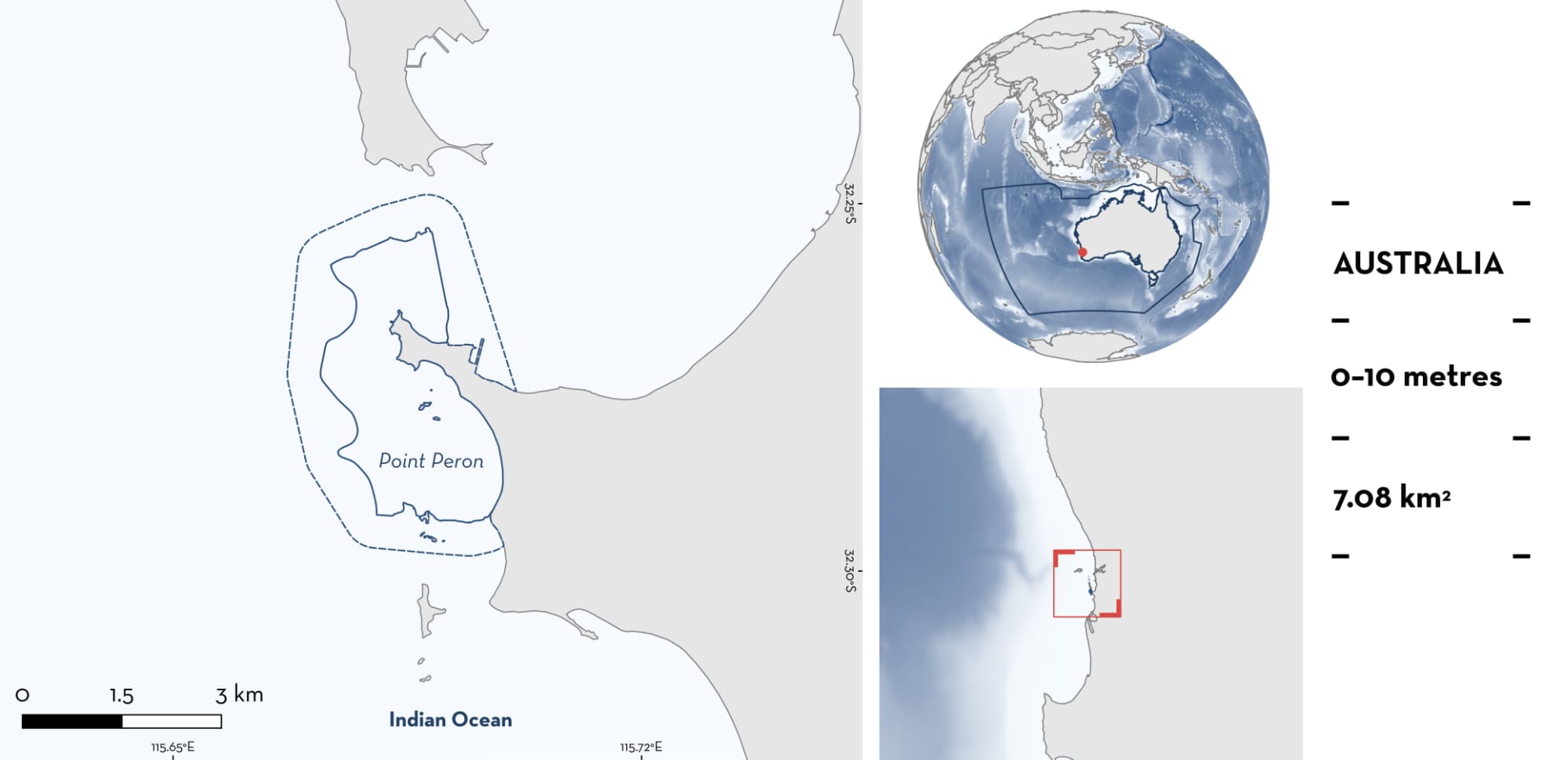
Point Peron is located in Western Australia, Australia. The area is situated off the Perth metropolitan area, adjacent to Rockingham. The habitat is characterised by macroalgal limestone reefs, seagrass, and sandy substrate. Sea surface temperature increases at the beginning of the austral summer and drops at the start of autumn. This area overlaps with the Shoalwater Islands Marine Park. Within this area there are: threatened species (e.g., Scalloped Hammerhead Sphyrna lewini); and undefined aggregations (e.g., Blacktip Shark Carcharhinus limbatus).
Download factsheet
Point Peron
DESCRIPTION OF HABITAT
Point Peron is located in Western Australia, Australia. The area is situated off the Perth metropolitan area, adjacent to Rockingham. The area is characterised by macroalgal limestone reefs, seagrass, and sandy substrate (DEC 2007). Limestone ridges and reef platforms protect the coast from south-westerly swell and waves. During the austral winter, strong storm fronts cause gale force winds, which also produce high storm surges and can combine with large waves (DEC 2007). Sea surface temperature increases at the beginning of summer (December) and drops at the start of autumn (March), ranging from 12.9 to 24.1°C (Hoang et al. 2016).
This area overlaps with Shoalwater Islands Marine Park (DEC 2007).
This Important Shark and Ray Area is benthic and pelagic and is delineated from inshore and surface waters (0 m) to 10 m based on the bathymetry of the area.
CRITERION A
VULNERABILITY
Two Qualifying Species considered threatened with extinction according to the IUCN Red List of Threatened Species regularly occur in the area. These are the Critically Endangered Scalloped Hammerhead (Rigby et al. 2019) and the Vulnerable Blacktip Shark (Rigby et al. 2021).
CRITERION C
SUB-CRITERION C5 – UNDEFINED AGGREGATIONS
Point Peron is important for undefined aggregations of two shark species.
Aggregations of Scalloped Hammerheads, Blacktip Sharks, as well as assemblages of both species occur regularly and predictably in this area. Aerial drone surveys were conducted weekly between 2019–2025 at Point Peron during four summer seasons (~November–March) focusing on documenting Scalloped Hammerheads (López et al. 2022, 2023; NA López unpubl. data 2025). A maximum of six flights were undertaken per day, and each flight included up to three transects standardised by length, altitude, and flight speed (during seasons 1 and 2) and/or targeted flights. Each transect consisted of a 200 m linear strip flown at a constant altitude of 25 m and a speed of 4 km/hr for a maximum duration of 4 min, depending on wind conditions. Additionally, targeted flights were conducted to locate and follow the Scalloped Hammerhead aggregation to study swimming behaviour and obtain individual length estimates. Targeted flights were conducted each year (seasons 3 and 4 included only targeted flights).
Scalloped Hammerhead aggregations were defined when the maximum number of individuals observed in a single video frame (MaxN) was >3. Over the six-year period, mean MaxN (± standard error; SE) was 6.0 ± 2.0 in November (based on 14 of 60 surveys with hammerhead sightings), 14.1 ± 1.4 in December (20 of 75 surveys), 15.3 ± 2.0 in January (63 of 161 surveys), and 20.1 ± 2.6 in February (58 of 141 surveys) (NA López unpubl. data 2025). Individual sizes were estimated using an adapted photogrammetry approach (Colefax et al. 2020). Scalloped Hammerheads within the aggregations were considered juveniles (110–200 cm total length [TL]; López et al. 2022; NA López et al. unpubl. data 2025). Size-at-maturity is 140–198 cm for males and ~200–250 cm TL for females (Ebert et al. 2021). Juvenile Scalloped Hammerheads could be using the area for resting purposes as they are always found on the surface with no other apparent behaviour but sinuous swimming (López et al. 2023). Additional information is required to understand the nature and function of these aggregations.
Aggregations of Blacktip Sharks were also observed in this area, occurring in 6% (n = 28) of surveys (3–22 individuals). Assemblages of both species were recorded in 14 surveys (3%). While Scalloped Hammerhead aggregations were consistently observed each season between November and February, mixed-species assemblages and Blacktip Shark aggregations were only documented in January and/or February during survey seasons 1 (2019–2020), 3 (2023–2024), and 4 (2024–2025). Additionally, social media records (n = 5) and local ecological knowledge (LEK) supports the occurrence of Blacktip Shark aggregations and assemblages of both species from late December to February (M DeBruin pers. comm. 2025). Additional information is required to understand the nature and function of these aggregations.
Download factsheet
SUBMIT A REQUEST
ISRA SPATIAL LAYER REQUEST
To make a request to download the ISRA Layer in either a GIS compatible Shapefile (.shp) or Google Earth compatible Keyhole Markup Language Zipped file (.kmz) please complete the following form. We will review your request and send the download details to you. We will endeavor to send you the requested files as soon as we can. However, please note that this is not an automated process, and before requests are responded to, they undergo internal review and authorization. As such, requests normally take 5–10 working days to process.
Should you have questions about the data or process, please do not hesitate to contact us.