ISRA FACTSHEETS
ISRA FACTSHEETS
NORTH AMERICAN PACIFIC
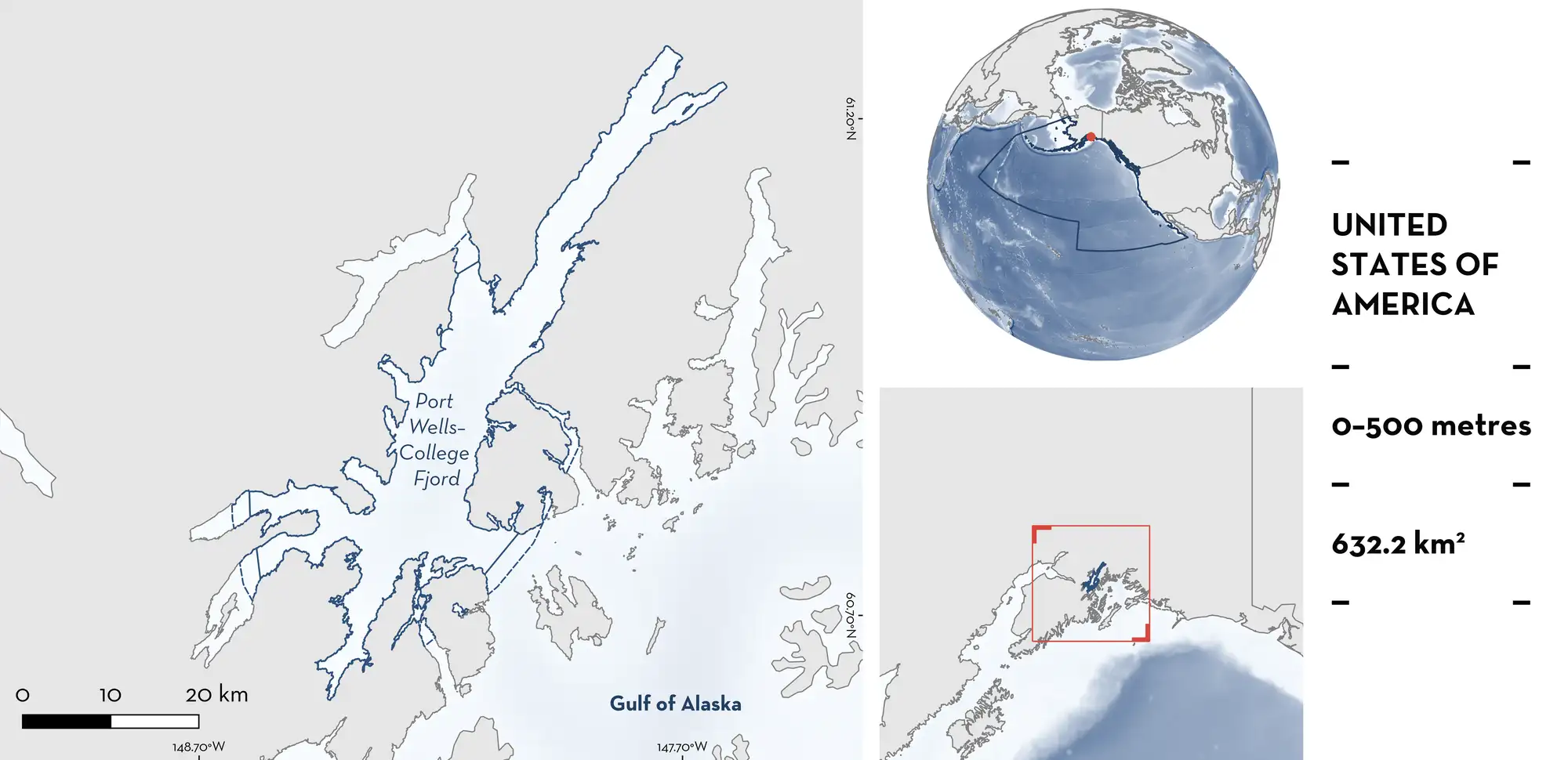
Port Wells–College Fjord
Summary
Port Wells–College Fjord is located in Alaska, United States of America. This area is situated in the northwest fjords of Prince William Sound. The habitat comprises deep, steep-flanked, convoluted fjords and inlets with tidewater glaciers that calve into the water. It is influenced by freshwater input from glacial meltwater, snow, and precipitation runoff. Within this area there are: areas important for movement (Pacific Sleeper Shark Somniosus pacificus).
Download factsheet
Port Wells–College Fjord
DESCRIPTION OF HABITAT
Port Wells–College Fjord is located in Alaska, United States of America. This movement area is situated in the northwest fjords of Prince William Sound, a large semi-enclosed marine basin, which reaches depths of 750 m, and that is surrounded by glaciated fjords and inlets (Bishop et al. 2026). It stretches from Port Wells Fjord in the centre of the area, where the fjord system connects to Prince William Sound, to College Fjord in the north, and also includes other fjords and inlets, such as Cochrane Bay and Passage Canal in the south. The habitat comprises deep, steep-flanked, convoluted fjords and inlets with tidewater glaciers that calve into the water (Bishop et al. 2026).
The area is influenced by snow, freshwater input from glacial meltwater and precipitation runoff, which peaks from June to October and drives strong haline stratification in the fjords during the boreal summer that persists into winter (Gay & Vaughan 2001). Thermoclines form in spring with solar heating and reach their peak in late autumn (Jin & Wang 2004; Bishop et al. 2026). The area experiences extreme seasonal variation in photoperiod, ranging from approximately six hours of daylight in midwinter to 19 hours in midsummer. Ambient water temperatures in the fjords range from 2.7–11.1°C, with a median of 5.9°C and little deviation year-round (Bishop et al. 2026).
This Important Shark and Ray Area is benthic and pelagic and is delineated from inshore and surface waters (0 m) to 500 m based on the bathymetry of the area.
CRITERION C
SUB-CRITERION C4 – MOVEMENT
Port Wells-College Fjord is an important movement area for Pacific Sleeper Sharks.
Pacific Sleeper Sharks seasonally move through this area, connecting deep waters at the entrance to the Fjord system with shallow areas near the glaciers (Bishop et al. 2026). Fourteen individuals were tagged in the southern end of the fjord system near Whittier and Cochrane Bay between June–August 2022. Animals ranged in size from 229–343 cm total length (TL). The size-at-maturity of 400 cm TL for males and 370–430 cm TL for females indicates that they were juveniles (Ebert et al. 2021; Bishop et al. 2026). Pop-up archival satellite tags were deployed on all sharks, with deployment durations of 365 days (n = 13) and 730 days (n = 1). Thirteen of these tags transmitted successfully, and 10 were physically recovered, providing high-resolution archival data. Additionally, 12 of the same sharks were also tagged with two mark-report pop-up tags programmed to detach after 120 days and 240 days. These tags provide the location of the sharks when they detach and transmit their signal via satellite. In high-latitude and demersal species, traditional satellite tracking using light levels to infer location does not work, and hence a Hidden Markov Model based on known locations from tag deployment, intermediary pop-up locations from mark-report tags, and final pop-up locations from satellite tags, as well as swimming depth and bathymetry was used to estimate daily location probabilities.
All mark-report tags popped up inside the area suggesting that tracked Pacific Sleeper Sharks remained in the fjord system over the tracking duration (Bishop et al. 2026). One shark likely left the fjord system briefly, indicated by deeper swimming depths than what is available within the system. The Hidden Markov Model indicated that in July/August, sharks were generally near the tagging locations in the southern end of the area near the mouth where Port Wells connects to Prince William Sound. The only report of a Pacific Sleeper Shark on the citizen science platform iNaturalist recorded in the wider region is also from this location in August 2024 (iNaturalist 2026). Tagged sharks then moved northward in November/December, reaching areas near active glaciers, such as in College Fjord, at the northern end of this area, in March/April. By July/August, tagged sharks were again in the southern end of the area. The intermediary pop-up locations from mark-report tags strongly support this seasonal movement pattern (Bishop et al. 2026).
A cluster analysis of depth and temperature data showed that tracked Pacific Sleeper Sharks made large diel vertical movements from shallower and warmer waters at night to deeper, colder waters during the day between October–January when they were in the central section of the area. In winter, they shifted to deep (300–400 m) and cold waters with minimal vertical movement between September–April. In spring and summer between March–August, they then either used intermediate depths (100–300 m) or shallow depths (50–250 m) during the day, when they were near the glaciers and back near the tagging locations. Although the area extends only ~80 km, the clear seasonal pattern suggests that this is an important movement area that connects different bathymetric habitat. Historical and contemporary evidence from Prince William Sound shows that multiple, or even large numbers, of individuals are sometimes captured in a fishing set, indicating that they may aggregate (Matta et al. 2024). The horizontal and vertical seasonal movements of tracked Pacific Sleeper Sharks suggest that they may shift from pelagic foraging to benthic scavenging and also balance foraging with resting (Bishop et al. 2026). This movement area thus likely connects different foraging and resting habitats.
Download factsheet
SUBMIT A REQUEST
ISRA SPATIAL LAYER REQUEST
To make a request to download the ISRA Layer in either a GIS compatible Shapefile (.shp) or Google Earth compatible Keyhole Markup Language Zipped file (.kmz) please complete the following form. We will review your request and send the download details to you. We will endeavor to send you the requested files as soon as we can. However, please note that this is not an automated process, and before requests are responded to, they undergo internal review and authorization. As such, requests normally take 5–10 working days to process.
Should you have questions about the data or process, please do not hesitate to contact us.