ISRA FACTSHEETS
ISRA FACTSHEETS
AUSTRALIA AND SOUTHEAST INDIAN OCEAN
Storm Bay-Pitt Water
Summary
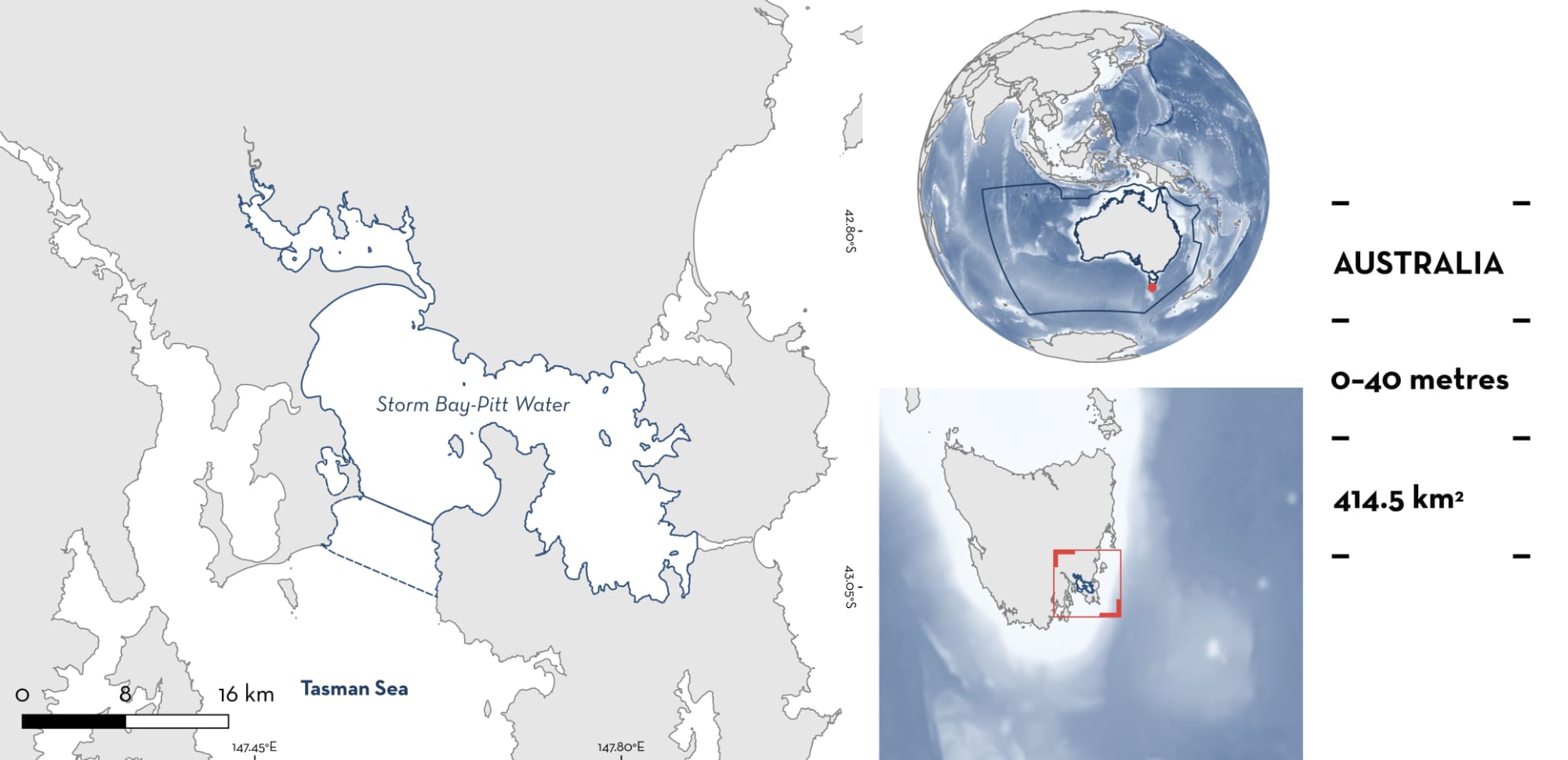
Storm Bay-Pitt Water is located on the southeast coast of Tasmania, Australia. The area is situated east of Hobart, encompassing Storm Bay (including Frederick Henry Bay and Norfolk Bay) and Pitt Water. It is characterised by sandy embayments, intertidal mudflats, and seagrass meadows. It is influenced by hypersaline conditions throughout the year, and is an estuarine system influenced by freshwater input from the Coal River. This area overlaps with the South Arm Key Biodiversity Area, the Pitt Water-Orielton Lagoon Ramsar Site, and the Frederick Henry Bay and Norfolk Bay Shark Refuge Area. Within this area there are: threatened species (e.g., Tope Galeorhinus galeus); reproductive areas (e.g., Gummy Shark Mustelus antarcticus); and feeding areas (Broadnose Sevengill Shark Notorynchus cepedianus).
Download factsheet
Storm Bay-Pitt Water
DESCRIPTION OF HABITAT
Storm Bay-Pitt Water is located on the southeast coast of Tasmania, Australia. The area is situated east of Hobart, encompassing Storm Bay (including Frederick Henry Bay and Norfolk Bay) and Pitt Water. Pitt Water is an estuarine system, characterised by intertidal sandflats, enclosed by a significant beach spit and bisected mid-length by two causeways. Pitt Water connects to the deeper waters of Storm Bay via Frederick Henry Bay (and in turn, Norfolk Bay). Frederick Henry Bay is a moderately deep embayment (mean depth = ~15 m) and is characterised by predominantly sandy substrates (McAllister et al. 2018). Norfolk Bay is characterised by silty and silty-sandy substrates with algae and seagrass (Barnett 2011).
Pitt Water is influenced by freshwater input from the Coal River and has hypersaline conditions throughout much of the year. Frederick Henry Bay has direct exposure to the coastal waters of Storm Bay and the Tasman Sea (McAllister et al. 2018). Norfolk Bay, a large semi-enclosed marine bay (mean depth = ~15 m) (Barnett 2011), connects to Frederick Henry Bay through a wide entrance and exhibits a small tidal range (~1.3 m) with minimal estuarine influence.
This area overlaps with the South Arm Key Biodiversity Area (KBA 2025), the Pitt Water-Orielton Lagoon Ramsar Site (Wetland of International Importance; Ramsar 2025), and the Frederick Henry Bay and Norfolk Bay Shark Refuge Area (Tasmanian Government 2025).
This Important Shark and Ray Area is benthic and pelagic and delineated from inshore and surface waters (0 m) to a depth of 40 m based on the bathymetry of the area.
CRITERION A
VULNERABILITY
Two Qualifying Species considered threatened with extinction according to the IUCN Red List of Threatened Species regularly occur in the area. These are the Critically Endangered Tope (Walker et al. 2020) and the Vulnerable Broadnose Sevengill Shark (Finucci et al. 2020).
CRITERION C
SUB-CRITERION C1 – REPRODUCTIVE AREAS
Storm Bay-Pitt Water is an important reproductive area for two shark and one chimaera species.
Based on historical longline and gillnet surveys and contemporary scientific longline surveys undertaken in this area, Tope, Gummy Shark, and Elephantfish use this area for reproductive purposes (Olsen 1954; Stevens & West 1997; Walker 1999; IMAS unpubl. data 2025). Despite the limited shark catches within this area due to the delineation of a Shark Refuge Area (Tasmanian Government 2025), contemporary scientific fishing confirms the importance of this area for these species. Between 2011–2022, 850 longlines were deployed across 120 days in 2011 (n = 14 lines; 2 days), 2012 (n = 326 lines; 39 days), 2013 (n = 116 lines; 14 days), 2014 (n = 136 lines; 17 days), 2015 (n = 20 lines; 2 days), 2017 (n = 20 lines; 4 days), 2019 (n = 18 lines; 4 days), 2020 (n = 15 lines; 5 days), 2021 (n = 135 lines; 25 days), and 2022 (n = 50 lines; 8 days) (IMAS unpubl. data 2025).
Between 1947‒1953, 531 neonate/young-of-the-year (YOY) Tope measuring 29‒51 cm total length (TL) were caught by handline in this area (Olsen 1954). The size-at-birth of this species is 30–40 cm TL (Ebert et al. 2021). Subsequently, between 1992–1996, 120 Tope aged 0+ years and nine Tope aged 1+ years were caught in 124 sets of a 75 m long gillnet in this area. In addition, 148 Tope aged 0+ years and one Tope aged 1+ years were caught on 66 sets of a 50-hook longline (Stevens & West 1997). Between 2011–2022, 1,486 Tope were caught in this area. Size data were available for 1,385 animals (93.2%). Of these, 89.5% (n = 1,239) were neonate/YOY measuring ≤50 TL (IMAS unpubl. data 2025). Neonate/YOY Tope were observed in 2012 (n = 477), 2013 (n = 103), 2014 (n = 172), 2015 (n = 21), 2017 (n = 71), 2020 (n = 6), 2021 (n = 310), and 2022 (n = 79) (IMAS unpubl. data 2025). Of the total, more than half (53.2%, n = 659) were neonates measuring = <40 cm TL. Neonate Tope were observed in 2012 (n = 327), 2013 (n = 61), 2014 (n = 85), 2015 (n = 21), 2017 (n = 10), 2020 (n = 3), 2021 (n = 143), and 2022 (n = 9). Tope at early life-stages are seasonally abundant between January–May in this area (IMAS unpubl. data 2025). This is the largest known hotspot of contemporary observations of Tope at early life-stages across Tasmania (IMAS unpubl. data 2025), highlighting the importance of this area.
In 1991, 66 neonate Gummy Sharks were caught from scientific gillnet fishing (n = 113 sets) between November–May in this area (Stevens & West 1997). Between 2011–2022, 616 Gummy Sharks were caught in this area. Size data were available for 590 Gummy Sharks (95.8%). Of these, 122 (20.7%) were neonate/YOY measuring <51 cm TL (IMAS unpubl. data 2025). The size-at-birth of this species is 30–35 cm TL (Ebert et al. 2021), and YOY measure 50 cm TL (Moulton et al. 1992; Stevens & West 1997). Neonate/YOY Gummy Sharks were caught mostly between September–March in 2011 (n = 4), 2012 (n = 54), 2013 (n = 20), 2014 (n = 28), 2015 (n = 6), 2017 (n = 2), and 2021 (n = 8) (IMAS unpubl. data 2025). This is the largest known hotspot of contemporary observations of Gummy Shark at early life-stages in Tasmania (IMAS unpubl. data 2025), highlighting the importance of this area.
Between 2012–2017, 48 female Elephantfish were sampled for hormone analysis through dedicated surveys (Barnett et al. 2019). This confirmed the presence of Elephantfish at different reproductive stages of the ovulation and oviposition (egg laying) cycle in this area. Individuals had higher levels of the three reproductive hormones (testosterone, estrogen, and progesterone) during the austral summer months. Two females were carrying eggs and two females had sperm plugs and mating scars during summer months (indicating recent mating events). Acoustic tagging of Elephantfish (n = 35) confirmed the seasonal migration out of the area in winter, with individuals returning in the following spring/summer (Dudgeon et al. 2015). In addition, Elephantfish egg cases are recorded regularly in the area by citizen scientists (iNaturalist 2025; B Woolley pers. obs. 2025), with local ecological knowledge confirming that they are predictably observed in summer months every year (B Woolley pers. obs. 2025).
CRITERION C
SUB-CRITERION C2 – FEEDING AREAS
Storm Bay-Pitt Water is an important feeding area for one shark species.
Broadnose Sevengill Sharks use this area seasonally to feed on two shark species and one chimaera species (Barnett et al. 2010a, 2010b, 2011, 2019; Barnett & Semmens 2012; Dudgeon et al. 2015; IMAS unpubl. data. 2025). Between December 2006 and February 2009, stomach content analysis of 203 Broadnose Sevengill Sharks showed a high frequency of occurrence (%F) and contribution by weight (%W) of chondrichthyan (shark, ray, or chimaera) prey species. This confirmed that Broadnose Sevengill Sharks prey on Gummy Sharks (19.2%F; 15.4%W), Tope (2%F; 0.9%W), and Elephantfish (4.4%F; 1.7%W), which all use this area seasonally for reproductive purposes (Barnett et al. 2010a, 2019; IMAS unpubl. data. 2025). Animals measured 105–270 cm TL, indicating that multiple life-stages of Broadnose Sevengill Sharks feed in this area. The size-at-birth of this species is 34–45 cm TL, and maturity is reached at ~150 and 180 cm TL for males and females, respectively (Ebert et al. 2021).
Acoustic telemetry data confirm that between March 2004–2008, 43 Broadnose Sevengill Sharks had strong seasonal site fidelity to southern Tasmanian embayments, including this area, from October/November–April, with individuals returning across multiple years (Barnett et al. 2010b, 2011). This seasonal presence of Broadnose Sevengill Sharks coincides with the peak abundance of Elephantfish, Gummy Sharks, and neonate/YOY Tope (IMAS unpubl. data. 2025). This infers a strong link between the seasonal presence of the species and prey availability (Barnett et al. 2011, 2019). Between 2012–2022, 108 Broadnose Sevengill Sharks were caught in this area via scientific longline fishing (IMAS unpubl. data 2025). Both size and sex data were available for 103 (95.4%) individuals. Of these, 31 (30.1%) were immature (24 males measuring ≤180 cm TL; 7 females measuring ≤220 cm TL), including one neonate (80 cm TL) and two YOYs (measuring 100–105 cm TL). This confirms that multiple life-stages use this area seasonally, seemingly for feeding purposes. Although this species has been recorded across every month, the seasonal peak in contemporary catches is between October–April. This seasonality matches the seasonality of other species in this area, including Gummy Sharks (October–April; n = 616 contemporary observations), Elephantfish (September–April, n = 93), and neonate/YOY School Sharks (January–May; n = 1,244) in this area (IMAS unpubl. data 2025). Between 2021–2022, eight half-eaten Gummy Sharks and 20 half-eaten Tope were recorded during the scientific longline surveys undertaken in this area (evidence of depredation). In addition, there is one contemporary record of a half-eaten Broadnose Sevengill Shark. These observations confirm that the area is still important for feeding purposes of Broadnose Sevengill Sharks. This is the only known location in Tasmania with a clear, regular, and predictable seasonal presence of the Broadnose Sevengill Shark in relation to prey abundance.
Download factsheet
SUBMIT A REQUEST
ISRA SPATIAL LAYER REQUEST
To make a request to download the ISRA Layer in either a GIS compatible Shapefile (.shp) or Google Earth compatible Keyhole Markup Language Zipped file (.kmz) please complete the following form. We will review your request and send the download details to you. We will endeavor to send you the requested files as soon as we can. However, please note that this is not an automated process, and before requests are responded to, they undergo internal review and authorization. As such, requests normally take 5–10 working days to process.
Should you have questions about the data or process, please do not hesitate to contact us.