ISRA FACTSHEETS
ISRA FACTSHEETS
NORTH AMERICAN PACIFIC
Del Mar-Torrey Pines
Summary
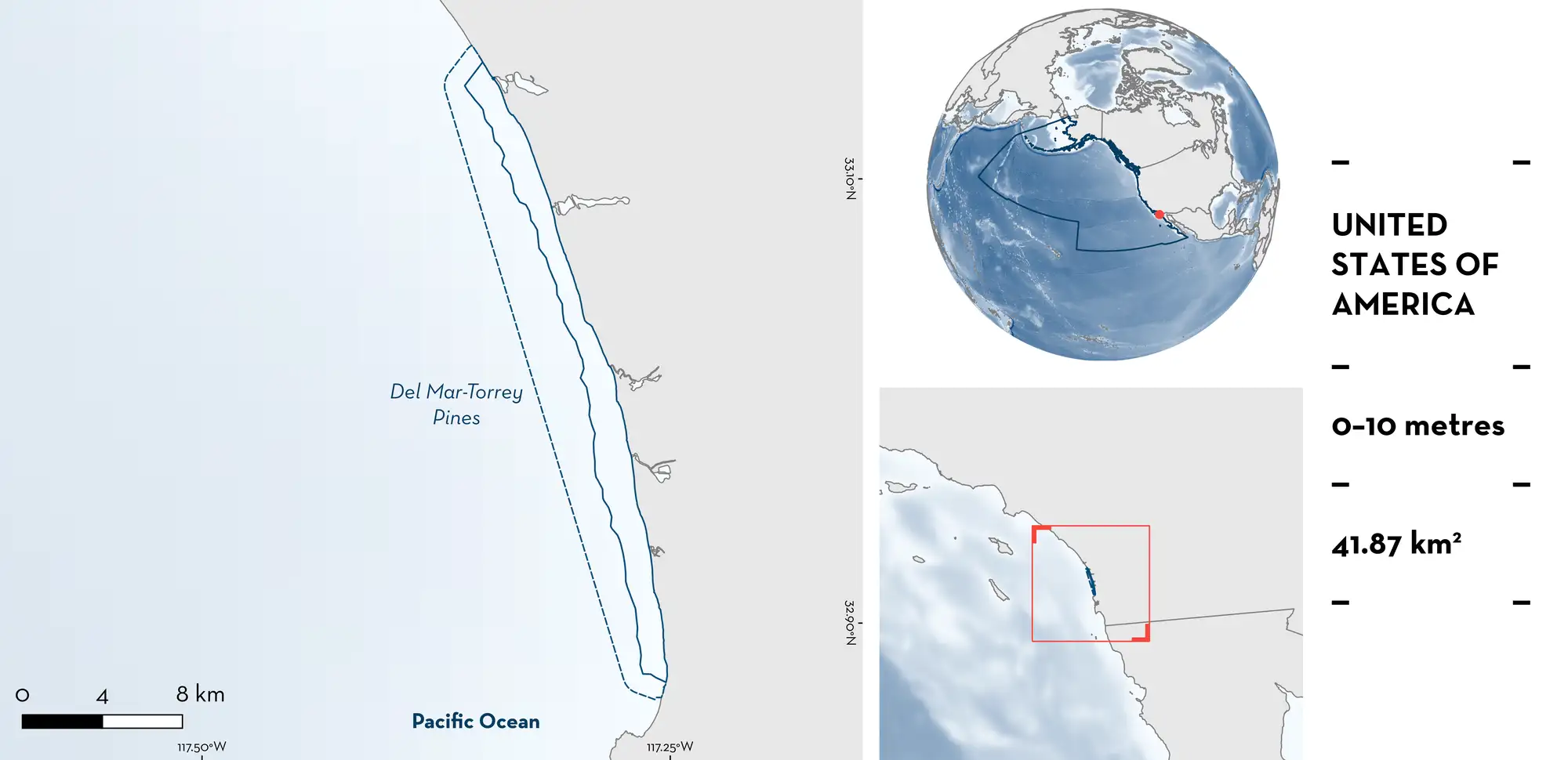
Del Mar-Torrey Pines is located in southern California, United States of America. The area is situated in the Southern California Bight and is characterised by the presence of multiple sandy beaches, subtidal rocky reefs, and kelp forests. Within this area there are: threatened species and reproductive areas (White Shark Carcharodon carcharias).
Download factsheet
Del Mar-Torrey Pines
DESCRIPTION OF HABITAT
Del Mar-Torrey Pines is located in southern California, United States of America. The area is situated in the Southern California Bight and extends from South Poncho Beach in the north to Blacks Beach in the south. The area is characterised by the presence of multiple sandy beaches with adjacent subtidal rocky reef habitats and Giant Kelp Macricystis pirifera patches (Young et al. 2023; Kelpwatch 2026). It receives freshwater input from rivers (e.g., San Dieguito) and creeks.
The area is influenced by the California Current, a surface current carrying water equatorward along the Pacific North America coast and is characterised by low temperatures, low salinities, and high dissolved oxygen (Lynn & Simpson 1987). Local surface winds, coastal upwelling during the boreal spring, surface heating, and topography produce high variability in stratification, thermocline depth, and micro-scale cells of water (Di Lorenzo 2003). In addition, the area is exposed to energetic swells during winter and lee energetic swells during summer (Young et al. 2023).
This Important Shark and Ray Area is benthic and pelagic and is delineated from inshore and surface waters (0 m) to 10 m based on the bathymetry of the area.
CRITERION A
VULNERABILITY
One Qualifying Species considered threatened with extinction according to the IUCN Red List of Threatened Species regularly occurs in the area. This is the Vulnerable White Shark (Rigby et al. 2022).
CRITERION C
SUB-CRITERION C1 – REPRODUCTIVE AREAS
Del Mar-Torrey Pines is an important reproductive area for one shark species.
Data from fishery catches, satellite and acoustic telemetry monitoring, unmanned aerial vehicle (UAV) surveys, and environmental DNA (eDNA) surveys have confirmed the regular presence of White Sharks in the area (Lowe et al. 2012; Anderson et al. 2021; Rex et al. 2023; McCauley et al. 2024; Merson et al. 2025). These data indicate that southern California contains spatiotemporally dynamic centres of primary and secondary nursery habitat for young-of-the-year (YOY) and juvenile White Sharks. Juveniles form aggregations at locations that are inter-annually variable along the coast, with individuals exhibiting increased site fidelity, residency levels, and spatially restricted movements for periods up to eight years (Anderson et al. 2021). Del Mar-Torrey Pines represents the second largest and interannually most reliable site in which such YOY and juvenile White Shark aggregations are regularly and predictably observed in southern California after Padaro Beach (~250 km north; Lowe et al. 2012; Anderson et al. 2021; Rex et al. 2023).
Catch data from multiple fisheries operating in nearshore waters between 1936–2009 revealed that the broader area of the Southern California Bight is a nursery area for White Sharks (Lowe et al. 2012). Of 369 records, 39% (n = 144) were neonate/YOY measuring <75 cm total length (TL; Cailliet et al. 1985; Malcolm et al. 2001), 21% (n = 77) were juveniles, 5% (n = 18) were adults, and the rest were of unreported size. Inside the Southern California Bight, Del Mar-Torrey Pines was identified as a hotspot for catches of YOY and juvenile White Sharks especially during the summer (Lowe et al. 2012).
Between 2010–2026, the California State University – Long Beach (CSULB) Shark Lab tagged 378 White Sharks across southern California. Of these, 40 (10.6%) were neonate (<150 cm TL; Ebert et al. 2021), 61 (16.1%) were YOY, and 243 (64.3%) were juveniles at the time of tagging (CSULB Shark Lab unpubl. data 2026). In Del Mar-Torrey Pines, one YOY and 70 juvenile White Sharks were tagged. In addition, 76 YOY and juvenile White Sharks tagged in other locations have been detected 2,769,575 times from 2010 to 2026 highlighting the area as a hotspot for these early life-stages (CSULB Shark Lab unpubl. data 2026). Drone surveys have recorded the regular presence of aggregations of up to 25 YOY and juveniles present at one time which has been confirmed from acoustic telemetry tracking (Rex et al. 2023). This area holds a large abundance of the main prey for early life-stage White Sharks (benthic sharks, rays, and bony fishes) compared to other areas across southern California (Jahn 2024).
Download factsheet
SUBMIT A REQUEST
ISRA SPATIAL LAYER REQUEST
To make a request to download the ISRA Layer in either a GIS compatible Shapefile (.shp) or Google Earth compatible Keyhole Markup Language Zipped file (.kmz) please complete the following form. We will review your request and send the download details to you. We will endeavor to send you the requested files as soon as we can. However, please note that this is not an automated process, and before requests are responded to, they undergo internal review and authorization. As such, requests normally take 5–10 working days to process.
Should you have questions about the data or process, please do not hesitate to contact us.