ISRA FACTSHEETS
ISRA FACTSHEETS
NORTH AMERICAN PACIFIC
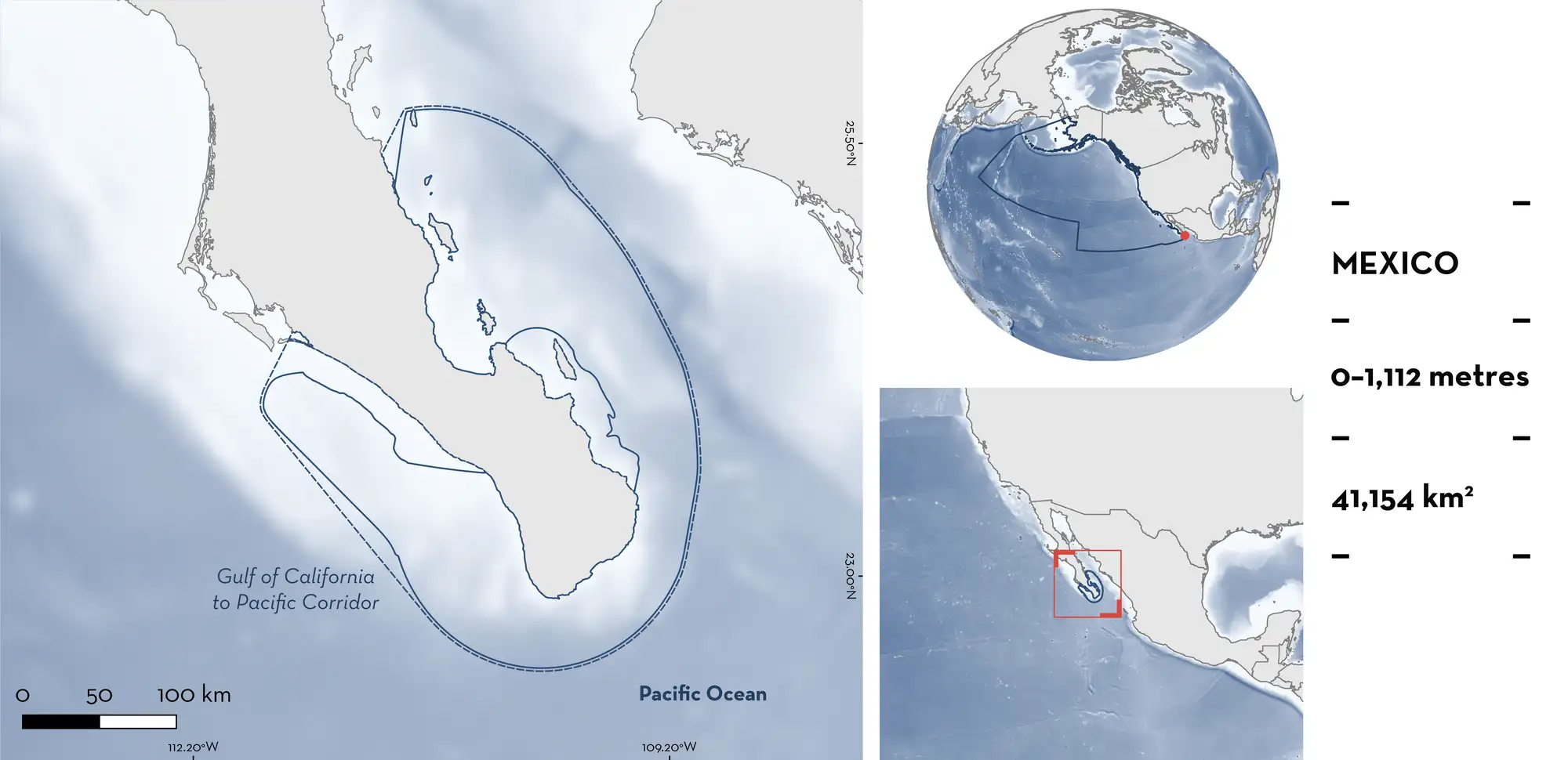
Gulf of California to Pacific Corridor
Summary
Gulf of California to Pacific Corridor is located in Baja California Sur, Mexico. This area stretches from Santa Catalina Island on the southeast coast of Baja California Sur (Gulf of California) south around Cabo San Lucas, and northward along the Pacific Ocean coast of Baja California Sur. The habitat is characterised by sandy and rocky coastlines and substrates, continental shelf, slope, and offshore pelagic waters. The area is influenced by seasonal coastal upwelling. Within this area there are: threatened species and areas important for movement (Spinetail Devil Ray Mobula mobular).
Download factsheet
Gulf of California to Pacific Corridor
DESCRIPTION OF HABITAT
Gulf of California to Pacific Corridor is located in Baja California Sur, Mexico. This area stretches from Santa Catalina Island on the southeast coast of Baja California Sur (Gulf of California), including the Bahía de La Paz, south around Cabo San Lucas, and northward along the Pacific coast of Baja California Sur to south of Bahía Magdalena. The habitat transitions from nearshore coastal waters, characterised by sandy and rocky coastlines and substrates, to continental shelf, slope, and offshore pelagic waters with canyons, escarpments, and terraces (Croll et al. 2012; Palacios et al. 2024).
The area is influenced by a monsoonal wind pattern, with north-westerly winds driving coastal upwelling during the cold season (December–May) and weak south-easterly winds during the warm season (June–November) (Palacios et al. 2024). The southern Gulf of California has a shallow oxygen minimum layer, occurring as shallow as 150 m (Croll et al. 2012).
This Important Shark and Ray Area is pelagic and is delineated from inshore and surface waters (0 m) to 1,112 m based on the global depth range of Qualifying Species.
CRITERION A
VULNERABILITY
One Qualifying Species considered threatened with extinction according to the IUCN Red List of Threatened Species regularly occurs in the area. This is the Critically Endangered Spinetail Devil Ray (Jabado et al. 2025).
CRITERION C
SUB-CRITERION C4 – MOVEMENT
Gulf of California to Pacific Corridor is an important movement area for Spinetail Devil Rays.
Spinetail Devil Rays regularly use this movement corridor to seasonally connect sites inside the Gulf of California with waters off the Pacific Ocean coast of Baja California (Croll et al. 2012). Spinetail Devil Rays (n = 14) were tagged with archival pop-up satellite tags off La Paz, Gulf of California, in June of 2004–2008. Tagged rays included ten males and four females ranging in size from 142–238 cm disc width (DW). Of these, seven individuals (50%) were mature. Track duration ranged from 12–186 days (mean = 71.8 days) and track length ranged from 28–1,536 km (mean = 610.4 km). While six tracked rays remained in the Gulf of California around La Paz, eight individuals (57%) dispersed into the Pacific Ocean. They mainly used this corridor to swim to the southern tip at Cabo San Lucas, with four individuals continuing north along the western shelf break and four others dispersing south into the Pacific Ocean (Croll et al. 2012). Although this movement corridor connects shallow nearshore waters with deeper slope and abyssal waters, tagged rays mainly spent their time in the upper 50 m (93%) or upper 5 m (~57%) of the water column (Croll et al. 2012). Monthly kernel utilisation distributions (KUDs) indicated a seasonal migration, with the 50% KUD shifting from La Paz in June to the Baja California west coast in August/September. This seasonal pattern is likely driven by variations in the abundance of their main prey (subtropical euphausiid Nyctiphanes simplex) which declines after a high in spring in the Gulf of California while in June/July it is still high in the western part of this movement corridor (Croll et al. 2012; Lezama-Ochoa et al. 2025). During the months of March-April sporadic aggregations of up to 75 individuals in the Bay of La Paz, within the Gulf of California, have been observed at least one time per year within the movement area by citizen scientists (between 2021-2026) and during scientific aerial surveys (from 2019–2023; M Palacios unpubl. data 2026). Additionally, aggregations exceeding 50 individuals captured in a single tuna purse-seine set have been documented in the Pacific side of this corridor during the months of July–September (Lezama-Ochoa et al. 2019), further supporting the seasonal movement through this movement area. Seasonal courtship observations between May–August near the northeastern part of the area suggest that reproduction may be an additional driver for their movements (Palacios et al. 2024). Neonate and young-of-the-year individuals visually estimated to be between ~100–120 cm DW, have been opportunistically observed between Espiritu Santo Archipelago and Cerralvo Island, in the northeast of the area, at least twice per year during the months of May–July between 2019–2022 (M Palacios pers. obs. 2026). This movement corridor thus likely connects distant feeding areas and reproductive sites.
Download factsheet
SUBMIT A REQUEST
ISRA SPATIAL LAYER REQUEST
To make a request to download the ISRA Layer in either a GIS compatible Shapefile (.shp) or Google Earth compatible Keyhole Markup Language Zipped file (.kmz) please complete the following form. We will review your request and send the download details to you. We will endeavor to send you the requested files as soon as we can. However, please note that this is not an automated process, and before requests are responded to, they undergo internal review and authorization. As such, requests normally take 5–10 working days to process.
Should you have questions about the data or process, please do not hesitate to contact us.