ISRA FACTSHEETS
ISRA FACTSHEETS
NORTH AMERICAN PACIFIC
Vancouver Island
Summary
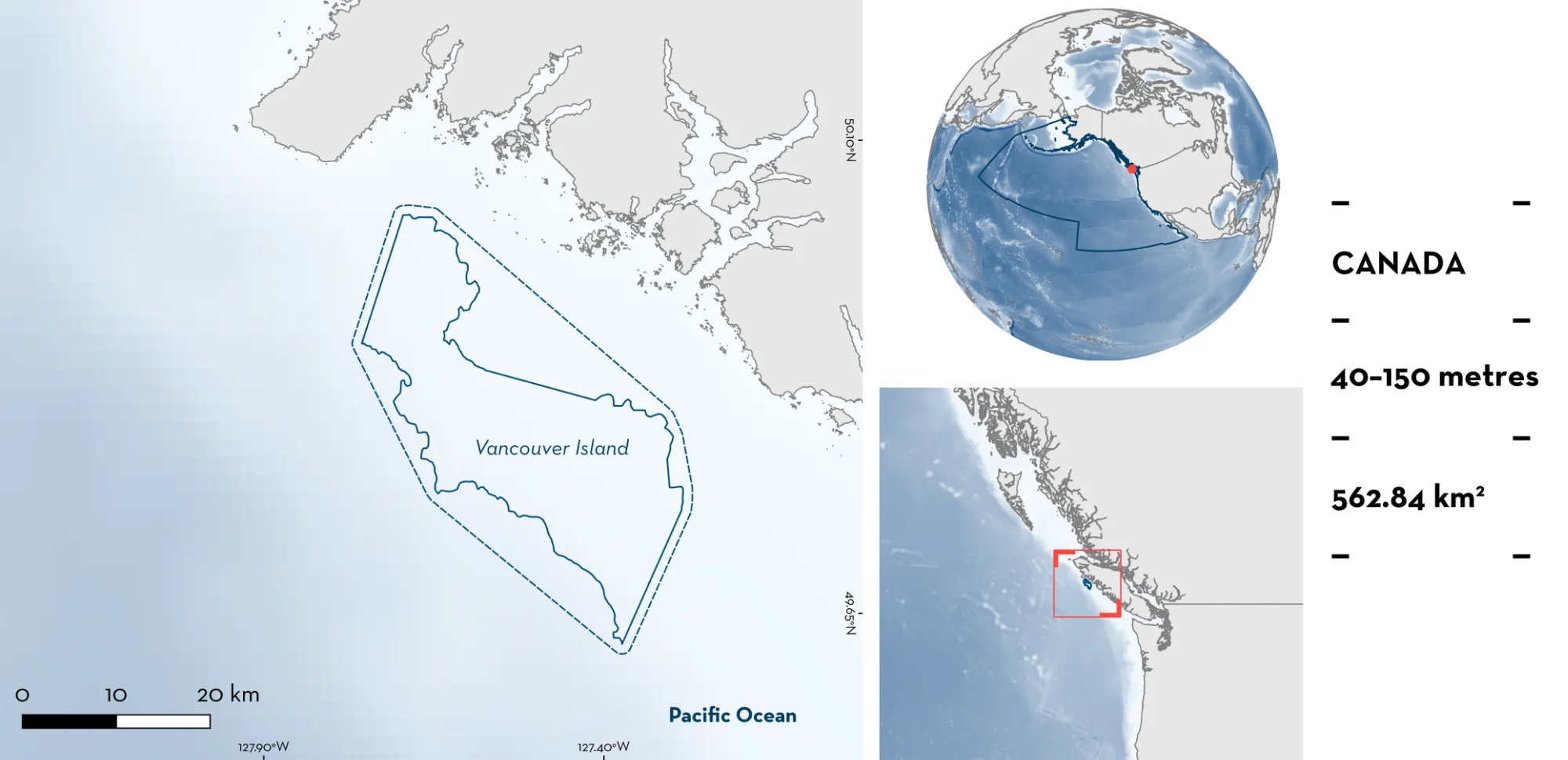
Vancouver Island is located in British Columbia, Canada. This area sits on the continental shelf and the steep uppermost slope off the western coast of Vancouver Island. The habitat is characterised by a moderately narrow shelf and boulder and gravel substrates on the inner shelf, transitioning to muddy sands on the outer shelf. The area is influenced by the California Current, Davidson Current, and tidal and wind-driven currents. Within this area there are: undefined aggregations (North Pacific Spiny Dogfish Squalus suckleyi).
Download factsheet
Vancouver Island
DESCRIPTION OF HABITAT
Vancouver Island is located in British Columbia, Canada. This area sits on the continental shelf and the steep uppermost slope off the western coast of Vancouver Island. Here, the shelf is moderately wide (up to 75 km) relative to more northern parts of Pacific Canada, although it is as narrow as 5 km off Brooks Peninsula just to the north of the area (Bornhold & Giresse 1985; Shaw et al. 2024). The shelf surface is generally smooth, but bedrock outcrops are found on the innermost shelf along with fjord troughs that extend onto the shelf and some areas of irregular terrain resulting from ice margins (Shaw et al. 2024). The shelf edge is idented by numerous canyons (Bornhold & Giresse 1985). The substrate comprises boulders and gravel on the inner shelf but transitions to muddy sands on the outer shelf (Bornhold & Giresse 1985).
The area is influenced by high wave and current energy on the inner shelf (Bornhold & Giresse 1985). The California Current intensifies in the boreal summer, is mainly southward flowing, but is deflected seaward in late autumn by the Davidson Current which is north-westerly flowing (Bornhold & Giresse 1985). Tidal and wind-driven currents influence the area on the shelf (Bornhold & Giresse 1985).
This Important Shark and Ray Area is benthic, pelagic and subsurface and is delineated from 40 m to 150 m based on the depth range of Qualifying Species in the area.
CRITERION C
SUB-CRITERION C5 – UNDEFINED AGGREGATIONS
Vancouver Island is an important area for undefined aggregations of one shark species.
Between 1998–2025, the International Pacific Halibut Commission (IPHC) conducted annual longline surveys during summer (May–September) across nearshore and offshore waters from Southern California to Alaskan waters (Gulf of Alaska, Aleutian Islands, and the Bering Sea; IPHC 2026a). Surveys were conducted at ~1,200 stations each year primarily at depths of 15–503 m. Longlines consisted of 4–8 skates (longline units) with 96–104 hooks per skate, with soak times between 5–24 hours (IPHC 2026b). Non-halibut species were counted either as subsample counts (20% observations, the majority for sharks) and whole-set counts (100% observations). The average (± standard deviation) number of hooks per set across the surveys was 643 ± 119, while the number of hooks observed per set (i.e., where bycatch was recorded) was 207 ± 120. Nominal catch-per-unit-effort (CPUE) was estimated as the number of individuals caught per 100 hooks per hour.
Across the IPHC surveys, North Pacific Spiny Dogfish were recorded in 15,525 longline sets, 109 (0.7%) of which were recorded inside this area in June–July at depths of 40–150 m (IPHC 2026a). For this species, individuals were counted in subsamples (20% of the observations) in 12,132 sets (78.1% of total). One of the highest mean CPUE of North Pacific Spiny Dogfish in the region (Southern California to Alaska) was reported from this area (mean = 1.68 individuals/100 hooks/hour; 0.01–7.45) compared to adjacent areas in the region (mean CPUE outside the area = 0.38 individuals/100 hooks/hour; 0.007–13.3). Captures of multiple individuals (>10) were recorded in 90 sets (82.6% of the sets with the species captured inside this area), with 461 individuals being the maximum number recorded in a single set (mean 122.0 individuals/set). High abundances for North Pacific Spiny Dogfish have been associated with aggregations and are mostly related to seasonal increases in abundance of prey species (Beamish et al. 1992).
Additional information is required to understand the nature and function of these aggregations.
Download factsheet
SUBMIT A REQUEST
ISRA SPATIAL LAYER REQUEST
To make a request to download the ISRA Layer in either a GIS compatible Shapefile (.shp) or Google Earth compatible Keyhole Markup Language Zipped file (.kmz) please complete the following form. We will review your request and send the download details to you. We will endeavor to send you the requested files as soon as we can. However, please note that this is not an automated process, and before requests are responded to, they undergo internal review and authorization. As such, requests normally take 5–10 working days to process.
Should you have questions about the data or process, please do not hesitate to contact us.