ISRA FACTSHEETS
ISRA FACTSHEETS
NORTH AMERICAN PACIFIC
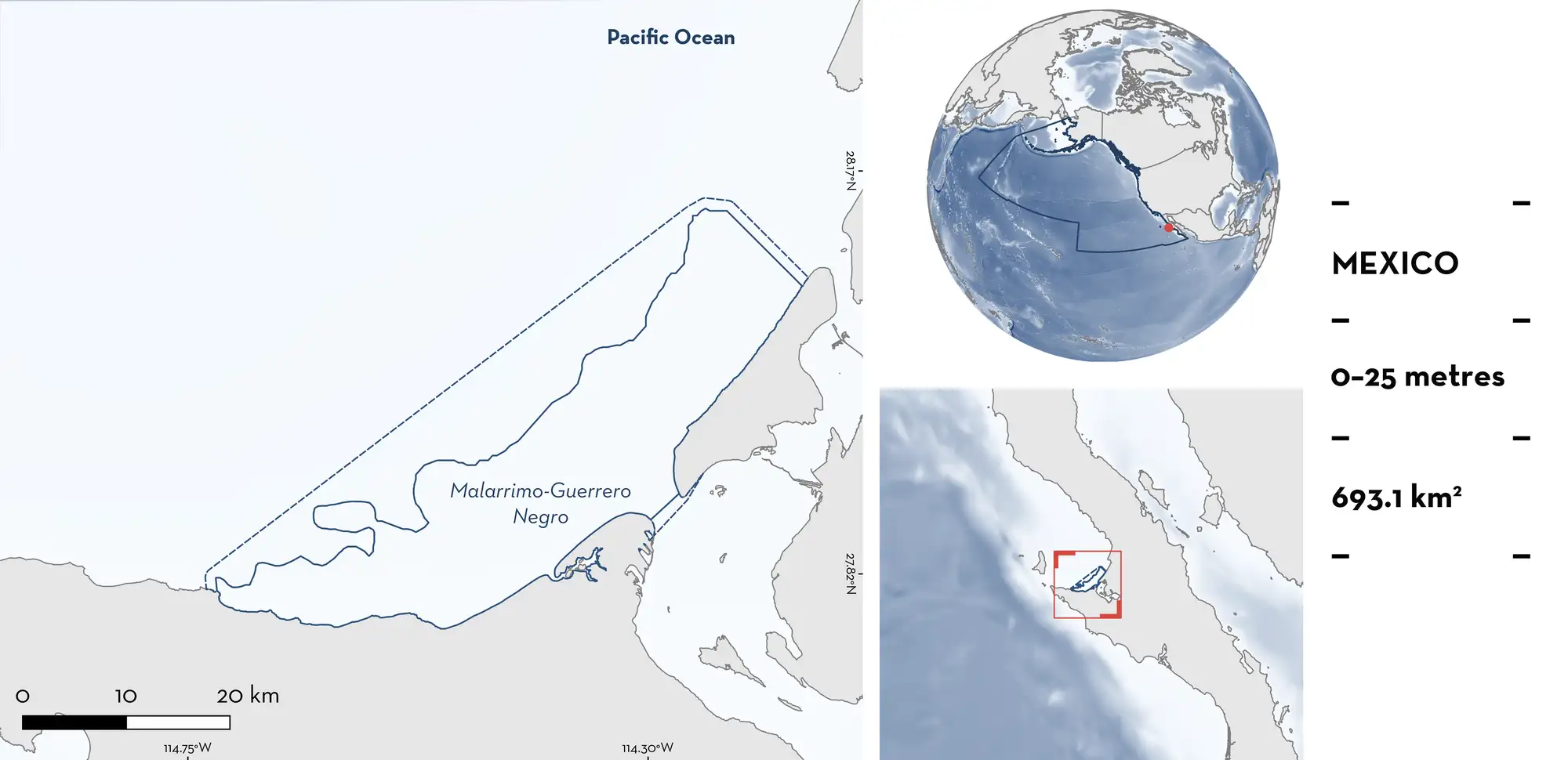
Malarrimo-Guerrero Negro
Summary
Malarrimo-Guerrero Negro is located on the west coast of the Baja California Peninsula, Mexico. The area sits inside Bahía Sebastián Vizcaíno and is characterised by sandy and rocky substrates. It is influenced by the California Current and is one of the most productive bays in the region due to high levels of upwelling. The area overlaps with the El Vizcaíno Biosphere Reserve. Within this area there are: threatened species (e.g., Smooth Hammerhead Sphyrna zygaena); range-restricted species (Shovelnose Guitarfish Pseudobatos productus); and reproductive areas (e.g., White Shark Carcharodon carcharias).
Download factsheet
Malarrimo-Guerrero Negro
DESCRIPTION OF HABITAT
Malarrimo-Guerrero Negro is located on the west coast of the Baja California Peninsula, Mexico. The area sits inside Bahía Sebastián Vizcaíno and extends from the mouth of Guerrero Negro Lagoon in the east to Malarrimo in the west, and the mouth of the Ojo de Liebre Lagoon in the middle. It is characterised by sandy and rocky substrates (Sosa-Nishizaki et al. 2015).
The area is found in the southern portion of the California Current, a surface current carrying water equatorward along the North America coast which is characterised by low temperatures, low salinities, and high dissolved oxygen (Lynn & Simpson 1987). It is one of the most productive bays in the California Current System due to high levels of upwelling, especially during the boreal spring and summer and provides retention, feeding, and nursery opportunities for multiple species (Amador-Buenrostro et al. 1995; Hernández-Rivas et al. 2000). Sea surface temperatures range ~16–21°C with temperatures increasing up to 2°C during El Niño events (Robles-Tamayo et al. 2025).
The area overlaps with the El Vizcaíno Biosphere Reserve (UNEP-WCMC & IUCN 2026).
This Important Shark and Ray Area is benthic and pelagic and is delineated from inshore and surface waters (0 m) to 25 m based on the bathymetry of the area.
CRITERION A
VULNERABILITY
Two Qualifying Species considered threatened with extinction according to the IUCN Red List of Threatened Species regularly occur in the area. These are the Vulnerable White Shark (Rigby et al. 2022) and Smooth Hammerhead (Rigby et al. 2019).
CRITERION B
RANGE RESTRICTED
This area holds the regular presence of Shovelnose Guitarfish as a resident range-restricted species. This species occurs year-round in the area and is regularly encountered and caught in local fisheries (Cartamil et al. 2011; Sosa-Nishizaki et al. 2014, 2015; Medina-Trujillo et al. 2020; Medina-Trujillo 2021). Artisanal fisheries operating in the broader Bahía Sebastián Vizcaíno region were monitored monthly between July–November in 2014 and 2015, and between August 2016–July 2017. During these periods, 4,874 individuals were recorded across the coast of Bahía Sebastián Vizcaíno and inside the Ojo de Liebre Lagoon (Sosa-Nishizaki et al. 2014, 2015; Medina-Trujillo et al. 2020; Medina-Trujillo 2021). The majority of individuals (~75%; n = ~3,655) were caught inside this area and were associated with sandy substrates very close to the shore. Individuals measured between 37.0–147.5 cm total length (TL) and all life-stages were recorded (Medina-Trujillo et al. 2020). In addition, historical surveys between 2006–2008 found this species was the most landed shark or ray in artisanal fisheries operating in the area (Cartamil et al. 2011). The largest catches of Shovelnose Guitarfish on the west coast of the Baja California Peninsula come from this area highlighting its regional importance (Medina-Trujillo 2021). This species occurs in the California Current Large Marine Ecosystem (LME) and the Gulf of California LME.
CRITERION C
SUB-CRITERION C1 – REPRODUCTIVE AREAS
Malarrimo-Guerrero Negro is an important reproductive area for two shark species.
This area is one of two confirmed nurseries for White Sharks in the Northeast Pacific and the only one in Mexico (Oñate-González et al. 2017). Between 1999–2025, incidental catches of White Sharks were recorded across the west coast of the Baja California Peninsula (Santana-Morales et al. 2012; Oñate-González et al. 2017; García-Rodríguez et al. 2021; O Sosa-Nishizaki et al. unpubl. data 2026). Of 353 White Sharks recorded between 1999–2013 for which sizes were available, 333 (94.3%) were caught inside the broader Bahía Sebastián Vizcaíno region with 89% (n = 296) being categorised as neonate or young-of-the-year (YOY; Oñate-González et al. 2017). Between 2014–2025, ~10 individuals per year of these early life-stages were recorded from artisanal fisheries operating in the area (García-Rodríguez et al. 2021; O Sosa-Nishizaki et al. unpubl. data 2026). Neonate/YOY were defined as individuals with the presence of an unhealed/healed umbilical scar or because they measured <175 cm TL which is the reported size for YOY White Sharks (Cailliet et al. 1985; Malcolm et al. 2001). Although neonate/YOY White Sharks have been recorded along the coast of Bahía Sebastián Vizcaíno, the largest catches of these life-stages are concentrated inside this area, from the mouth of the Guerrero Negro Lagoon to Malarrimo, at depths <25 m (García-Rodríguez & Sosa-Nishizaki 2020). Acoustic telemetry of 13 neonate/YOY White Sharks tagged inside the area showed that early life-stages mostly use nearshore waters near the mouth of the Ojo de Liebre Lagoon (inside this area; García-Rodríguez 2020). White Sharks are present year-round in the area, but neonates/YOY are mostly caught between May–September (Oñate-González et al. 2017; García-Rodríguez 2020; García-Rodríguez & Sosa-Nishizaki 2020). Acoustic and satellite telemetry of YOY and juvenile White Sharks tagged in California have shown back and forth movements to Malarrimo-Guerrero Negro especially during autumn and winter (White et al. 2019; Logan et al. 2024), also highlighting the importance of this area for individuals coming from the other known nursery for the species.
Artisanal fisheries operating in the area were monitored monthly at landing sites between August–November in 2014 and 2015, and between August 2016–July 2017 (Sosa-Nishizaki et al. 2014, 2015; O Sosa-Nishizaki et al. unpubl. data 2026). During this monitoring, 115 Smooth Hammerheads were recorded of which 78 were measured (O Sosa-Nishizaki et al. unpubl. data 2026). Individuals ranged between 45–190 cm TL of which 26 (33.3%) were between 45–70 cm TL and were classified as neonate/YOY because they had an umbilical scar or because their size was close to the reported size-at-birth for the species (49–63 cm TL; Ebert et al. 2021). The rest of the individuals were juveniles as these were below the reported size-at-maturity for the species (~210–265 cm TL; Ebert et al. 2021). Although artisanal fisheries operate across the whole Bahía Sebastián Vizcaíno, early life-stages of Smooth Hammerhead were caught inside this area (near the Ojo de Liebre Lagoon mouth) and were recorded in August and September. This is the only location where neonate/YOY individuals have been regularly recorded along the west coast of the Baja California Peninsula.
Download factsheet
SUBMIT A REQUEST
ISRA SPATIAL LAYER REQUEST
To make a request to download the ISRA Layer in either a GIS compatible Shapefile (.shp) or Google Earth compatible Keyhole Markup Language Zipped file (.kmz) please complete the following form. We will review your request and send the download details to you. We will endeavor to send you the requested files as soon as we can. However, please note that this is not an automated process, and before requests are responded to, they undergo internal review and authorization. As such, requests normally take 5–10 working days to process.
Should you have questions about the data or process, please do not hesitate to contact us.