
ISRA FACTSHEETS
ISRA FACTSHEETS
NORTH AMERICAN PACIFIC
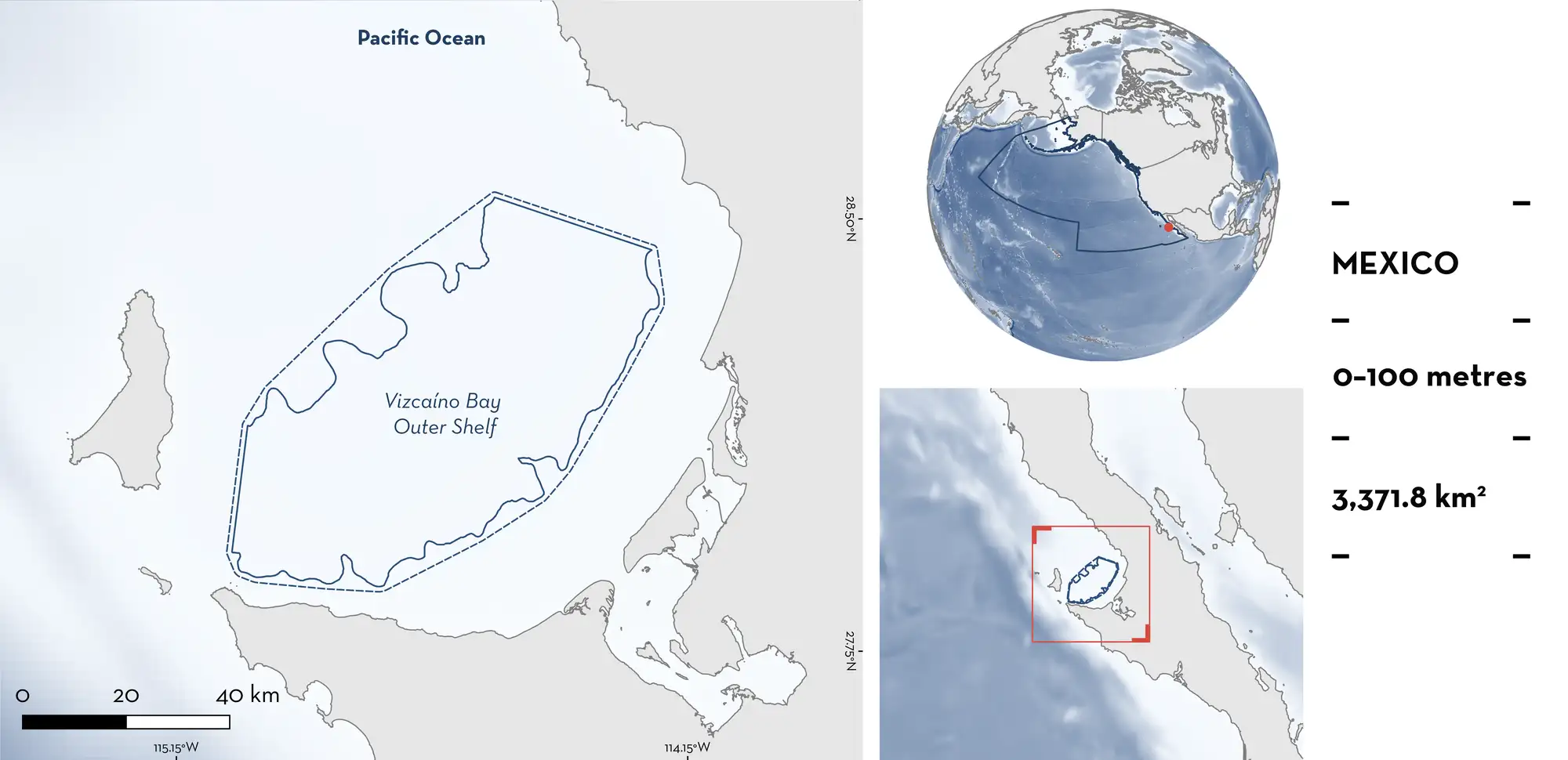
Vizcaíno Bay Outer Shelf
Summary
Vizcaíno Bay Outer Shelf is located off the west coast of the Baja California Peninsula, Mexico. The area is characterised by a wide continental shelf and sandy and rocky substrates. It is influenced by the California Current and is one of the most productive bays in the region due to high levels of upwelling. The area overlaps with the El Vizcaíno Biosphere Reserve. Within this area there are: threatened species (Shortfin Mako Isurus oxyrinchus); and reproductive areas (e.g., Blue Shark Prionace glauca).
Download factsheet
Vizcaíno Bay Outer Shelf
DESCRIPTION OF HABITAT
Vizcaíno Bay Outer Shelf is located off the west coast of the Baja California Peninsula, Mexico. The area extends from Santa Rosalillita, Baja California in the east to Punta Eugenia, Baja California Sur in the west. It is characterised by a wide continental shelf and sandy and rocky substrates (Hernández-Rivas et al. 2000).
The area is found in the southern portion of the California Current, a surface current carrying water equatorward along the Pacific coast of North America and is characterised by low temperatures, low salinities, and high dissolved oxygen (Lynn & Simpson 1987). Vizcaíno Bay is one of the most productive bays in the California Current System due to high levels of upwelling, especially during the boreal spring and summer (Amador-Buenrostro et al. 1995; Hernández-Rivas et al. 2000). Sea surface temperatures range ~16–21°C with temperatures increasing by up to 2°C during El Niño events (Robles-Tamayo et al. 2025).
The area overlaps with the El Vizcaíno Biosphere Reserve (UNEP-WCMC & IUCN 2026).
This Important Shark and Ray Area is pelagic and is delineated from surface waters (0 m) to 100 m based on the bathymetry of the area.
CRITERION A
VULNERABILITY
One Qualifying Species considered threatened with extinction according to the IUCN Red List of Threatened Species regularly occurs in the area. This is the Endangered Shortfin Mako (Rigby et al. 2019).
CRITERION C
SUB-CRITERION C1 – REPRODUCTIVE AREAS
Vizcaíno Bay Outer Shelf is an important reproductive area for two shark species.
Between 2007–2015, Shortfin Mako were reported as one of the most landed shark species in artisanal longline fisheries operating in the Bahía Sebastián Vizcaíno region (Castillo-Géniz et al. 2016). Furthermore, neonate and young-of-the-year (YOY) Shortfin Mako have been regularly recorded in the area (Cartamil et al. 2011; Sosa-Nishizaki et al. 2014, 2015; Castillo-Géniz et al. 2016; O Sosa-Nishizaki et al. unpubl. data 2026).
Landings from artisanal fisheries operating with longlines in the area were monitored between 2006–2008 and 2014–2017. Between 2006–2008, 881 Shortfin Mako were recorded from catches inside the area, of which 447 individuals were measured. Animals measured between 70–200 cm total length (TL) and 17% (n = 81) were classified as neonate/YOY based on their size (Cartamil et al. 2011). Size-at-birth for the species is 60–70 cm TL (Ebert et al. 2021) and size for YOY has been estimated at ~100 cm TL based on age-and-growth studies from the region (Rodríguez-Madrigal et al. 2023). Age-1 individuals (100–120 cm TL) were the most frequent in landings (n = 133; 28%). In addition, 6,091 Shortfin Mako carcasses were documented in the area (Cartamil et al. 2011). Between 2014–2017, 120 Shortfin Mako were recorded, of which 46 individuals were measured. Animals measured between 86–182 cm TL and nine (19.5%) measured <100 cm TL and were categorised as YOY (Sosa-Nishizaki et al. 2014, 2015; O Sosa-Nishizaki et al. unpubl. data 2026). Between 2016–2017, 165 Shortfin Mako were sampled for stable isotope analysis from artisanal fisheries operating in the area (Tamburin et al. 2019). Of these, 49 (29.7%) were neonate/YOY, and two pregnant females were also recorded (Tamburin et al. 2019). Neonate/YOY are caught year-round with a peak in summer (July–September; O Sosa-Nishizaki et al. unpubl. data 2026) which is also when large females from California (United States of America) arrive to the area, according to satellite telemetry (Nasby-Lucas et al. 2019).
During the same monitoring years, 13,402 Blue Sharks were recorded from captures in the area (Cartamil et al. 2011; Sosa-Nishizaki et al. 2014, 2015; O Sosa-Nishizaki et al. unpubl. data 2026). Between 2006–2008, 1,068 individuals were measured, with sizes between 80–260 cm TL, and ~3% (n = 32) were classified as YOY based on their size (Blanco-Parra et al. 2008). Size-at-birth for the species is 33–44 cm TL (Ebert et al. 2021) and size for YOY has been estimated at ~98 cm TL based on age-and-growth studies from the region (Blanco-Parra et al. 2008). Age-1 and age-2 individuals (98–150 cm TL) were the most frequent in landings (n = 609; 57%) and were caught in aggregations of 11–50 individuals (Cartamil et al. 2011). Between 2014–2017, 535 Blue Sharks were measured and ranged in size between 48–290 cm TL. Of these, 38 animals (7.1%) measured <98 cm TL and were categorised as YOY (Sosa-Nishizaki et al. 2014, 2015; O Sosa-Nishizaki et al. unpubl. data 2026). At least 10 neonates (with unhealed umbilical scars) were recorded during this monitoring. This species has been reported as one of the most landed sharks in artisanal longline fisheries in the Bahía Sebastián Vizcaíno region between 2007–2015 (Castillo-Géniz et al. 2016). Catches of neonate/YOY in the area may be underestimated due to hook size selectivity and because fishers usually discard them because of their small size (E García-Rodríguez pers. obs. 2026).
Early life-stages of Shortfin Mako and Blue Shark are mostly caught in areas with depths between 50–100 m (García-Rodríguez & Sosa-Nishizaki 2020; O Sosa-Nishizaki et al. unpubl. data 2026). While formal monitoring of artisanal fisheries stopped after 2017, local fishers still report the catches of both species in the area although these have decreased especially after the warming events of 2015–2016 (E García-Rodríguez unpubl. data 2026). This is the only coastal shelf area in the west coast of the Baja California Peninsula where these life-stages have been regularly recorded.
Download factsheet
SUBMIT A REQUEST
ISRA SPATIAL LAYER REQUEST
To make a request to download the ISRA Layer in either a GIS compatible Shapefile (.shp) or Google Earth compatible Keyhole Markup Language Zipped file (.kmz) please complete the following form. We will review your request and send the download details to you. We will endeavor to send you the requested files as soon as we can. However, please note that this is not an automated process, and before requests are responded to, they undergo internal review and authorization. As such, requests normally take 5–10 working days to process.
Should you have questions about the data or process, please do not hesitate to contact us.

