
ISRA FACTSHEETS
ISRA FACTSHEETS
NORTH AMERICAN PACIFIC
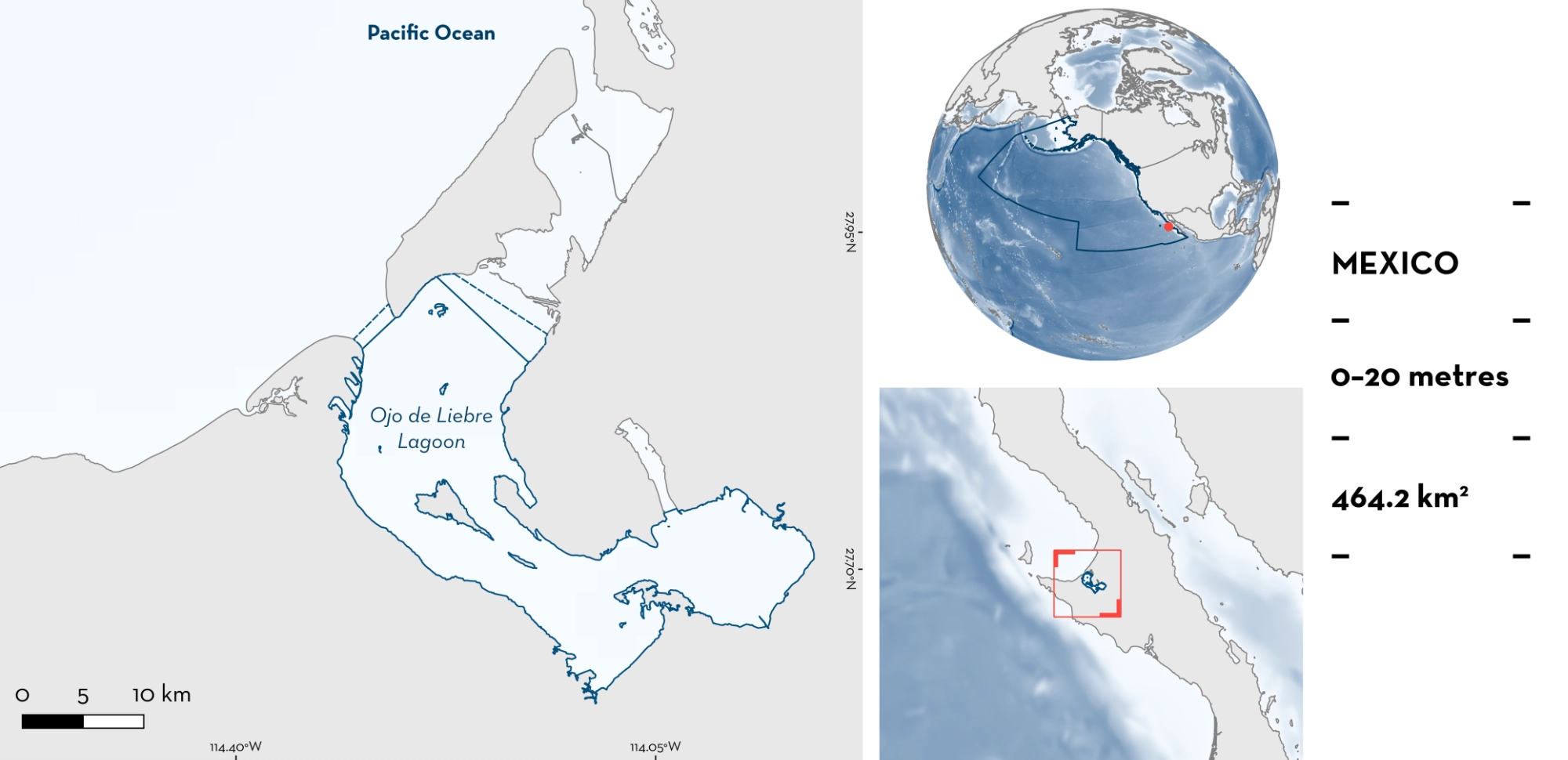
Ojo de Liebre Lagoon
Summary
Ojo de Liebre Lagoon is located on the west coast of the Baja California peninsula, Mexico. It is a shallow and hypersaline lagoon with deep channels near the mouth that connects it with Bahía Sebastián Vizcaíno. The area includes five small islets and is characterised by sandy, muddy, and clay substrates with extensive seagrass beds. It is highly influenced by tidal dynamics and by cold and nutrient-rich waters entering from the outer bay, especially during the upwelling season. The area overlaps with the El Vizcaíno Biosphere Reserve and with the Laguna Ojo de Liebre Ramsar site. Within this area there are: range-restricted species (Horn Shark Heterodontus francisci); and reproductive areas (Shovelnose Guitarfish Pseudobatos productus).
Download factsheet
Ojo de Liebre Lagoon
DESCRIPTION OF HABITAT
Ojo de Liebre Lagoon is located on the west coast of the Baja California Peninsula, Mexico. It is part of a larger lagoon system including Guerrero Negro Lagoon and Manuela Lagoon. It is a shallow and hypersaline lagoon with deep channels (~20 m) near the mouth that connects it with Bahía Sebastián Vizcaíno. The area includes five small islets (Zacatoso, Concha, Alambre, Piedra, and Cholla) and is characterised by sandy, muddy, and clay substrates with extensive seagrass (mostly Common Eelgrass Zostera marina) beds (Contreras 1985; Cabello-Pasini et al. 2003; Ramsar 2026).
The area is highly influenced by tidal dynamics that expose sand barriers during low tides (Álvarez-Borrego & Granados-Guzmán 1992). In addition, waters from Bahía Sebastián Vizcaíno flow into the area bringing cold and nutrient-rich waters specially during the upwelling season in late boreal winter and spring. Due to high evaporation and a lack of freshwater input, dynamics in the area are similar to an inverse estuary, in which salinity levels can be particularly high (Ramsar 2026). Average sea surface temperature ranges between ~17°C in January and ~27°C in August with maximum values in summer (~26°C). Salinity ranges between 32–41 ppt (Castellanos-Vidal 2017; Ramsar 2026).
The area overlaps with the El Vizcaíno Biosphere Reserve (UNEP-WCMC & IUCN 2026) and with the Laguna Ojo de Liebre Ramsar Site (Wetland of International Importance; Ramsar 2026).
This Important Shark and Ray Area is benthic and pelagic and is delineated from inshore and surface waters (0 m) to 20 m based on the bathymetry of the area.
CRITERION B
RANGE RESTRICTED
This area holds the regular presence of Horn Shark as a resident range-restricted species. This species occurs year-round in the area and is regularly encountered and caught in local fisheries (Sosa-Nishizaki et al. 2014; Castellanos-Vidal 2017; Domínguez-Reza 2017). Artisanal fisheries operating in the broader Bahía Sebastián Vizcaíno area were monitored monthly between August–November in 2014 and 2015, and between August 2016–July 2017. During these periods, 3,868 Horn Sharks were recorded from the broader region, of which ~80% (n = ~3,094) were caught inside Ojo de Liebre Lagoon (Sosa-Nishizaki et al. 2014; Castellanos-Vidal 2017; Domínguez-Reza 2017), highlighting the importance of this area for the species. This species occurs in the California Current Large Marine Ecosystem (LME) and the Gulf of California LME.
CRITERION C
SUB-CRITERION C1 – REPRODUCTIVE AREAS
Ojo de Liebre Lagoon is an important reproductive area for one ray species.
Artisanal fisheries operating in the area were monitored monthly between August–November in 2014 and 2015, and between August 2016–July 2017 (Sosa-Nishizaki et al. 2014, 2015; Medina-Trujillo et al. 2020; Medina-Trujillo 2021). During this monitoring, pregnant Shovelnose Guitarfish were regularly recorded inside the area (Sosa-Nishizaki et al. 2014, 2015; Medina-Trujillo et al. 2020; Media-Trujillo 2021).
A total of 4,874 Shovelnose Guitarfish were recorded inside the area and across the coast of Bahía Sebastián Vizcaíno (outside the area; Sosa-Nishizaki et al. 2014, 2015; Medina-Trujillo et al. 2020; Medina-Trujillo 2021). Of these, 1,118 were measured (557 females and 561 males). Females measured between 37.0–147.5 cm total length (TL; mean = 87.6 cm) with a large proportion (~30%) being classified as mature based on size, with a size-of-maturity for the species of ~90 cm TL (Medina-Trujillo et al. 2020). Pregnant females with uterine eggs were recorded between September–April while females with embryos were recorded between May–August (Medina-Trujillo et al. 2020). Between June–July, all individuals (~50 per month) recorded inside the area were pregnant females (E García-Rodríguez per. obs. 2026). In the area, this species has a diapause of eight months similar to what has been reported in other parts of its distribution (Downton-Hoffman 2007; Romo-Curiel et al. 2017). Pregnant females were recorded inside and outside of the area, but as embryonic development starts, females move inside the lagoon to pup with late-term pregnant females recorded almost exclusively inside this area. Neonates (with the presence of umbilical scars) were sporadically recorded as fishing gear is too large to capture them. Aborted pups are commonly recorded during manipulation of pregnant females caught in August (E García-Rodríguez pers. obs. 2026) Of 789 individuals sampled for age-and-growth studies, 22 (2.8%) were aged as young-of-the-year (age-0+). In addition, near-term embryos of ~20 cm TL were recorded in females analysed during August indicating that this is the pupping month. In September, only females with uterine eggs were recorded (Medina-Trujillo 2021).
Download factsheet
SUBMIT A REQUEST
ISRA SPATIAL LAYER REQUEST
To make a request to download the ISRA Layer in either a GIS compatible Shapefile (.shp) or Google Earth compatible Keyhole Markup Language Zipped file (.kmz) please complete the following form. We will review your request and send the download details to you. We will endeavor to send you the requested files as soon as we can. However, please note that this is not an automated process, and before requests are responded to, they undergo internal review and authorization. As such, requests normally take 5–10 working days to process.
Should you have questions about the data or process, please do not hesitate to contact us.

